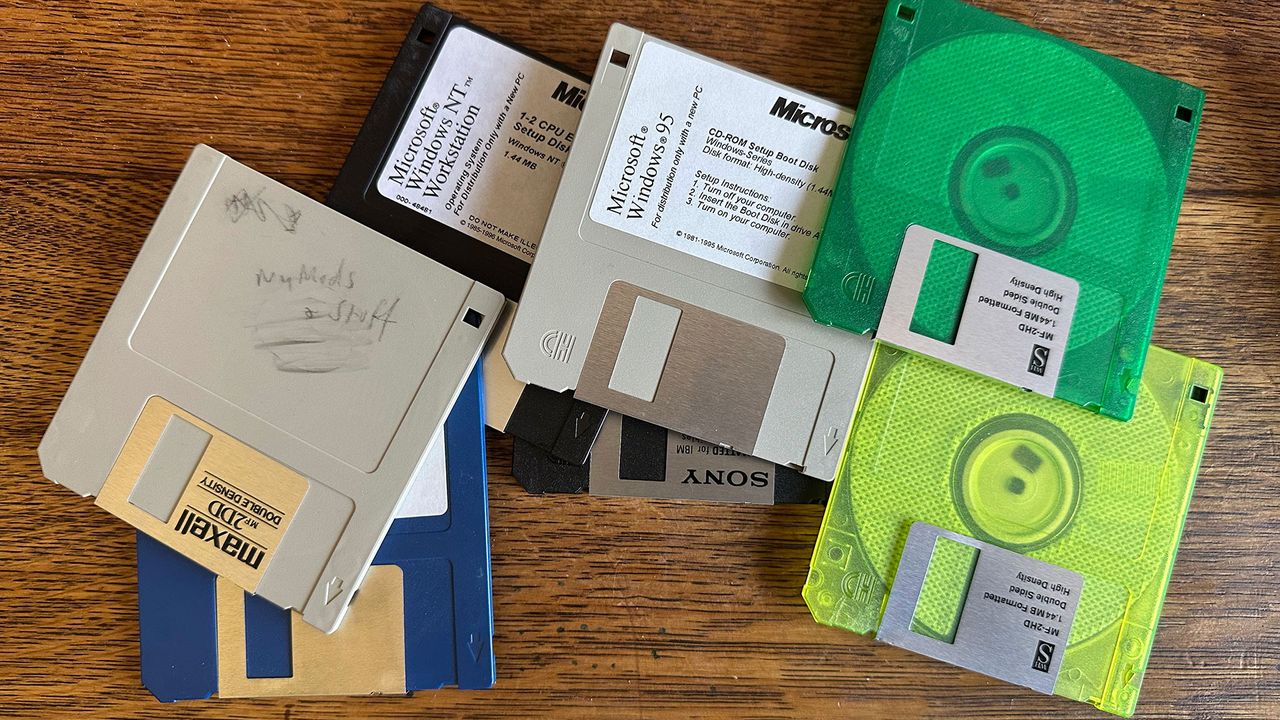
Anyone who owned a computer in the 1990s remembers the warning: “Don’t Copy That Floppy.” That campaign, accompanied by a cult rap video, equated copying floppies to theft, a sabotage of the software industry. Today, the Future Nostalgia project flips that message: “Copy That Floppy” is no longer an incitement to piracy, but the only way to save decades of data, games, applications, and digital art trapped on magnetic media nearing collapse.
This is not a simple vintage homage. Floppy disks suffer from relentless decay: magnetic dust detaches from the substrate, oxides deteriorate, and magnetic fields weaken. Every day, a piece of computing history disappears into the silence of demagnetization. The project urges owners of old disks — retro hoarders, home archivists, nostalgic tinkerers — to dump their contents onto modern media, verify file integrity, and share them in distributed archives. Copying becomes the ultimate weapon against digital extinction.
The cultural reversal runs deep. In the 1990s, software majors feared the perfect reproducibility of bits; today the open-source community and preservation groups exploit that very property to build redundancy and resilience. What is at stake is no longer a publisher’s lost revenue, but the survival of software without which entire cultural and technical niches become unreadable. Drivers for vanished peripherals, system disks for forgotten architectures, historical demos, early works by game designers: all risk vanishing forever unless someone copies.
There is an undertone of digital sovereignty here. Do-it-yourself archiving emphasizes that custody of memory cannot be delegated solely to the cloud services of a few large companies, which archive on a planetary scale but decide what to keep and for how long. Floppies hold data that, for reasons of forgotten copyright or lack of commercial value, no cloud provider would ever save. Copying them and distributing them over local networks or self-managed repositories means reasserting control over one’s technological history — a principle that anyone evaluating on-premise deployment of critical infrastructure will recognize immediately.
Future Nostalgia exposes a paradox: the war on piracy three decades ago produced an entire generation raised with the feeling that copying was wrong, while today it is the only act that can guarantee data persistence. It is not an invitation to copyright infringement, but a recognition that preservation requires deliberate acts of duplication, verification, and periodic migration — all actions condemned by the industry of the time. The project reminds us that digital memory is not spontaneous: it must be built, copied, and curated, before the disk stops spinning for good.




💬 Comments (0)
🔒 Log in or register to comment on articles.
No comments yet. Be the first to comment!