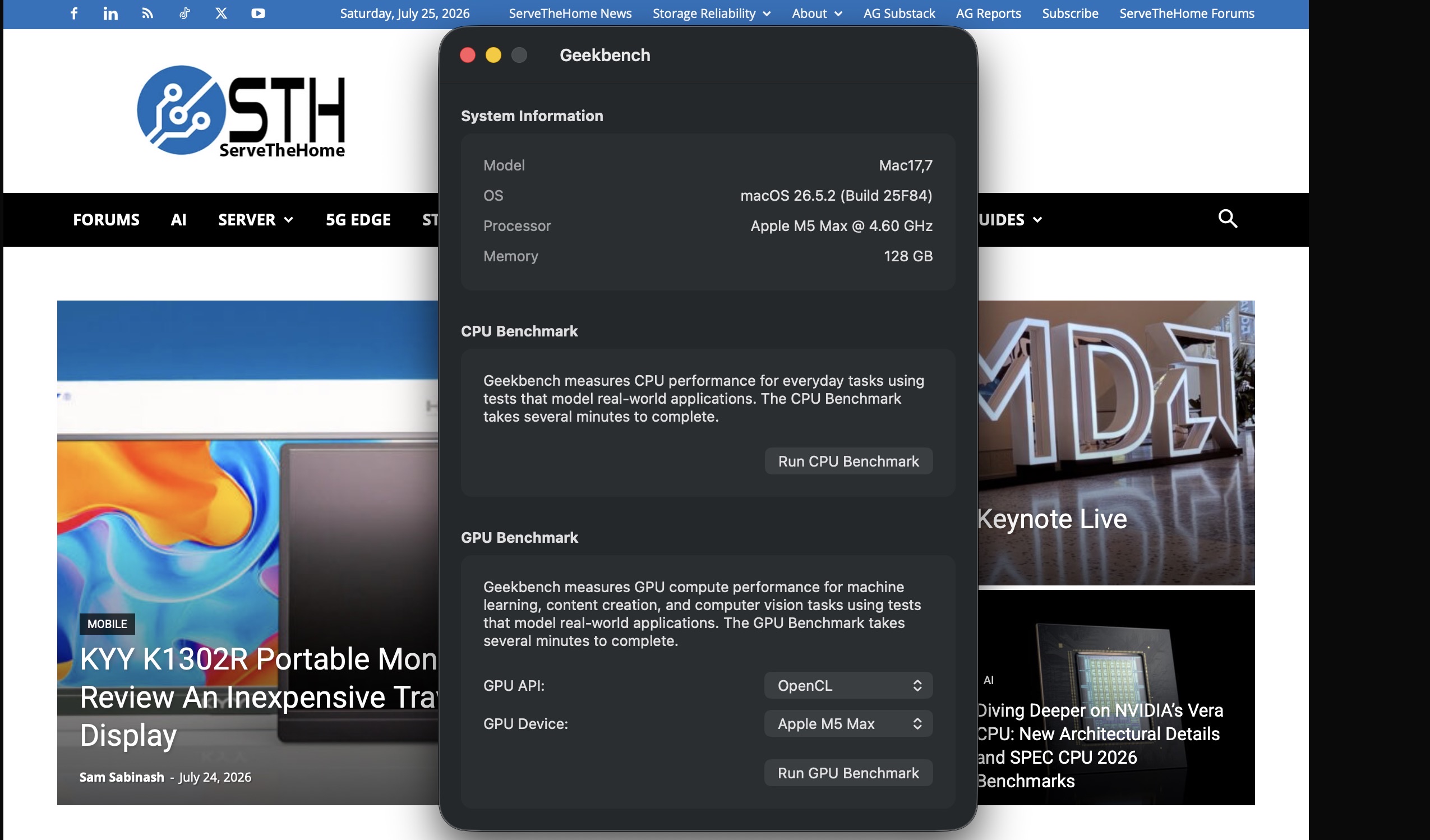
Primate Labs has released Geekbench 7, and it is not a cosmetic update. The well‑known cross‑platform benchmark — already being tested by the ServeTheHome team — thoroughly overhauls its scoring metric and the structure of CPU and GPU workloads. Behind the announcement, a question is already forming among on‑premise system architects: how will the new numbers translate into hardware choices for real workloads, especially those tied to Large Language Model inference?
The competitive pressure from modern workloads — parallel computing, vector operations, memory bandwidth saturation — has made many synthetic indices obsolete. Geekbench 7 attempts to answer this by chasing what analysts call representativeness: less abstract arithmetic, more observed behavior on everyday tasks and, potentially, on data‑intensive compute kernels. It is not a coincidence: the LLM world is pushing evaluations toward real‑world throughput and latency, not floating‑point peaks.
Who loses from the reshuffling? Vendors that optimized drivers and firmware to maximize scores on old suites. With the new scoring, some architectures may scale down, and so may the comparison tables that guide enterprise purchases. Who wins? Silicon designers who invested in efficiency for heterogeneous loads, where memory bandwidth and access latency matter more than declared core count. For teams evaluating hardware for inference, on‑premise deployment, and air‑gapped environments, a benchmark that better mirrors real dynamics means choosing with fewer distorted filters, reducing the risk of over‑provisioning or, worse, hitting bottlenecks invisible in the spec sheets.
A second‑order effect is even more interesting. The update reminds us that no single score is enough to decide: for LLM stacks, variables like quantization, available VRAM, and serving pipeline efficiency count as much, if not more, than raw compute. Geekbench 7 may become a screening tool, but the last mile of purchasing decisions will always run through field tests, on FP16 or INT8 models, with specific frameworks. At AI‑RADAR we explore exactly these trade‑offs: an updated suite raises the bar for transparency, but it does not replace Total Cost of Ownership analysis in a real context.
The release comes at a time when AI hardware is in full upheaval: GPUs with bandwidth above 2 TB/s, CPUs with integrated accelerators, edge solutions promising low‑power inference. The benchmark reset may accelerate configuration turnover, forcing vendors to recalibrate marketing — and users to relearn how to read charts. Those who manage on‑premise infrastructure should not underestimate the long tail: the score they use to compare two machines today might tell a different story tomorrow, and the real difference will lie not just in the number, but in the kind of questions that number enables them to ask.




💬 Comments (0)
🔒 Log in or register to comment on articles.
No comments yet. Be the first to comment!