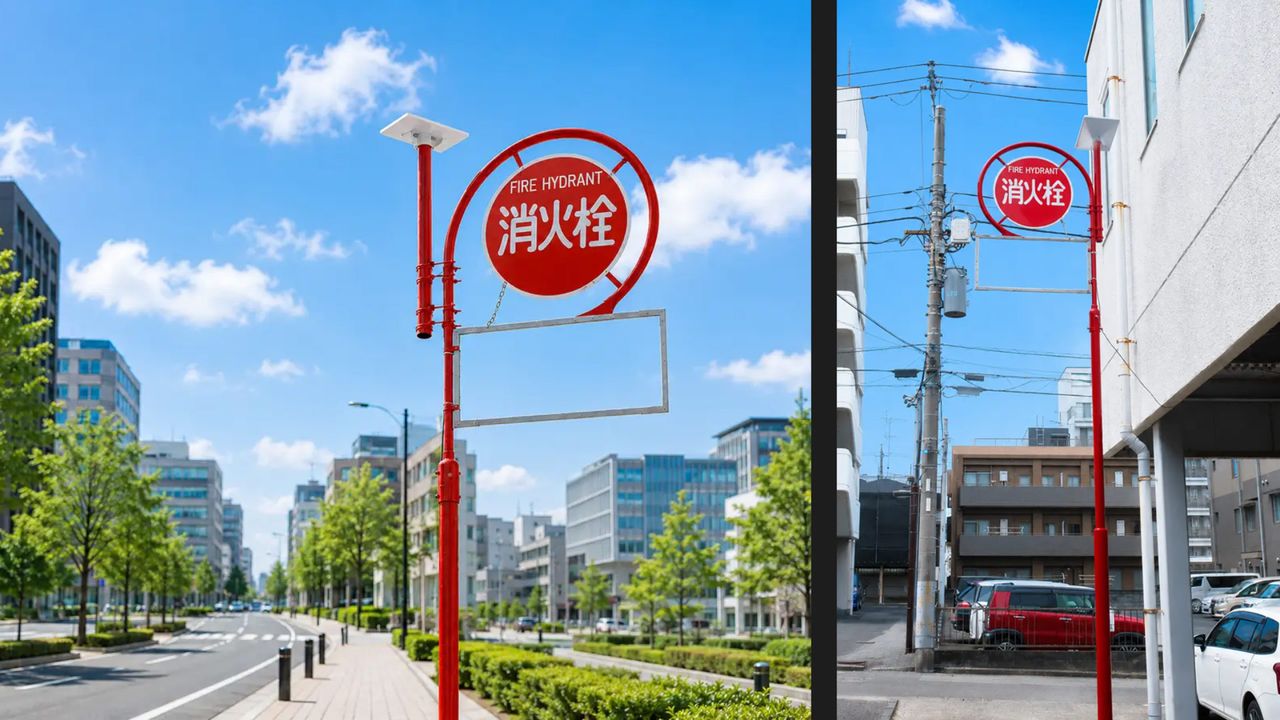
In Japan, fire hydrant street signs are being reimagined. Typically plain markers for emergency water access, they are now being tested as nodes in a resilient communication network. The latest trial involves fitting these widely distributed signs with Starlink antennas, weaving a blanket of emergency Wi-Fi across a country constantly threatened by earthquakes, tsunamis, and typhoons.
The concept is simple. A fire hydrant sign pole—already a familiar piece of street furniture—hosts a Starlink satellite dish and a Wi-Fi access point. In normal times, it may sit idle or provide local information. When terrestrial networks buckle under a disaster, these hotspots activate, delivering an independent communication channel for both citizens and first responders. Power, while not detailed in the trial, typically comes from integrated solar panels or battery backups in similar setups.
The novelty is not satellite connectivity itself—Starlink has proven its mettle in Ukraine and after US hurricanes—but the way it is grafted onto existing urban fixtures. Fire hydrant signs number in the thousands, evenly spread across urban, suburban, and rural areas. They form a mesh of infrastructure already paid for, maintained, and known to the public. Repurposing them avoids the cost and time of installing new poles and rapidly scales the network’s reach.
For those managing local infrastructure, this model flips the centralized cloud thinking. Instead of relying solely on distant data centers, it bets on distributed communication nodes—akin to edge computing, where capacity sits close to the point of use. In a disaster, a direct link to a LEO constellation means essential data (locations, rescue requests, IoT sensor readings) can flow even when fiber is cut and cell towers fail. It complements on-premise and edge architectures: not just local servers for AI inference, but networks that survive when everything else goes down.
The test aligns with Japan’s long-standing push for communication redundancy. After the 2011 earthquake, the fragility of fixed and mobile networks prompted investment in alternative systems, from tethered balloons to vehicular mesh networks. Adding Starlink to fire hydrant signs introduces an element of ubiquity that no mobile solution can match: a hydrant pole stays put, can be permanently powered, and requires no emergency deployment logistics.
Open questions remain about performance in extreme weather and the ability to handle thousands of simultaneous connections without congestion. Yet the idea has a rare elegance: it wakes up dormant infrastructure and turns it into an active lifeline at modest incremental cost. For anyone designing enterprise or public networks, it’s a reminder that resilience often starts with what we already have, rather than overhauling the whole system.








💬 Comments (0)
🔒 Log in or register to comment on articles.
No comments yet. Be the first to comment!