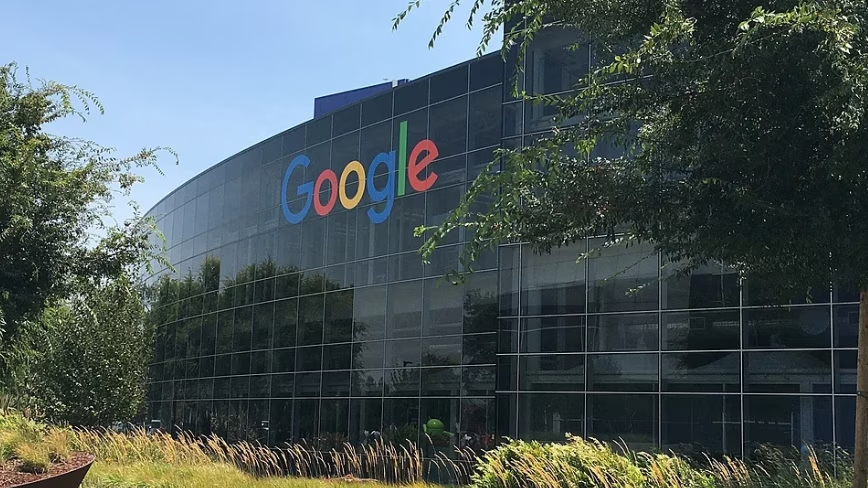
Google has made a notable foray into the film industry by investing $75 million in A24, the independent studio behind recent hits like Backrooms and Obsession. More than just a financial move, the deal includes a research collaboration with DeepMind to explore AI's role in filmmaking. This marks Google's first equity stake in a studio, signaling the company's strategic intent to position DeepMind's generative models at the heart of creative production.
What the A24-DeepMind partnership entails
Technical specifics remain under wraps, but the announcement suggests that A24 filmmakers will gain access to DeepMind's research resources to experiment with generative models. The aim isn't to replace human creativity, but to create a lab where LLMs, image synthesis, and perhaps multimodal technologies can assist writing, pre-visualization, and post-production. It's the first time a major AI lab is so directly paired with a studio known for its auteur-driven approach.
Why filmmaking is embracing large language models
The movie industry has already started exploring Large Language Models to generate dialogue, script drafts, and even animated storyboards. Tools like GPT-4 and Claude are used in brainstorming, while generative adversarial networks and diffusion models promise to speed up editing and visual effects. Google's move confirms that AI is no longer a Silicon Valley curiosity, but a competitive lever that can reshape production workflows.
The infrastructure conundrum: cloud APIs vs. on-premise inference
For a studio looking to integrate models of this caliber, an architectural dilemma immediately arises. Relying on a provider's APIs — like Google Cloud — offers agility and access to cutting-edge GPUs, but raises concerns around intellectual property, the confidentiality of developing scripts, and vendor lock-in. On the other hand, deploying LLMs on-premise, while requiring hardware investments with sufficient VRAM for inference (e.g., A100 80GB or equivalents), returns full control over the creative pipeline and data. It's a trade-off many organizations are evaluating, especially when the final product has high competitive value. For those tracking such dynamics, AI-RADAR provides analytical frameworks on the self-hosting of LLMs, a domain that may become critical even for the entertainment sector.
A signal of maturity for applied AI
Google's investment isn't merely a venture capital play. It demonstrates how top-tier labs like DeepMind are seeking concrete application domains where technology can accelerate — not replace — human talent. For A24, the deal means access to computational resources and know-how no other independent studio can afford, but also the responsibility to define the ethical and creative boundaries of this collaboration. Cinema, always a workshop of narrative techniques, may become the next testing ground for increasingly immersive models.










💬 Comments (0)
🔒 Log in or register to comment on articles.
No comments yet. Be the first to comment!