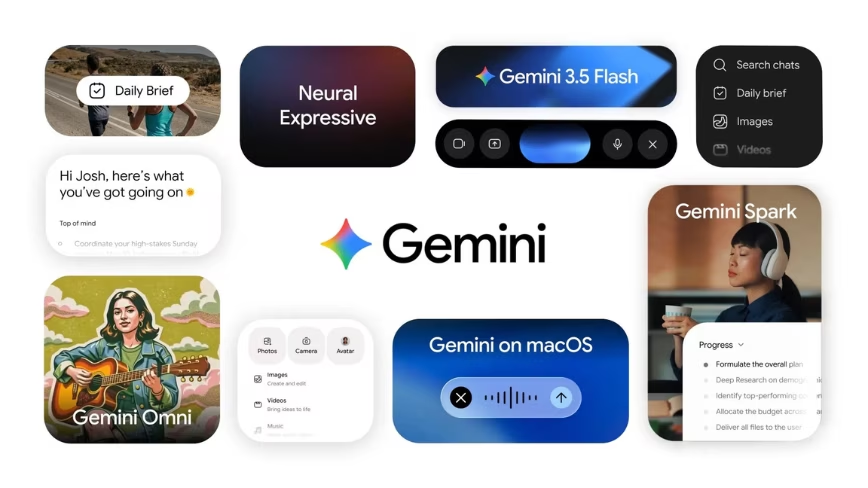
Google Enhances Gemini with Daily Brief at I/O 2026
Introduction
During the opening keynote of I/O 2026, Google unveiled a series of significant updates for its Gemini application. The event highlighted the evolving capabilities of Large Language Model (LLM)-powered assistants, with a particular focus on integrating proactive and personalized features into users' daily routines.
These developments reflect the industry's continuous drive towards more contextualized and useful LLMs, capable of moving beyond simple text generation to become true digital agents. The direction Google is taking with Gemini aims to transform interaction with artificial intelligence into a more fluid and predictive experience.
The "Daily Brief" in Detail
The flagship new feature presented is called "Daily Brief." This personalized morning digest is designed to provide users with an organized and prioritized overview of their commitments and relevant information for the day. The system draws data from various personal user sources, including email inbox, calendar, and task lists.
The distinctive aspect of Daily Brief lies in its ability to go beyond a mere summary of information. The feature has been conceived to analyze context and suggest concrete actions, thereby helping users better manage their time and priorities. This proactive approach marks a step forward in user-AI interaction, transforming a simple data aggregator into a genuine decision-making aid.
Implications for Users and the AI Context
The introduction of features like Daily Brief underscores the potential of LLMs in optimizing personal productivity. For users, it means having a tool that not only organizes information but actively interprets it to offer a practical advantage. This type of deep integration with personal data, however, raises important considerations regarding data sovereignty and privacy.
While consumer applications like Gemini typically operate in cloud environments managed by service providers, enterprises evaluating LLM implementations for sensitive workloads often prioritize self-hosted or air-gapped solutions. This is to maintain direct control over their data and ensure compliance with specific regulations. For those considering on-premise deployment, AI-RADAR offers analytical frameworks on /llm-onpremise to evaluate the trade-offs between control, security, and Total Cost of Ownership (TCO) compared to cloud-based solutions.
Future Prospects and the Role of LLMs
Gemini's evolution with Daily Brief is an example of how LLMs are becoming increasingly sophisticated in processing and applying context. It is no longer just about generating coherent text, but about understanding user intentions, anticipating their needs, and acting accordingly. This paves the way for a new generation of AI assistants capable of integrating more organically into professional and personal life.
The role of LLMs thus expands from simple conversational interaction to that of true "agents" capable of executing complex tasks based on an in-depth analysis of available data. The ability to offer a prioritized summary and suggest concrete actions demonstrates the maturation of these technologies, which continue to push the boundaries of what is possible with artificial intelligence.


💬 Comments (0)
🔒 Log in or register to comment on articles.
No comments yet. Be the first to comment!