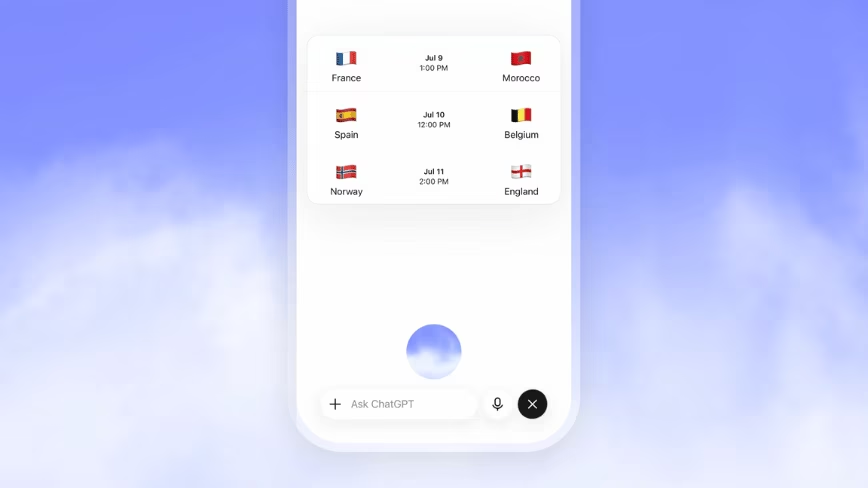
OpenAI has made its move: talking to ChatGPT will no longer be an asynchronous back-and-forth of typed prompts and read responses, but a fluid conversation where voice becomes the primary interface. On July 8, the company launched GPT-Live, a new family of voice models optimized for real-time dialogue. Two versions are available: GPT-Live-1 and a smaller GPT-Live-1 mini, already rolling out to global users.
The core technical leap is the elimination of the stop-and-go pattern dictated by turn-taking pauses. Now the model listens and speaks simultaneously, bringing interaction closer to human norms. At first glance it looks like a user-interface polish, but it carries deep structural implications for anyone developing and deploying Large Language Models outside cloud data centers.
Voice-first radically changes hardware and networking requirements. Unlike text, voice demands ultra-low latency and continuous streaming audio processing: every frame must be handled in real time, and any pause or glitch undermines conversational naturalness. For OpenAI, this load is absorbed by its own cloud infrastructure, but for enterprises that cannot—or will not—entrust potentially confidential conversations to third-party servers, the problem becomes acute. Voice data in Europe carries double weight: it is personal data and, in many cases, biometric. Submitting it to an external cloud service can clash with GDPR obligations, pushing IT leaders to evaluate self-hosted alternatives.
The existence of a “mini” variant is no cosmetic detail. It signals that local inference, perhaps on edge servers or hardware with limited VRAM, is no longer science fiction. Shrunk voice-to-voice models, combined with quantization techniques, could soon run on on-premise appliances, freeing companies from cloud dependency and returning full control over conversational flows. This is a scenario AI-RADAR tracks closely: the Total Cost of Ownership of a local solution must be weighed against consumption-priced voice APIs, but where sovereignty is a non-negotiable requirement, the balance tilts quickly toward on-premise deployment.
A second-order effect concerns the evolution of serving frameworks. Serving a voice LLM is not like serving text: it demands audio pre-processing pipelines, voice activity detection, and speech-to-speech codecs that run with minimal overhead. Current orchestrators (vLLM, TGI, Ollama) are built for text workloads, and the leap to bidirectional audio streaming may require significant extensions. Teams developing for air-gapped environments will need to integrate these components into their stack, turning on-premise deployment into not just a GPU procurement exercise but the design of an entire real-time system.
GPT-Live is not merely a product; it is a signal of where the industry is heading. Voice will become the norm, and with it will grow the demand for hardware optimized for audio inference and for architectures that keep data close. For anyone evaluating a local AI strategy today, it is no longer sufficient to ask how many tokens per second a model can process: one must begin to understand how quickly, and how securely, it can converse.




💬 Comments (0)
🔒 Log in or register to comment on articles.
No comments yet. Be the first to comment!