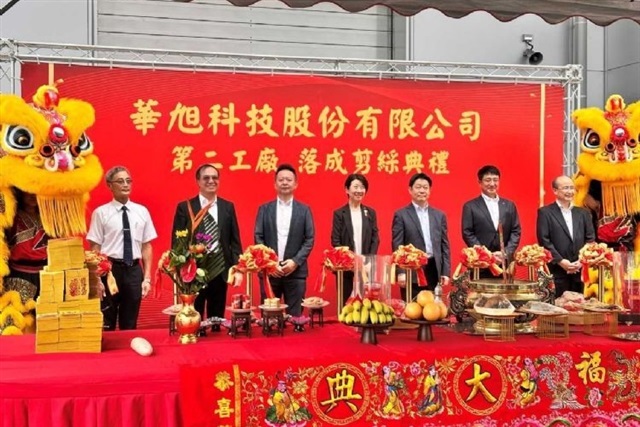
The news is short and comes from Wah Lee, a Taiwanese distributor of semiconductor materials: its affiliate Huahsu is expanding production capacity to capture demand from artificial intelligence and advanced packaging. Few words that conceal a raw nerve in the entire AI hardware infrastructure.
This is no ordinary factory upgrade. Advanced packaging – the set of techniques that stack logic and memory chips in 3D, physically bringing components closer to cut latency and power consumption – is the real bottleneck that has held back the spread of the most powerful GPUs. TSMC with its CoWoS (Chip-on-Wafer-on-Substrate) dominated this segment, but capacity has never been enough to meet orders from NVIDIA, AMD, and the big hyperscalers. Every H100 or MI300X that leaves a fab must go through packaging steps that connect the compute dies with HBM (High Bandwidth Memory) stacks, and any hiccup here turns into months of waiting for those building on-prem clusters or upgrading data centers.
Huahsu’s expansion, as a specialty chemical supplier, should be read precisely from this angle: the AI supply chain does not only suffer from a shortage of advanced lithography, but from an almost monolithic dependence on a few players capable of assembling chips at scale. The entry of complementary players – not just the large foundries – signals that the market is trying to diversify a component that is, paradoxically, more critical than the silicon itself. In practical terms: you can have all the 4 nm transistors you want, but without packaging that efficiently connects them to memory, your LLM runs like molasses, with energy costs that wreck the TCO.
For those considering on-premise deployment, this move has direct and second-order implications. In the short term, every capacity increase in packaging translates into greater GPU availability: fewer queues, less speculative price hikes, lead times that begin to drop from 6-9 months toward more manageable figures. But the structural signal is subtler: diversifying the actors involved in advanced assembly reduces the systemic risk that a single earthquake in Taiwan or a capacity allocation decision at a foundry could paralyze half the AI ecosystem. It’s a hardware sovereignty issue that directly touches Italian companies wanting to keep data and inference within their own borders: depending on a chip coming from a unique logistical chain is precisely the kind of vulnerability one tries to avoid.
True, this expansion does not solve everything. Fine chemistry for packaging is just one link in a chain that includes substrates, interposers, bonding tools, and testing. Nevertheless, Huahsu’s move suggests that AI demand is no longer seen as a cyclical spike, but as a structural shift for the materials industry. Investing in capacity today means expecting sustained volumes for years, hype cycles aside. And this is the takeaway for anyone planning hybrid or fully self-hosted architectures: we are not facing a temporary emergency, but a rebuild of the industrial base that – if completed – could make local inference economically viable even for large models.
What remains is the issue of geographic concentration, which no single supplier can untangle. As long as the bulk of advanced packaging capacity stays in East Asia, the autonomy of Western AI infrastructure will be partial. It’s a tension that will cut through 2025 and, for the first time, pushes chemical companies like Huahsu into the spotlight of LLM and GPU experts. Perhaps invisible to the general public, but for industry insiders it’s a decisive piece of the puzzle.




💬 Comments (0)
🔒 Log in or register to comment on articles.
No comments yet. Be the first to comment!