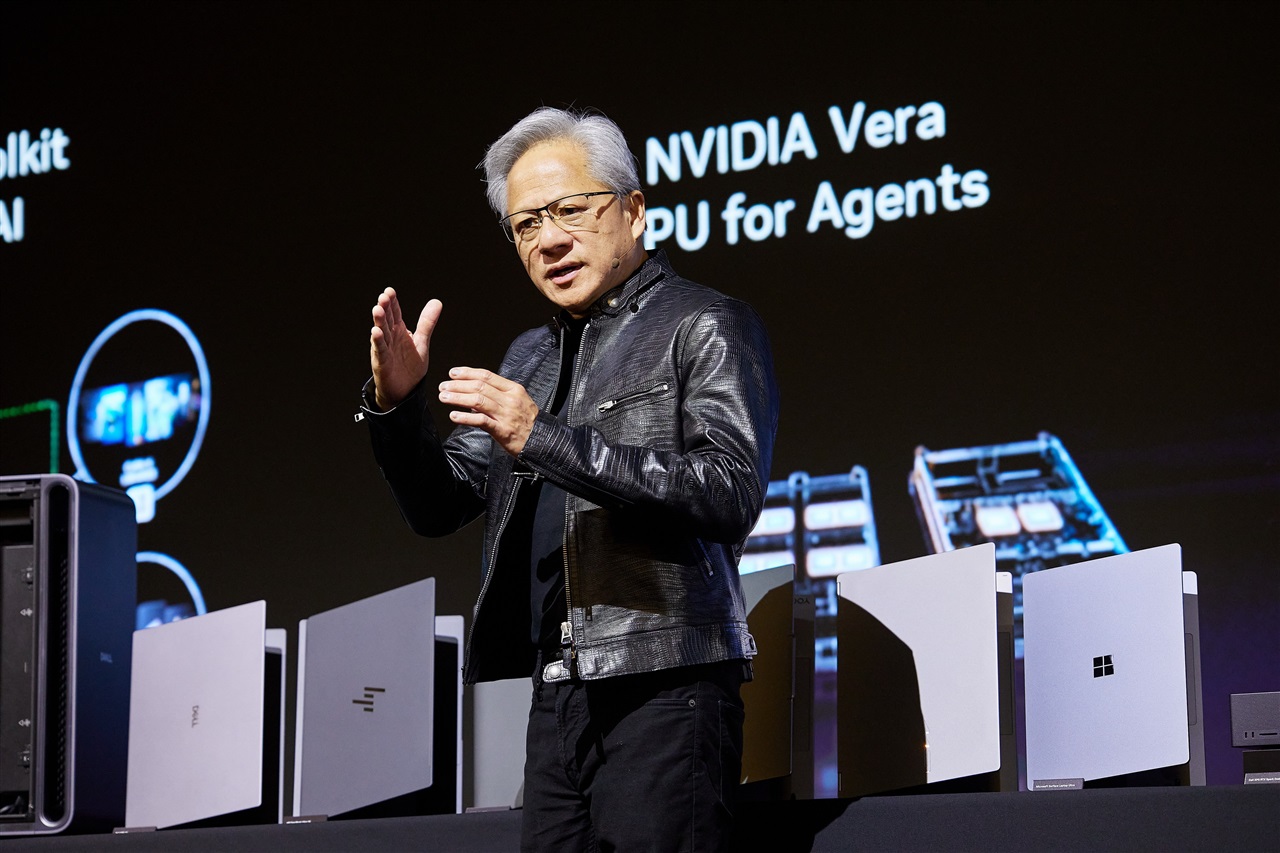
Jensen Huang’s visit to Japan is more than a diplomatic or commercial stopover: it’s a return to the roots that helped save Nvidia when the company, now the undisputed king of artificial intelligence chips, was on the brink of collapse. As competition in the emerging AI PC market intensifies, the CEO of the Santa Clara giant goes back to the country where, in the mid-’90s, Sega bet on a young startup facing bankruptcy.
Back then, Nvidia had just launched the NV1 chip, co-developed with Sega for the Dreamcast, and was in dire financial straits. The Japanese manufacturer’s investment and trust gave it the breathing room needed for a pivotal turn toward the PC market, laying the groundwork for the ascent we all know. The picture today is radically different. Nvidia dominates data centers with GPUs like the H100 and B200, essential for training and inference of Large Language Models (LLMs). But the battleground is shifting toward client devices: the so-called AI PCs, equipped with neural processing units (NPUs) capable of running quantized models directly on-device, without sending data to the cloud.
The stakes are high. Whoever controls the hardware for LLM execution on laptops and desktops will gain an edge not just in the consumer space but also in the enterprise, where privacy requirements increasingly push for on-premise or edge deployments. Here Nvidia, though strong with its discrete GPUs, faces integrated silicon from Intel, AMD, and Qualcomm, all promising local inference at lower cost and with reduced power consumption.
For those evaluating on-premise deployments, the parallel with the AI PC wars is direct: the choice between cloud and local acceleration requires balancing performance, total cost of ownership, and data sovereignty. AI-RADAR provides analytical frameworks to navigate these trade-offs, without one-size-fits-all answers. Huang’s trip, which includes meetings with partners and developers, is also a chance to strengthen ties in a country home to electronics and robotics giants—sectors increasingly hungry for on-device AI processing. The company’s past and future converge in a Japan that remains crucial both for its historical significance and for the new geography of intelligent hardware.






💬 Comments (0)
🔒 Log in or register to comment on articles.
No comments yet. Be the first to comment!