
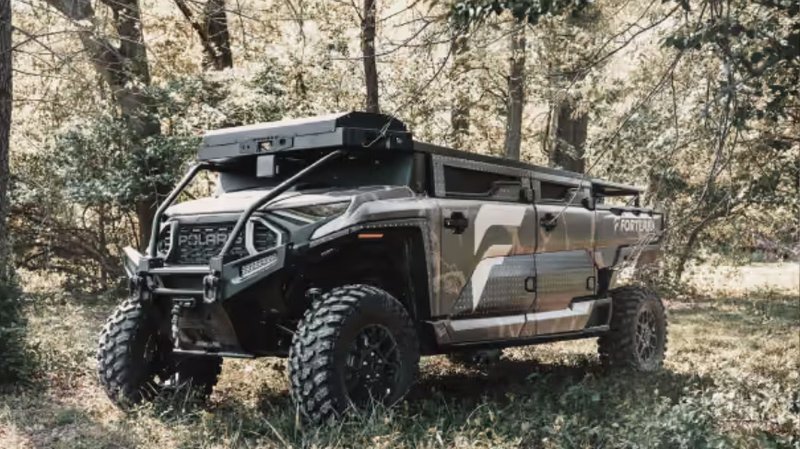
More than a hundred autonomous vehicles from Forterra are already operating on Ukrainian soil. It marks the first time that American-made unmanned ground systems have entered active combat, and the figure – however sparse in technical specifics – is not just a military news item. It is the birth certificate of a battlefield AI that completely forgoes remote connectivity and imposes a brutal constraint on hardware: continuous local inference, in environments where a GPS signal is a luxury.
The architectural choice is not optional. In an operational theater awash with electronic warfare, a round-trip to a cloud data center is out of the question. Perception, navigation, and targeting models must run on embedded chips directly aboard, shielded against dust, shocks, and extreme temperatures. This is no footnote: it shifts the frontier of applied AI from the comfort of a liquid-cooled rack to the grit of a dirt track, and forces suppliers to think in TCO terms that encompass logistics, maintenance, and updates under impossible conditions.
For the on-premise AI ecosystem, the message is clear. Defense is becoming the most demanding customer of edge inference, and it is doing so not with trade-fair prototypes but with production units deployed in war. This pushes toward specialized hardware – low-power GPUs, FPGAs, embedded neural units – that must deliver enough throughput to handle tactical-resolution video streams without latency gaps. And it does so under a regime of total data sovereignty: every frame, every decision, remains confined within the vehicle's physical perimeter, never crossing network boundaries controlled by third parties.
The structural implications extend beyond the single theater. The operational use of these platforms proves that military AI can no longer afford dependencies on cloud stacks or opaque software supply chains. It opens space for fully verifiable architectures with local audit trails and out-of-band updates. Makers of rugged inference hardware – companies like NVIDIA with its Jetson line, but also custom-chip manufacturers in defense – are seeing a market consolidate that rewards mechanical reliability as much as FLOPS. And software contractors are forced to guarantee training pipelines and model compression that work under tight thermal envelopes, without ever suffering drift or accuracy losses under stress.
It is no accident that Forterra won this round by betting on full-stack autonomy. The Ukrainian story aligns the beneficiaries of the acceleration: robotic platform providers, systems integrators able to fit sensors and compute into cramped spaces, and national supply chains that can certify every component without compliance gaps. Conversely, those who bet on cloud-centric solutions or remote orchestration middleware see their paradigm challenged at its root. Battlefield AI does not talk to distant servers: it computes, decides, and acts locally, with the same independence that many enterprise IT departments – grappling with GDPR constraints and confidentiality – are beginning to demand in their own data centers.







💬 Comments (0)
🔒 Log in or register to comment on articles.
No comments yet. Be the first to comment!