Twenty-eight million tonnes. The stark figure reported on 14 July confirmed that China’s crude oil imports had hit their lowest point since October 2016, plunging 41.3% year-on-year. All this while the Strait of Hormuz remains a geopolitical tinderbox, yet Beijing is buying less oil than it has in a decade.
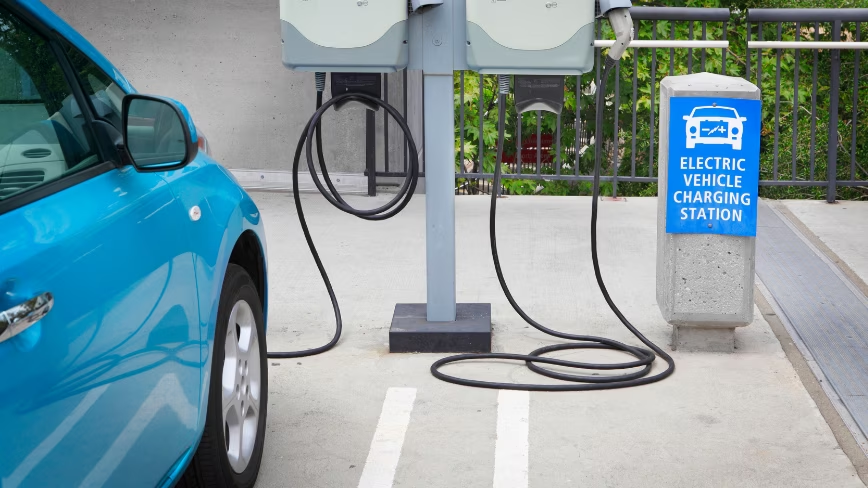
Some of the slack, the analysis shows, is being taken up by electric taxis. Vehicles that glide silently through Chinese megacities, chipping away at fossil fuel demand kilometre after kilometre. It’s a green transition story that works, but with a significant caveat: the effect is marginal, a useful buffer rather than a structural shift.
For anyone watching digital infrastructure, however, the narrative tastes different. It’s not electric mobility that’s truly rewriting energy balances, but the voracious appetite of AI workloads. Training a large language model, running global-scale inference, keeping GPU clusters always on — all of these turn data centres into de facto power stations, their requirements climbing at double-digit rates year after year.
In this landscape, oil dependence gives way to electricity dependence, and the geography of risk moves from maritime chokepoints to local distribution grids. The reasoning hits home for those evaluating on-premise deployments: owning the hardware also means securing the power supply, and in times of energy crisis or geopolitical instability, control over the source becomes as critical as data ownership.
It’s no coincidence that major cloud providers are signing power purchase agreements with wind and solar farms, while companies opting for self-hosted setups are beginning to integrate on-site renewable generation. The total cost of ownership (TCO) of an on-premise installation is no longer just about GPUs, VRAM and cooling: energy is the primary variable cost, and its predictability becomes an operational survival factor.
The catch is that, like electric taxis with oil, on-site power generation for data centres also offers only marginal relief when the system is under stress. An hour of downtime for an inference cluster can cost more than a day of intermittent production. That’s why the real structural lever is efficiency: quantized models, optimized serving frameworks, architectures that cut down on unnecessary token passes. Every watt saved on an inference is a watt you don’t have to generate or buy.
China, with its electric taxis, is showing that energy diversification works, but it works at the margins. For the AI ecosystem, the message is clear: data sovereignty also means electrical sovereignty, and anyone designing on-premise infrastructure would do well to read the plunge in crude oil not as a distant phenomenon, but as a reminder of the fragility of any supply chain.




💬 Comments (0)
🔒 Log in or register to comment on articles.
No comments yet. Be the first to comment!