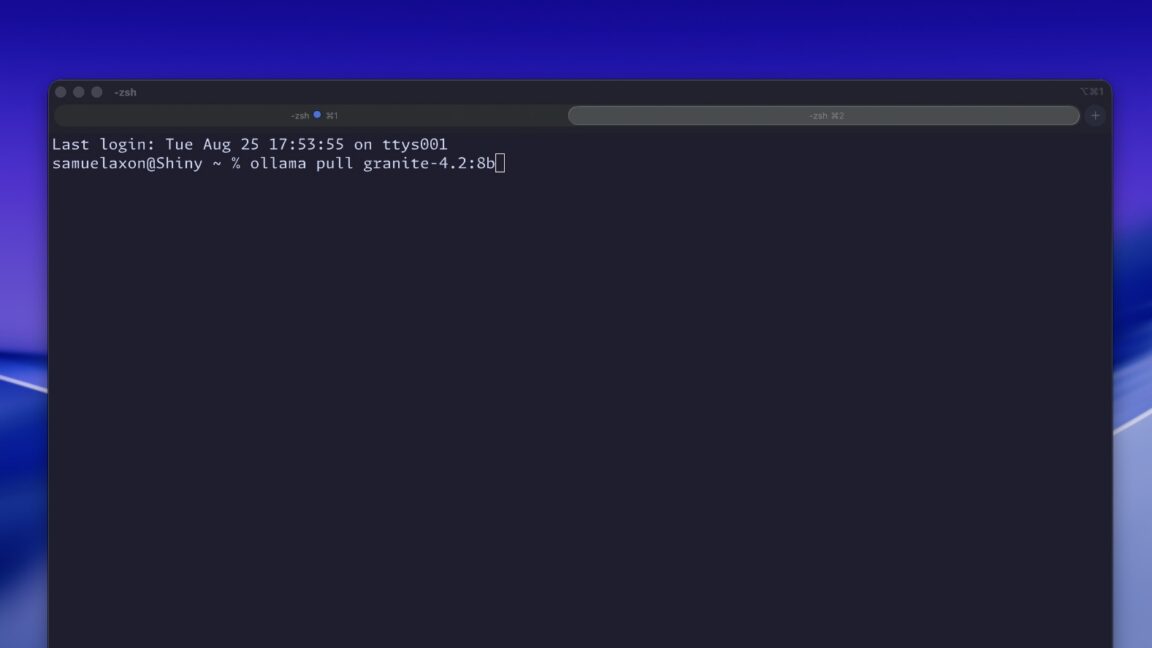
IBM has expanded its Granite family with three new open-weight LLMs designed to be downloaded and run in self-hosted environments. Granite 4.2 arrives in 3, 8 and 30 billion parameter variants, all with a decoder-only architecture and a native 128,000-token context window. The detail that shifts the center of the discussion, however, is not just model scale: it is the clear separation in tool-use capability. The 8B and 30B models go through an agentic reinforcement learning block aimed at tasks such as using the terminal, searching the web or calling external tools. The 3B supports tools, but without the same level of specialized training.
This choice introduces a new hierarchy in local deployment. Until now, open model families tended to differentiate mainly by parameter count and inference cost; here the difference is qualitative and concerns operational autonomy. A 3B may be enough for extraction, classification or document assistance, but for orchestrating multi-step actions the larger models become the reference. For teams building self-hosted pipelines, this means thinking not of a single LLM but of multiple models from the same family with different roles: a factor that affects VRAM allocation, hardware choices and workload distribution across nodes.
The 128,000-token context window has a specific meaning in this scenario. In agentic flows, context is not only for ingesting long documents; it must preserve the state of operations, tool outputs and intermediate instructions. The wider the native context, the less the system depends on compression strategies or forced summaries that can lose relevant details during a task. For models that must interact with a terminal or the web, context management is not optional: it is part of operational robustness.
From a data sovereignty and security perspective, the arrival of open-weight models with agentic capabilities changes the perimeter. An LLM that can use a terminal or browse the web is no longer just a response engine: it is an actor with potential effects on systems and network. Self-hosting offers an important advantage, because it allows organizations to keep credentials, network egress and sandboxing policies under control without delegating everything to a cloud API. But it also shifts responsibility: security is no longer only the model provider's concern, but the organization's job as it decides which tools to expose, with which permissions and under which conditions.
There is a structural reading. IBM's direction confirms that local models are not just chasing benchmark performance; they are trying to become executable components inside real operational flows. Competition is shifting from a single score to the ability to complete a compound task reliably, with context and security constraints. For teams evaluating an on-premise deployment, the trade-off is no longer only between text quality and inference cost, but between model autonomy, risk surface and tool control. AI-RADAR offers analytical frameworks on /llm-onpremise for evaluating these trade-offs systematically.


💬 Comments (0)
🔒 Log in or register to comment on articles.
No comments yet. Be the first to comment!