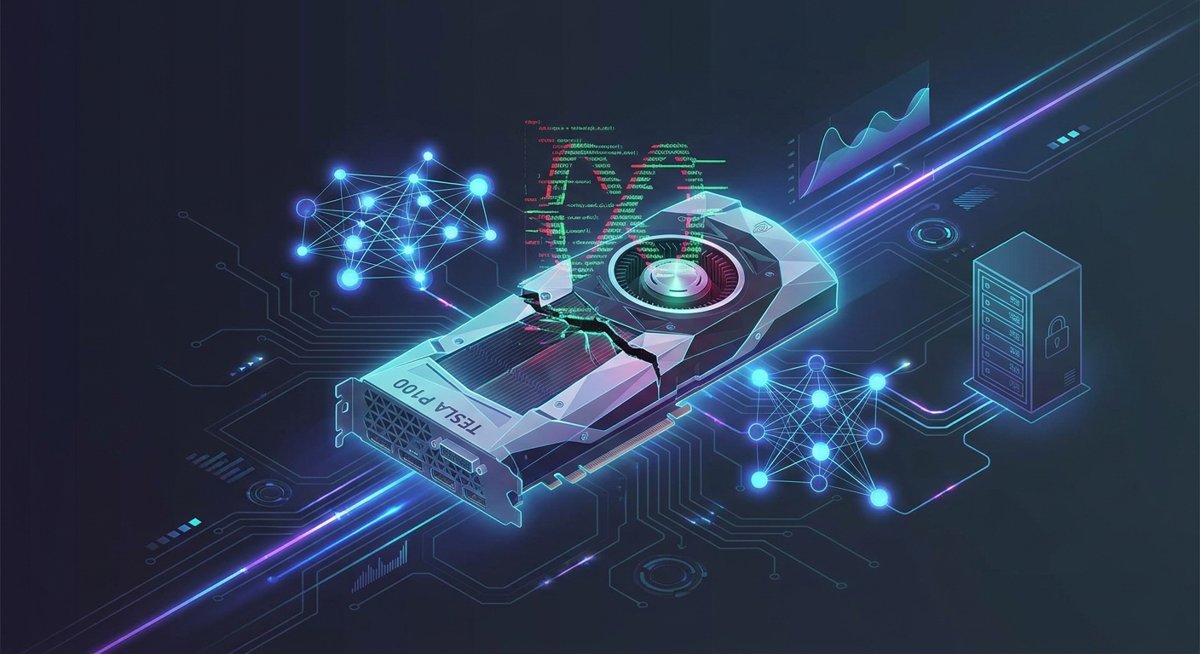
The P100’s hidden arithmetic anomaly: a silent error with a concealed cost
For years, anyone trying to run LLMs with llama.cpp on a Tesla P100 got results worse than the hardware could actually deliver. No crashes, no error messages: just an imperceptible numerical drift, a tiny shift in token distribution that seemed like an architectural limit. The P100, with 16 GB of HBM2 and a market price around $80, was often dismissed for inference in favor of nominally more expensive cards believed to be more precise. The reality, as a researcher demonstrated by comparing benchmarks from a quad‑P100 machine against an RTX 3090, was different: the root of the degradation lay in three lines of CUDA code never corrected for the sm_60 architecture.
The issue traces back to an outdated optimization choice. Inside llama.cpp’s CUDA backend, a flag enables the FP16 computation path for GPUs deemed “fast” in that mode. GTX 10‑series cards and P40s based on sm_61 had been exempted long ago because they lacked dedicated FP16 hardware units. The P100, ironically, has them – NVIDIA designed it for scientific computing, where native FP16 accelerates specific workloads – so the flag included it without exception. The result was math at degraded precision that introduced a median Kullback‑Leibler divergence of 0.0023 compared to the FP32 reference. Translated into output, that meant roughly one wrong token every 29 generated.
The most insidious aspect is that the community had sensed some “odd behavior” from P100s, but attributed it to aging silicon or HBM2 memory limitations. Nobody had probed the framework’s arithmetic layer with the same rigor devoted to newer architectures. The defect’s multi‑year latency is a warning for the entire on‑premise inference ecosystem: when validation resources cluster around Volta, Ampere, and Ada, previous generations can carry silent inaccuracies that distort benchmarks and purchasing decisions.
Three lines of correction and a leap in numerical fidelity: why math matters in inference
The fix introduced is surgical: three patch lines that exclude the P100 from the FP16 “fast” path, forcing it to use the full‑precision path already serving its sm_61 siblings. The quality jump is unambiguous. Median KL divergence plunged from 0.0023 to 0.000001, an improvement of over 2000x. Next‑token agreement – the metric that translates arithmetic fidelity into coherent model output – rose from 96.5% to 99.9%. In concrete terms, the residual error became statistically invisible, aligning the P100 with cards costing ten times as much.
On the performance side, the patch introduces no penalty and actually recorded a slight decode gain (about 1.4%), while prefill remained stable. The reason is that real inference workloads on P100s are bound by HBM2 memory bandwidth (732 GB/s) and GEMM operations, not the FP16 vector units. The “fast” path was buying no measurable benefit, only inaccuracy. It’s a lesson in system architecture: reduced‑precision acceleration must be validated against the actual load, because the bottleneck may lie far from the arithmetic plane.
This episode underscores a neglected principle: in LLM inference, data‑type choice is not an aesthetic preference but a design parameter that directly impacts output quality. Especially when working with quantized models, the accumulation of errors in the compute path can erode signal in ways that are hard to trace without systematic monitoring. For those building on‑premise stacks, the P100 proof shows that control must reach down to a CUDA compilation flag if one truly wants to master the trade‑off between cost, speed, and fidelity.
The LLM GPU market: the Tesla P100 reclaims its role as an on‑premise budget candidate
On the used market, the Tesla P100 has always been an odd card. With 16 GB of HBM2 at 732 GB/s bandwidth, its memory specs surpass many consumer cards from later generations, yet its price hovered around $80 – far below the roughly $300 of a Tesla P40 with only 346 GB/s of GDDR5. The market, in effect, had penalized it: low prices were read as a sign of lesser suitability for LLM workloads, perhaps due to higher power draw or uneven software compatibility. We now know that part of that gap was artificial, created by a latent error that undermined calculation precision.
With the bug resolved, the TCO arithmetic for on‑premise inference nodes needs redoing. A P100 offers nearly double the memory bandwidth of a P40 for a third of the cost, and output fidelity is now comparable to far more expensive GPUs. For running mid‑sized models in 4‑bit or 8‑bit quantization, the combination of ample VRAM and high bandwidth at a rock‑bottom price suddenly becomes competitive. In scale‑out scenarios where budget is the binding constraint, the P100 enables building clusters with more aggregate capacity, ideal for serving multiple users in data‑sovereignty contexts where hardware must remain in the local data center.
The fix doesn’t make the P100 a universal choice: it remains a 2016 card, with power consumption and thermals that demand careful management in production. However, it tips the balance for engineers who had previously ruled it out. The signal for AI‑RADAR is that the dated‑GPU market must be read dynamically: prices also reflect undiscovered software bugs, and a community discovery can redistribute value as quickly as a hardware launch.
Low‑level verification and data sovereignty: control starts with arithmetic
The P100 episode drives home a central point for those who choose to keep data and LLM workloads on‑premise: sovereignty is not merely the absence of cloud, but actual control over the entire stack, down to the mathematical primitives. When an organization entrusts sensitive data processing to a self‑hosted LLM, it assumes the hardware returns faithful results. Learning that a compilation flag in an open‑source framework could silently corrupt output for years challenges that assumption.
The three‑line fix was isolated with the help of an automated agent that systematically compared numerical outputs – confirmation that empirical verification on real hardware, even dated, is an indispensable complement to trust in community software. Those managing a heterogeneous GPU fleet cannot rely on the framework’s standard checklists alone; they must implement regression tests that measure divergence against an FP32 reference, at least for critical models. It’s an added cost, but also a quality guarantee that bears on reputation and compliance.
In regulated environments or when model output feeds decision‑making processes, arithmetic integrity becomes a system requirement. The episode suggests that on‑premise deployment pipelines should include a mathematical fidelity probe as part of ongoing health checks, not just initial qualification. AI‑RADAR promotes this approach: mastery of the inference stack begins with awareness of which instruction executes on which GPU unit – a level of detail that cloud services, by their nature, conceal.
The hidden debt of backward compatibility: open‑source frameworks and forgotten generations
That such a bug went unnoticed for years is not an isolated incident but a symptom of a systemic dynamic. The open‑source LLM framework ecosystem evolves rapidly with limited resources: thorough testing concentrates on the latest architectures – Volta, Ampere, Ada – where contributors and primary users cluster. Previous‑generation GPUs, abundant on the secondary market and potentially valuable for tight budgets, become a sort of no‑man’s‑land, receiving only superficial checks.
In this specific case, the fix author verified that other architectures with native FP16 units (sm_61, Volta and later) were unaffected, because the full‑precision path was already active for them. The exact combination of flag and silicon generation that struck the P100 was thus a “blind spot” in the compatibility matrix. This raises an uncomfortable question: how many other cards, in other niches, are silently executing imprecise calculations due to micro‑differences in compilation that went untested?
For on‑premise operators, the message is that validation can’t be fully delegated to the framework. A hardware‑diversification strategy that includes cross‑generation coherence tests is needed. When building nodes with mixed architectures – a common scenario when aggregating used GPUs – it’s essential to verify not just performance, but also comparative numerical stability. AI‑RADAR sees in this necessity a strength of the local model: the ability to inspect the binary, modify flags, and validate in‑house, something impossible in managed environments.
A prospective view: how to monitor calculation fidelity in your local stack
The P100 story provides practical guidance for those designing or managing a self‑hosted inference environment today. The first step is to accept that model fidelity depends on the entire path a token takes from input to output, and that a vector‑calculation error can have the same impact as overly aggressive quantization. Anyone evaluating used hardware should include a divergence test against a known reference in their benchmarking scripts, perhaps using a deterministic model with a fixed seed and comparing token probability distributions.
The second lesson concerns software management. Instead of blindly updating to the latest llama.cpp commit, on‑premise teams can adopt a “validate then deploy” approach, with test pipelines that include not only throughput and latency but also numerical accuracy metrics on a sample of loads. Automating these tests, using tools like the agents employed to isolate the bug, can reduce maintenance cost and prevent future regressions.
Looking ahead, this episode could spark a broader reckoning in the ecosystem. The adoption of standardized floating‑point precision test suites, akin to those used in scientific compilers, might become common practice in major inference frameworks. For AI‑RADAR, the signal is clear: while the race for latency and model size continues, those who invest in arithmetic transparency build a reliability advantage that no hyperscaler can easily replicate. The next frontier is not just running LLMs locally, but running them with the mathematical certainty that every operation is the right one.







💬 Comments (0)
🔒 Log in or register to comment on articles.
No comments yet. Be the first to comment!