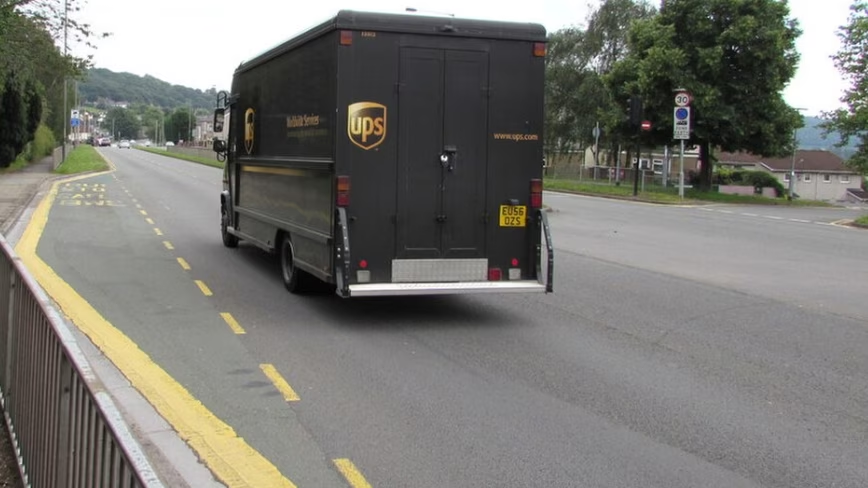
Key takeaway: UPS is deploying a real-time digital twin of its entire logistics network, refreshed every 10 minutes. The system monitors performance and enables self-healing mechanisms, marking a leap in maturity for AI-driven logistics at a global scale.
The core of the digital replica
The project described by UPS is not a simple dashboard: it is a virtual representation synchronized with the physical state of facilities, air fleets, ground networks, and package flows. A 10-minute refresh cycle implies a data ingestion infrastructure capable of absorbing signals from hundreds of thousands of endpoints — IoT sensors, sorting scanners, vehicle telemetry — and aligning them into a coherent model. For teams building similar architectures, this requires streaming pipelines with ordering guarantees and low latency, often implemented using distributed brokers and hybrid storage (on-premise and cloud).
Technically, a digital twin of this scale must manage the coherence of spatial and temporal representations. It is not merely a data lake; the model must reflect physical constraints (hub capacities, transit times) and simulate what-if scenarios. Horizontal scalability becomes as critical as computational efficiency: each processing node, likely distributed geographically, contributes to a unified view without centralized bottlenecks.
Automation and self-healing
UPS explicitly mentions “self-healing” capabilities. In the context of the digital twin, this means the system can detect anomalies — an unexpected backlog at a sorting center, a delay in air routes — and recalibrate flows without human intervention. This presupposes AI models (not necessarily LLMs, but optimization and forecasting algorithms) operating in real time, with extremely narrow decision windows.
Self-healing relies on continuous feedback loops: current data is compared with historical series and operational plans, and deviations trigger adaptive rules or inferences. In an on-premise deployment, this logic would require local computing capacity to avoid the latency of cloud round-trips, a trade-off familiar to those designing mission-critical control systems. UPS has not disclosed its hardware architecture, but the global scale suggests a hybrid approach, with edge computing at major hubs and centralized orchestration for network-wide decisions.
Why it matters
For AI-RADAR readers, the UPS announcement serves as a case study in how predictive AI is colonizing traditional sectors, bringing with it specific infrastructure requirements. Those evaluating on-premise or hybrid deployments for similar workloads — supply chain, manufacturing, utilities — see confirmation of key trends: the need to process data at near-real-time latency without dependence on unreliable WAN connections, the importance of distributed models that survive network failures, and the push toward self-adaptive systems that reduce operational cost.
The most evident trade-off is between cloud centralization (elasticity, simplified management) and compute proximity to data (sovereignty, reduced latency, resilience). A digital twin updated every 10 minutes still tolerates a modest delay, but as these systems evolve toward second or sub-second windows, on-premise becomes an enabling factor. UPS does not reveal TCO or hardware details, but the economic sustainability of such initiatives depends on optimizing cost per inference or simulation — a central theme for those adopting local stacks based on GPUs or dedicated accelerators.
Beyond logistics: lessons for AI infrastructure
UPS’s experience is not isolated. Similar efforts in manufacturing (digital twins for production) and energy (twinning power grids) show that AI infrastructure must be designed for hybridization from the outset. Data pipelines must operate reliably with intermittent connectivity, using persistent queues and catch-up mechanisms when local nodes come back online.
From a data sovereignty perspective, replicating a significant portion of the global supply chain raises questions of residency and compliance (GDPR and extra-EU regulations). While UPS operates through local legal entities, the information flow across jurisdictions requires careful data partitioning, often tied to on-premise resources for sensitive segments. This scenario is familiar to those following AI-RADAR’s frameworks on /llm-onpremise: physical control of hardware is not just a technical choice but a compliance lever.
Finally, the direction taken by UPS signals that the logistics and industrial systems market is ready for turnkey AI solutions that integrate local compute, cloud orchestration, and pre-trained models. For those developing on-premise stacks, the implicit invitation is to build modular architectures capable of adapting to these hybrid patterns without radical rewrites.








💬 Comments (0)
🔒 Log in or register to comment on articles.
No comments yet. Be the first to comment!