The Complexity of Neurovascular Care
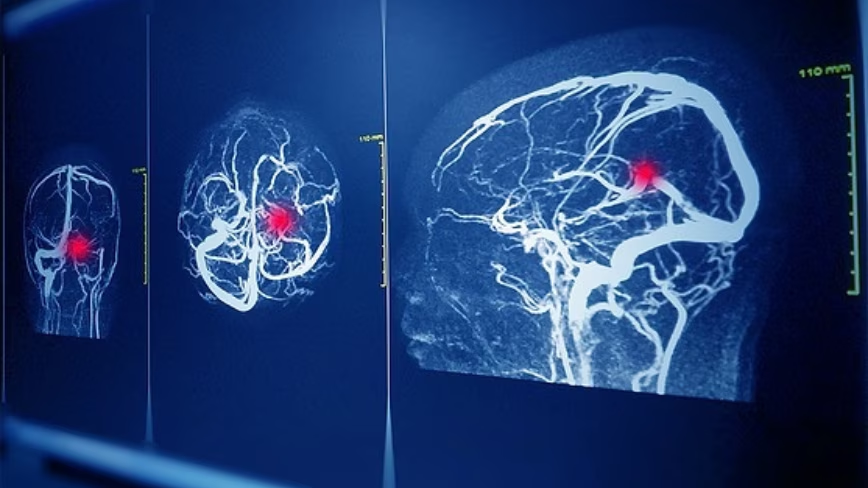
Modern medicine constantly faces complex challenges, and neurovascular care stands out as one of the most uncertain and delicate areas. Millions of people live with conditions such as intracranial aneurysms, often without exhibiting clear symptoms for extended periods. This absence of warning signs makes managing such pathologies particularly insidious.
However, when an acute event occurs, the consequences can be devastating. Mortality rates are high, and the risk of long-term neurological disability is significant. For neurospecialists, the ability to make rapid and accurate decisions in contexts of high uncertainty is fundamental, yet also extremely demanding, requiring refined clinical judgment supported by every available tool.
The Evolution of Clinical Decision Support
In this scenario, technological innovation, particularly in the field of artificial intelligence and Large Language Models (LLMs), is emerging as a potential ally. Although the source does not specify technical details, it is clear that the "reinvention of clinical judgment" implies an approach that leverages these technologies' ability to process and correlate vast amounts of clinical data, from scientific literature to diagnostic reports.
The goal is not to replace the physician's experience and intuition, but rather to augment them. LLMs, for example, can rapidly analyze complex datasets, identify patterns, suggest differential diagnoses, or recall treatment protocols based on the latest evidence. This support can reduce uncertainty and improve decision consistency, especially in critical situations where every second counts.
Data Sovereignty and On-Premise Deployment in Healthcare
The application of AI technologies in healthcare raises crucial questions related to data sovereignty and regulatory compliance, such as GDPR. Patient data is among the most sensitive and requires the highest levels of security and control. This makes on-premise deployment or air-gapped environments particularly attractive for healthcare institutions.
A self-hosted infrastructure offers direct control over data, reducing the risks associated with transferring and processing on third-party cloud platforms. For LLM inference, this implies the need for dedicated hardware, such as GPUs with high VRAM and compute capability, to ensure adequate throughput and latency. Evaluating the Total Cost of Ownership (TCO) therefore becomes a determining factor, balancing initial investment (CapEx) with operational costs (OpEx) and the benefits in terms of security and compliance.
Future Prospects and Trade-offs
The potential of AI to transform medicine is immense, but its integration requires careful consideration of trade-offs. The choice between an on-premise, cloud, or hybrid deployment depends on a multitude of factors, including specific security requirements, expected performance, and available resources. For critical AI workloads and sensitive data, the on-premise approach offers distinct advantages in terms of control and sovereignty.
For those evaluating different deployment options for LLMs, AI-RADAR offers analytical frameworks and insights on /llm-onpremise, useful for understanding the constraints and opportunities of each model. The "reinvention" of clinical judgment, supported by AI, is not just a technological issue, but also a strategic one, requiring informed decisions about infrastructure and data management.







💬 Comments (0)
🔒 Log in or register to comment on articles.
No comments yet. Be the first to comment!