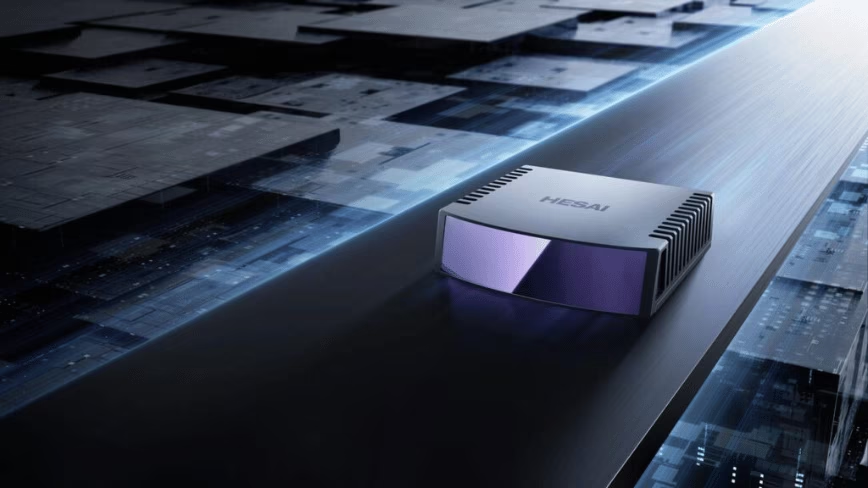
Robotaxis cruising American streets, self-driving trucks, airport systems. They all see the world through lidar manufactured in Shanghai by Hesai, a company the US Department of Defense classifies as a Chinese military enterprise. The paradox has been simmering for a while, but a fresh CNBC report has reignited the spotlight on the contradiction: while the Pentagon puts Hesai on its blacklist, its sensors are already hardwired into the optical nerves of American automation. And among its partners: Nvidia, a name that alone evokes the entire artificial intelligence ecosystem.
Hesai’s pervasiveness is no small detail. The Shanghai-based company’s lidar has become a near-standard component for autonomous vehicles thanks to a cost-performance ratio that is hard to match. For robotaxi fleet operators trying to contain costs to scale up, every hundred dollars saved on a sensor counts. But that economic convenience collides with an increasingly tense geopolitical reality: the Defense Department places Hesai on a list of companies supporting the Chinese military, a designation that brings potential restrictions, stigma, and the concrete risk of cascading future sanctions that could hit anyone integrating these components.
For the on-premise AI ecosystem, the Hesai case acts like a telltale mineral. The knee-jerk reflex of anyone running inference workloads on-site is to focus on servers, GPUs, and software stacks to lock down data sovereignty. Yet the lesson from the streets is more subtle: hardware trust doesn’t stop at the rack. A lidar sensor is effectively a data-gathering node that feeds perception models, often in real time. If that node is made by a company under the control of a rival state, the security perimeter of the entire AI system expands to include the silicon of origin. Anyone evaluating on-premise deployment for critical applications today — healthcare, defense, infrastructure — is faced with the same question: can we trust the boards, the chips, and, in the case of autonomous vehicles, the sensors that make up the physical supply chain?
The Hesai precedent suggests that the market, left to its own devices, trades security for cost. Robotaxi companies have so far chosen Hesai because the risk of a backdoor or supply-chain compromise was perceived as remote, or perhaps because the competitive advantage of a rapid launch outweighed all other considerations. This asymmetry is identical to the one that once pushed enterprises to pour sensitive data into the public cloud without proper risk analysis, until regulation and a few glaring breaches changed the incentives. Today, on-premise LLMs are a response to that awakening; tomorrow, a similar logic will demand verified sensor hardware, ideally produced within well-understood geopolitical trust regimes.
The likely winners in this scenario are Western lidar makers — Luminar, Innoviz, Ouster — who would see a sudden regulatory tailwind open the doors of American fleets. Nvidia, for its part, finds itself in an awkward spot: a commercial partner of Hesai but also a provider of full-stack autonomous vehicle platforms, it may have to recalibrate alliances to avoid national security blowback. For robotaxi operators, the bill would be steep: higher costs and longer integration timelines, threatening to slow a race to autonomy that has already burned through billions.
Structurally, the affair signals that the technological decoupling between the United States and China won’t be confined to data center semiconductors, but will slide along the entire AI value chain: from sensors that harvest real-world data, to the chips that process it, to the servers running the models. On-premise deployment has taught us to eye shared infrastructure with suspicion; Hesai teaches that without a verified hardware supply chain, data sovereignty is a sandcastle. For now, robotaxis keep using Chinese eyes. Until an accident — or a regulatory act — forces them to look elsewhere.







💬 Comments (0)
🔒 Log in or register to comment on articles.
No comments yet. Be the first to comment!