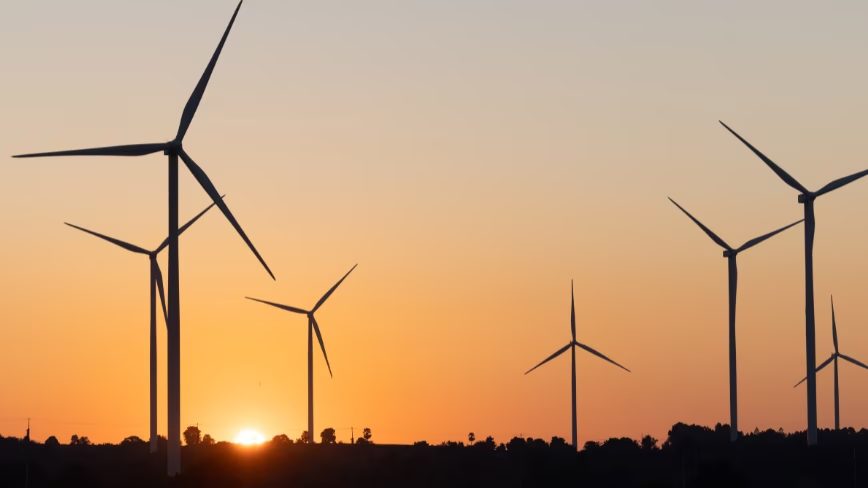
The Pentagon froze the permitting process for at least 155 new wind projects across 24 American states for nearly a year. The official rationale sounds paradoxical: turbines can hide drones, letting them slip past military radar. Behind the headline, however, lies more than a clash between renewable energy and national security. There is an architectural lesson aimed straight at those designing artificial intelligence systems for critical infrastructure.
Modern radars do more than capture echoes. They process signals in real time, often using neural networks to classify objects amid environmental clutter. Buildings, birds, atmospheric turbulence – everything must be distinguished from potential threats. When a wind farm introduces dozens of moving targets with complex Doppler signatures, the model’s ability to tell a commercial drone from a spinning blade collapses. The problem is not new, but its scale – 44 gigawatts of blocked capacity, four times America’s offshore wind generation – signals that the issue has become systemic.
Reading this freeze merely as an algorithmic shortfall would be reductive. The real tension lies in where that algorithm runs. For years the mantra has been: collect data at the edge, ship it to the cloud, train on centralized clusters and send back the response. In a defense theater, this pipeline is useless. Network latency, exposure of the data stream to interception or connectivity failures turn every millisecond into a danger. Inference must happen locally, on the radar unit itself or in a protected rack beside the antenna, with hardware accelerators processing turbine signatures and adapting the model as the scenario evolves.
This scenario is not science fiction. Frameworks for self-hosted LLM serving already exist, but in the radar signal domain, on-premise deployment takes extreme form: it demands sub-10ms inference on architectures that must operate in air-gapped conditions or with intermittent connectivity. Model quantization, say from FP16 to INT8, becomes crucial not to save TCO but to fit the neural network into the limited memory of a DSP or edge GPU, without losing the precision needed to avoid mistaking a glider for an ordnance.
Then there is sovereignty. Raw radar data is a sensitive asset. Handing it to a cloud infrastructure, even an encrypted one, multiplies attack vectors and ties every model update to an external vendor. On-premise pipelines, by contrast, allow classifiers to be trained and retuned directly on locally collected signals, retaining full control over the chain. Those developing for the defense industry know that regulatory compliance (ITAR, and GDPR where European citizen data may be involved) leaves no shortcuts: data must stay within well-defined boundaries.
Blocking 155 plants signals more than a technical alarm. It says we are building physical infrastructure without having solved the integrity of the artificial perception that defends it. Every turbine becomes a node that degrades the signal-to-noise ratio of the entire surveillance grid. The answer will not be to stop renewables forever, but to push radar and AI system designers to radically rethink where and how inference is executed. And for those evaluating on-premise deployment in less extreme settings, the lesson is clear: when security is at stake, an architecture reliant on remote servers is not an option – it is a vulnerability.
It comes as no surprise that the frozen projects have a combined capacity of 44 GW, a figure that redraws priorities for the tech industry as well. The contest is not about which radar is more powerful, but about which compute architecture can coexist with an increasingly crowded electromagnetic environment, without ever phoning home.


💬 Comments (0)
🔒 Log in or register to comment on articles.
No comments yet. Be the first to comment!