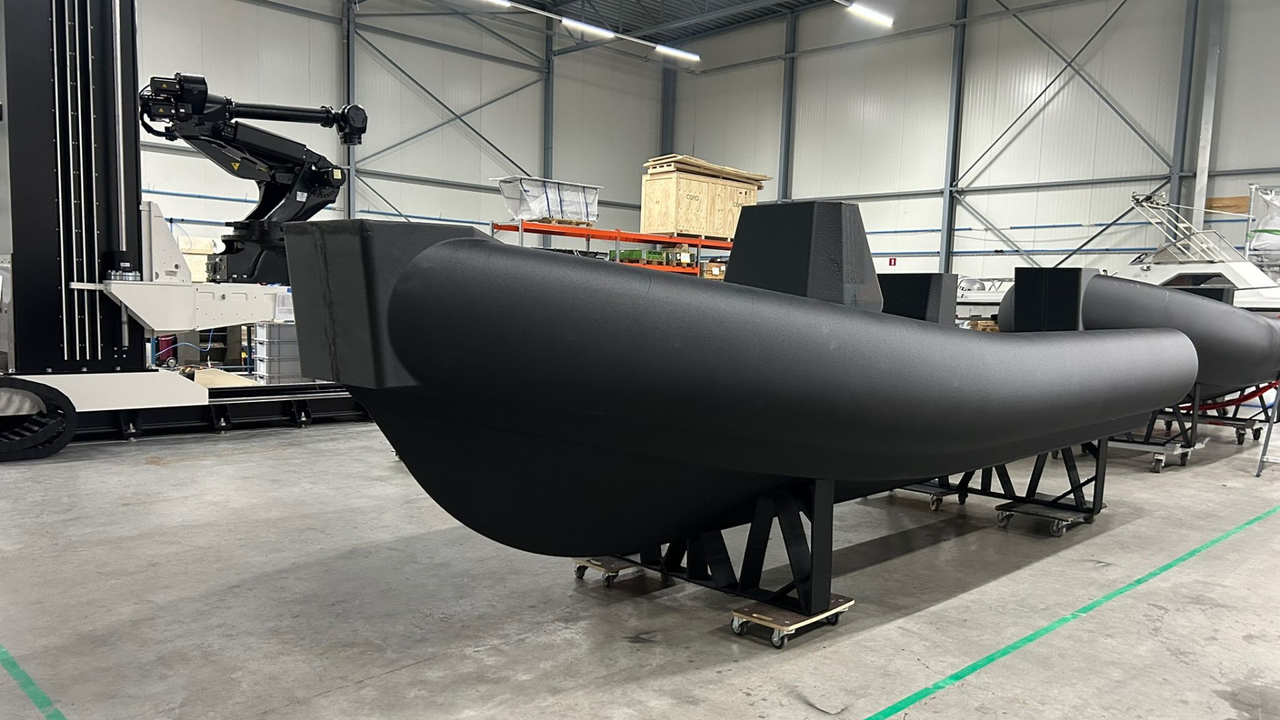
Pentagon Explores 3D-Printed Volcanic Fiber Boats: Stealth and Supply Chain
The U.S. Department of Defense is evaluating an innovative technology that could redefine the production and deployment of military assets: 3D-printed boats made from volcanic fiber. This initiative, involving the company Voltage Vessels, aims to integrate advanced stealth capabilities with a radical optimization of supply chains, crucial elements for modern operations.
The proposed approach is not limited to a mere technological upgrade but represents a potential paradigm shift in logistics and operational security. The ability to locally produce a high number of units per year at forward bases, drastically reducing reliance on long and complex global supply chains, has profound strategic implications.
Technical Details and Operational Advantages
At the core of this innovation are the non-conductive hulls, made from volcanic fiber through 3D printing processes. This characteristic provides vessels, such as the RHIBs (Rigid Hull Inflatable Boats) developed by Voltage Vessels, with significant stealth capabilities. Non-conductivity reduces the electromagnetic signature, making the assets harder to detect by radar systems and other enemy sensors, a tactical advantage in complex operational scenarios.
Beyond the stealth benefits, the proposed production model aims to replace a supply chain extending over 6,545 miles. The possibility of producing up to 25,000 vessels per year directly at forward bases not only accelerates deployment times but also reduces logistical costs and the vulnerability associated with transporting components over long distances. This approach ensures greater resilience and operational autonomy.
Implications for Sovereignty and Control
The adoption of advanced manufacturing technologies like 3D printing for critical assets reflects a broader trend towards resource sovereignty and control, a central theme also in the artificial intelligence sector. Similar to how organizations evaluate the on-premise deployment of Large Language Models (LLMs) to maintain data control and ensure compliance, the Pentagon seeks direct control over production here.
The ability to manufacture boats locally, with specific materials and proprietary processes, minimizes dependence on external suppliers and global supply chains that can be subject to disruptions or geopolitical influences. This approach strengthens national security and rapid response capabilities, reducing the indirect Total Cost of Ownership (TCO) linked to logistical and security risks. For those evaluating on-premise deployments in critical sectors, similar trade-offs exist, which AI-RADAR explores with analytical frameworks on /llm-onpremise to assess benefits in terms of control, security, and TCO.
Future Prospects and Strategic Considerations
The Pentagon's initiative with Voltage Vessels highlights the transformative potential of additive manufacturing technologies for military and industrial applications. The combination of innovative materials, such as volcanic fiber, and distributed manufacturing processes, such as 3D printing at forward bases, opens new frontiers for strategic autonomy.
This model not only promises to improve immediate operational capabilities but also sets a precedent for how nations can rethink their procurement and production strategies in technology-intensive sectors. The pursuit of greater control, resilience, and autonomy, both in the production of physical hardware and in the deployment of digital infrastructures like LLMs, represents a key strategic direction for the future.









💬 Comments (0)
🔒 Log in or register to comment on articles.
No comments yet. Be the first to comment!