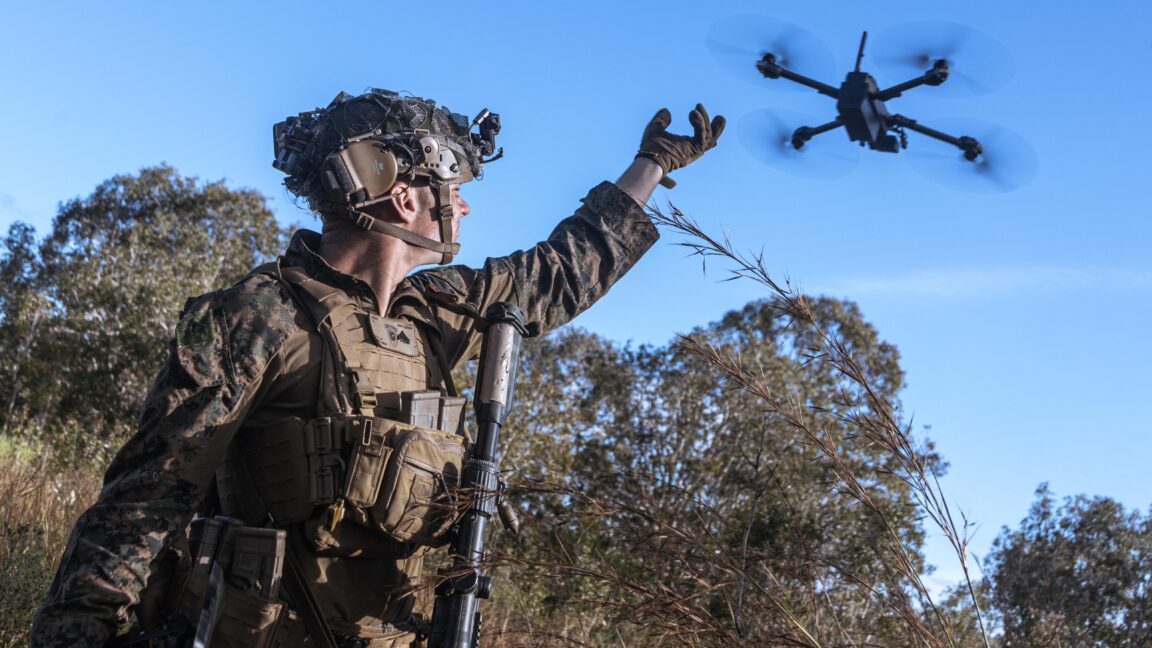
Unprecedented Investment in Autonomous Warfare
The US Department of Defense has submitted a $1.5 trillion budget request for the upcoming fiscal year, including what Pentagon officials describe as the largest investment in drone warfare and counter-drone technology in US history. This move highlights a clear strategic direction towards the large-scale adoption of autonomous systems in military operational contexts.
The proposed spending on drone and autonomous warfare technologies, included in the FY2027 budget, is substantial enough to surpass the defense budgets of most nations, ranking among the top ten globally. To illustrate its scale, this figure exceeds the amounts allocated by countries such as Ukraine, South Korea, and Israel for their entire military expenditures.
Details and Objectives of the Allocation
Specifically, the Pentagon has requested $53.6 billion. These funds are intended to boost US production and procurement of drones, train specialized operators, build a robust logistics network for sustaining drone deployments, and expand counter-drone systems to defend more US military sites. The breadth of these objectives demonstrates a strategy that goes beyond mere hardware acquisition, encompassing the entire operational lifecycle.
The funding request is managed by the Defense Autonomous Warfare Group (DAWG), an organization established in late 2025. DAWG is set to see a massive budget increase, rising from approximately $226 million in fiscal year 2026 to $53.6 billion for fiscal year 2027. This exponential increase reflects the urgency and priority assigned to these capabilities.
Implications for AI Infrastructure and Deployment
An investment of this magnitude in autonomous technologies raises significant questions for technological infrastructure. The large-scale deployment of drones and counter-drone systems requires a complex and resilient network, capable of managing enormous volumes of data in real-time, often in distributed and potentially air-gapped environments. This implies the need for edge computing capabilities, with stringent requirements in terms of latency and throughput for AI model inference.
The creation of a "logistics network for sustaining drone deployments" suggests a hybrid or self-hosted architecture, where control over data and operations is paramount. For organizations evaluating self-hosted alternatives versus cloud for AI/LLM workloads, this scenario offers important insights. Data sovereignty, compliance, and security in critical environments become determining factors, influencing decisions on hardware, software, and deployment strategies. Analyzing the Total Cost of Ownership (TCO) for such a vast and distributed infrastructure is crucial, considering both initial costs (CapEx) and operational costs (OpEx) for maintenance, energy, and upgrades.
Future Prospects and Technological Challenges
The Pentagon's financial commitment highlights a clear trend towards automation and artificial intelligence as pillars of modern defense. Managing an ecosystem of drones and countermeasures on a global scale presents considerable technical challenges, from connectivity and security management to the need for continuous software and hardware updates.
For infrastructure architects and DevOps leads, this scenario underscores the importance of robust and scalable solutions, capable of operating under extreme conditions and with extremely high reliability requirements. The ability to effectively deploy and manage autonomous systems in such critical contexts will demand continuous innovations in every aspect of the technological pipeline, from processing hardware to management and orchestration frameworks.









💬 Comments (0)
🔒 Log in or register to comment on articles.
No comments yet. Be the first to comment!