The Rebirth of an Icon: The LisaFPGA Project
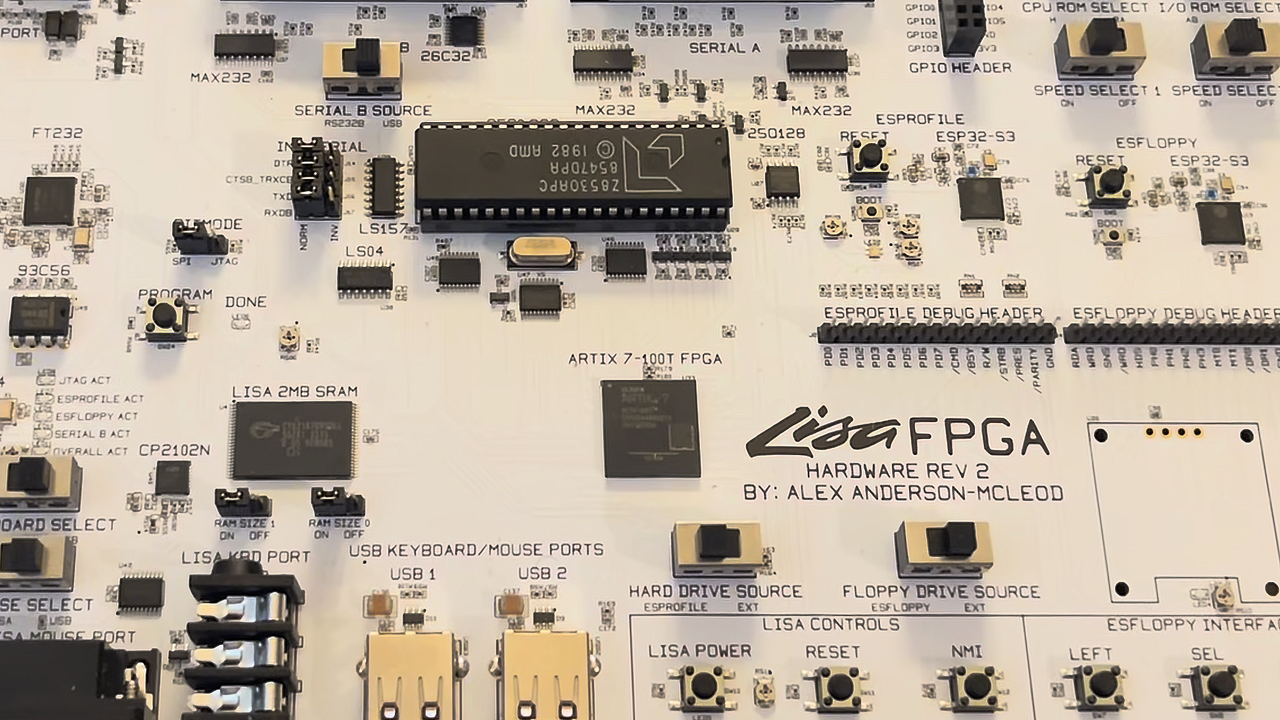
The computing world celebrates the recreation of the Apple Lisa, an epoch-making computer, thanks to the LisaFPGA project. 43 years after its debut, the Apple Lisa, known for being the first commercial computer to introduce a graphical user interface (GUI), has been faithfully reproduced on a modern FPGA (Field-Programmable Gate Array) board. This initiative, led by an enthusiast, is not merely an exercise in nostalgia but a concrete demonstration of FPGAs' capabilities in replicating complex hardware architectures.
The LisaFPGA project stands out for its fidelity to the original, while leveraging current technologies. The goal was to clone the operation of the historical machine, offering a unique perspective on how past architectures can be preserved and studied through reconfigurable hardware. For system architects and technical decision-makers, such projects offer interesting insights into emulation methodologies and the versatility of modern silicio.
Technical Detail: The Role of FPGAs in Emulation and Beyond
At the heart of the LisaFPGA project is the use of an FPGA board. FPGAs are integrated circuits that can be configured or reprogrammed to perform specific logical functions after their manufacture. Unlike general-purpose processors (CPUs) or graphics processing units (GPUs), which have fixed architectures, FPGAs allow for the implementation of custom hardware logic, making them ideal for emulating complex systems like the Apple Lisa.
This flexibility is crucial in contexts where required performance or functionalities are not easily achievable with standard hardware. In the field of artificial intelligence, for example, FPGAs are used to accelerate specific inference workloads, especially in edge environments or for applications requiring low latency and high throughput with contained power requirements. The ability to adapt hardware to software, or vice versa, offers granular control that can be decisive for optimizing TCO and ensuring data sovereignty in self-hosted or air-gapped deployments.
Context and Implications for On-Premise Infrastructure
While the LisaFPGA project focuses on historical recreation, the implications of using FPGAs strongly resonate with the needs of modern infrastructure, particularly for on-premise deployments. The ability to create custom silicio or emulate specific architectures on FPGAs offers companies unprecedented control over their hardware stack. This is particularly relevant for sectors requiring high security standards, regulatory compliance, or the management of sensitive data, where reliance on external cloud services can present challenges.
For CTOs and infrastructure architects, FPGAs represent an option for AI/LLM workloads that require specific hardware optimizations not available with commercial GPUs or that demand superior energy efficiency for certain algorithms. Although FPGA development may entail higher initial CapEx and greater development complexity compared to using cloud infrastructure, the long-term benefits in terms of TCO, performance, and data sovereignty can be significant. For those evaluating on-premise deployments, AI-RADAR offers analytical frameworks on /llm-onpremise to assess these trade-offs.
Final Perspective: Beyond Nostalgia, Towards the Future of Silicio
Project LisaFPGA transcends simple nostalgia, serving as a powerful reminder of the intrinsic value of reconfigurable hardware. The ability of a single chip to transform itself to replicate a decades-old complex system underscores the versatility of FPGAs as a tool for innovation and technological preservation. This approach to hardware design and implementation is increasingly pertinent in an era where customization and efficiency are fundamental to addressing emerging computational challenges.
Looking ahead, FPGA technology will continue to evolve, offering new opportunities for AI workload acceleration, edge processing, and embedded system development. The lesson from LisaFPGA is clear: understanding and leveraging the potential of custom and reconfigurable silicio is essential for organizations aiming to build resilient, high-performing, and sovereign infrastructures capable of adapting to the most advanced computing needs.







💬 Comments (0)
🔒 Log in or register to comment on articles.
No comments yet. Be the first to comment!