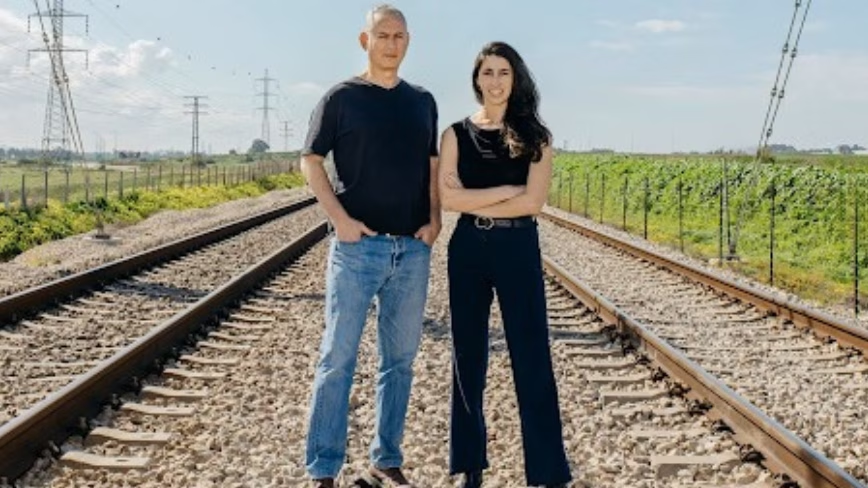
Moving goods by rail is the most energy-efficient mode we know of, yet a paradox hides behind that record: every locomotive burns diesel, one of the dirtiest fossil fuels. The industry knows it must leave diesel behind, but the route is anything but clear. On one side there is electrification via overhead catenary lines – designed for high-density corridors – on the other, battery packs that suffer from weight, range, and charging time. Voltify, a startup still largely under the radar, promises a new model: beyond wires and beyond batteries, perhaps a hybrid or distributed induction system. Technical details are postponed, but the direction is unmistakable: the rail industry is literally searching for a third rail.
That is where an intriguing short circuit occurs for anyone deciding where to run their Large Language Models. We too are squeezed between two choices that appear exhaustive but are not: the cloud – wires pulled taut by a global provider, nearly unlimited power, nearly zero control – and edge or small on-premise servers, digital batteries that keep data close but struggle to scale. Enterprises that need constant inference on sensitive data under strict compliance (think GDPR, finance, healthcare) soon discover that neither solution is satisfying. Cloud offers state-of-the-art GPUs but subtracts sovereignty and inflates TCO with opaque operational costs; pure self-hosted setups hand back control but impose hardware limits that often translate into aggressive quantization, higher latency, or stripped-down models. Just as in freight, something else is needed.
Voltify, in its still undisclosed design, signals an escape from technological bipolarism. If the «beyond catenary and battery» model works, we will have an infrastructure capable of adapting to traffic density without the extreme drawbacks of either pole. Translated to AI, this blueprint suggests a distributed but not fragmented architecture: on-premise compute nodes that converse with cloud resources only when required, orchestrated by a management layer that allocates inference based on latency, privacy, and energy cost – much like rail microgrids that decide in real time where to draw power. This is no science fiction: hybrid scheduling frameworks already exist, but the willingness to design them as first-class citizens, rather than patches, is missing. Voltify’s lesson, however indirect, is that architectural innovation weighs more than any single technology.
Who stands to gain? System integrators able to assemble hybrid stacks, vendors of NVMe storage and low-latency networking who would see a market for solutions not solely tied to the cloud, and IT managers who can show the CFO a linear TCO built on predictable CapEx and contained OpEx. Who risks losing are the hyperscalers that built their advantage on the idea that everything, sooner or later, will migrate to their data centers. If the third rail materializes, that migration will never be total: sensitive workloads will stay local by choice, not backwardness. This shifts R&D incentives, channeling resources toward model compression, inference optimization on limited VRAM, and data-at-rest security – themes dear to anyone evaluating on-premise LLM deployment.
Of course the analogy has limits: nobody moves containers over GPUs the way containers move on rails. Yet the structural signal remains: when a mature industry refuses the binary choice between extreme solutions, it often anticipates a real need that the compute industry will discover a few years later. The demand for «beyond cloud» options does not spring from ideological whim but from operational constraints around data control, cost predictability, and resilience. Voltify may not know it is speaking to us, but it might already be drawing the map of our next data center.









💬 Comments (0)
🔒 Log in or register to comment on articles.
No comments yet. Be the first to comment!