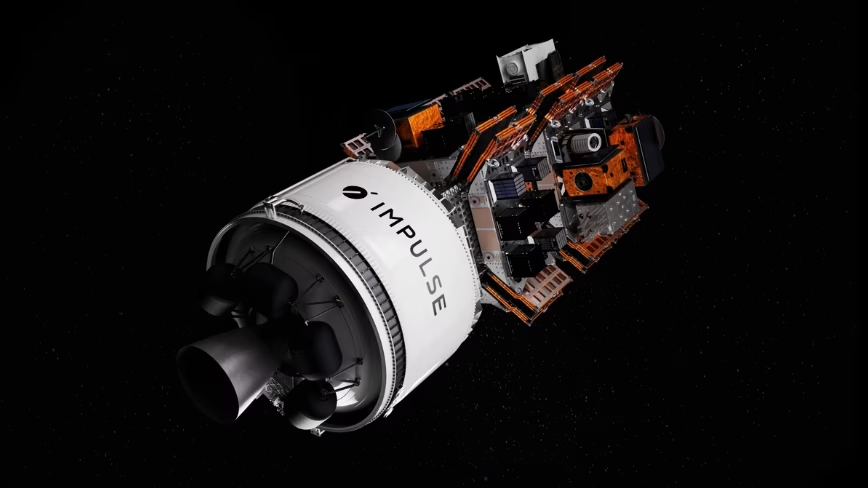
Impulse Space: A $500 Million Round for Orbital Mobility
Impulse Space, the startup founded by Tom Mueller, known as SpaceX's first employee and a key figure in the development of its rocket engines, has announced a significant funding round. The company has raised $500 million in a Series D round, bringing its valuation to $4.26 billion. This investment, co-led by 137 Ventures and Banner VC, with participation from existing investors such as Peter Thiel’s Founders Fund and Linse Capital, underscores the growing interest in advanced space technologies.
Impulse Space focuses on developing orbital transfer vehicles, a fundamental technology for the modern space industry. These vehicles are designed to move satellites into the correct orbit once rockets have deployed them in suboptimal positions. The ability to correct or modify satellite orbits is crucial for optimizing missions, extending the operational life of space assets, and ensuring the precision of satellite constellations.
The Complexity of Space Operations and Critical Infrastructure
Orbital transfer operations, such as those managed by Impulse Space, represent a prime example of the engineering and operational complexity that characterizes the space sector. Managing autonomous vehicles in space requires extremely reliable control systems, real-time data processing capabilities, and robust communication infrastructure. In this context, the need to process large volumes of data, often in environments with latency and connectivity constraints, poses significant challenges that echo those of Large Language Model (LLM) deployments in critical scenarios.
To ensure data sovereignty and operational control, many organizations operating in high-security sectors or with stringent compliance requirements, such as the space industry, evaluate self-hosted or air-gapped computing solutions. Onboard processing on vehicles or in dedicated ground stations, rather than relying exclusively on public cloud services, allows for full control over infrastructure, data, and decision-making processes. This approach is particularly relevant when considering intensive workloads such as AI model Inference for autonomous navigation, onboard diagnostics, or trajectory optimization.
Market Implications and Infrastructure TCO
The substantial capital invested in Impulse Space reflects a broader trend in the space sector, where private companies are taking an increasingly central role in developing critical capabilities. This influx of investment not only accelerates technological innovation but also highlights the growing demand for supporting infrastructures that can manage the complexity and scalability of these new initiatives. Impulse Space's $4.26 billion valuation suggests strong confidence in the market potential for space mobility services.
For companies operating in this ecosystem, the choice of computing infrastructure is a strategic decision with significant implications for the Total Cost of Ownership (TCO). Managing complex systems, which often require specialized hardware (such as GPUs for parallel processing) and proprietary software, can entail high upfront costs but offer long-term benefits in terms of control, security, and performance. The ability to optimize resource utilization and reduce reliance on external providers becomes a key factor for operational sustainability.
Perspectives for the AI-RADAR Ecosystem
While the news about Impulse Space does not directly concern LLMs, it offers important insights for our audience. The need for robust, secure, and controllable infrastructures for critical space missions mirrors the requirements of many companies evaluating on-premise LLM deployment. Data sovereignty, low latency, and the ability to operate in disconnected environments are shared priorities.
For those evaluating on-premise LLM deployments, complex trade-offs exist between initial costs, operational flexibility, and security requirements. AI-RADAR offers analytical frameworks on /llm-onpremise to evaluate these aspects, providing tools to compare self-hosted options with cloud-based ones. The Impulse Space story underscores how, in technology-intensive sectors, investment in proprietary infrastructure and direct control over operations can be decisive factors for long-term success and resilience.











💬 Comments (0)
🔒 Log in or register to comment on articles.
No comments yet. Be the first to comment!