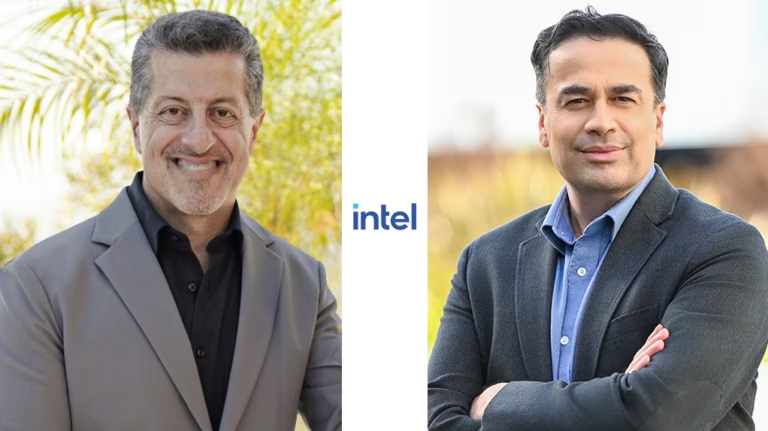
Intel Boosts Distributed AI with New Leadership
Intel recently announced a significant talent acquisition, bringing in Alex Katouzian, a 25-year veteran from Qualcomm. This move aligns with Intel's established strategic pattern: attracting key figures from rival companies, reorganizing internal structures around these new competencies, and strengthening its workforce. The objective is clear: to enhance strategic sectors and maintain a competitive edge in a rapidly evolving technological landscape.
Katouzian will take the helm of the new Client Computing and Physical AI division, an area poised to redefine how artificial intelligence is integrated into devices and local infrastructures. His extensive experience, gained from leading Qualcomm's mobile, compute, and extended-reality businesses, positions him as a central figure to guide Intel in this strategic direction.
The Significance of "Physical AI" for Local Deployments
The concept of "Physical AI" at the core of Katouzian's new division is particularly relevant for companies evaluating on-premise deployments and edge solutions. This term refers to the implementation of artificial intelligence capabilities directly on physical devices, such as PCs, workstations, sensors, or embedded systems, rather than relying solely on centralized cloud infrastructures. For organizations, this translates into greater data control, reduced latency, and enhanced operational resilience.
Local AI processing demands specific hardware, often with stringent requirements for VRAM and compute capacity for Large Language Models (LLM) Inference or other complex workloads. This approach allows for maintaining data sovereignty, a crucial aspect for regulated industries or air-gapped environments where external connectivity is limited or absent. Furthermore, optimizing silicio for "Physical AI" can directly impact the Total Cost of Ownership (TCO), reducing long-term operational costs associated with data transfer and processing in the cloud.
Strategic Context and Market Implications
Alex Katouzian's arrival and the creation of a dedicated "Physical AI" division reflect Intel's growing awareness of the importance of distributed AI processing. While cloud computing remains fundamental for many workloads, the need to process data locally for reasons of privacy, security, latency, or energy efficiency is becoming increasingly pressing. This trend is driving companies to explore self-hosted and edge computing solutions for their AI workloads.
Intel's strategy of attracting talent from rivals like Qualcomm highlights the highly competitive nature of the semiconductor and AI industries. Katouzian's expertise in mobile and extended reality is particularly valuable, as these sectors are at the forefront of integrating AI directly into user devices. For companies designing their AI infrastructure, this evolution means a more diversified hardware offering optimized for specific deployment scenarios, with a growing emphasis on performance per watt and the ability to handle LLMs even with limited resources.
Future Prospects for On-Premise AI and the Edge
The direction Intel is taking with the new Client Computing and Physical AI division suggests a future where artificial intelligence will be increasingly pervasive and integrated directly into devices and local infrastructures. This scenario offers significant opportunities for organizations seeking to maximize control, security, and efficiency of their AI workloads. The ability to perform LLM Inference and other complex models directly on client or edge hardware can transform sectors such as manufacturing, healthcare, and finance, where data protection and low latency are non-negotiable requirements.
For those evaluating on-premise deployments, there are significant trade-offs between performance, TCO, and infrastructure requirements. The evolution of hardware and software frameworks for "Physical AI" aims to make these solutions more accessible and performant. AI-RADAR continues to monitor these developments, providing in-depth analysis of the constraints and opportunities emerging in the distributed AI landscape, supporting decision-makers in choosing the most suitable architectures for their specific needs.







💬 Comments (0)
🔒 Log in or register to comment on articles.
No comments yet. Be the first to comment!