AI Meets Physiology: The Vision of James Zou
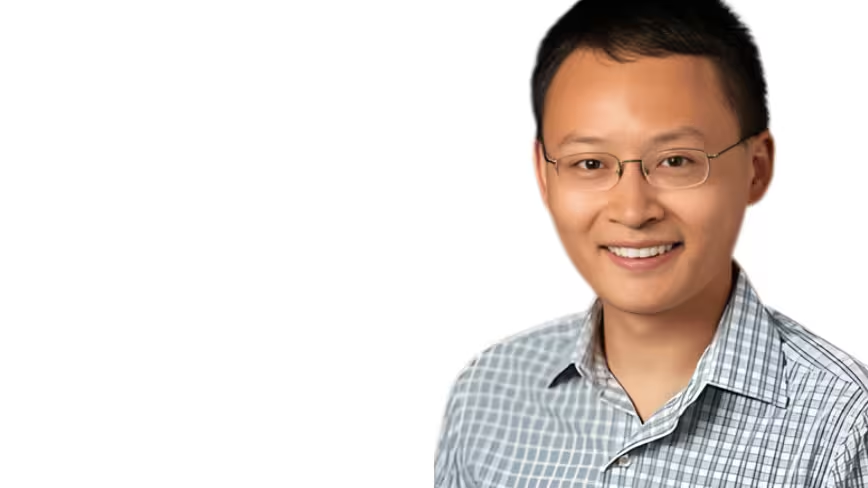
The landscape of artificial intelligence continues to expand into critical sectors, with medicine and biology representing one of the most promising frontiers. In this context, Professor James Zou of Stanford University stands as a key figure with his new entrepreneurial venture, Human Intelligence. According to Bloomberg, the startup is currently engaged in a significant funding round, aiming to raise approximately $100 million with an overall valuation that could reach $1 billion.
Human Intelligence aims to apply AI to research on the human body, a vast field ranging from diagnostics to new drug discovery, and personalized medicine. Zou's approach is not new to concrete successes: his resume includes the development of EchoNet, an FDA-cleared cardiac AI, and a Virtual Lab, whose results were published in Nature, dedicated to designing innovative nanobodies. These pre-existing experiences confirm the team's ability to translate academic research into applicable and clinically relevant solutions.
The Potential of AI in Biomedical Research
The application of artificial intelligence to human physiology opens up revolutionary scenarios. Large Language Models (LLMs) and other machine learning models can analyze enormous amounts of biological, genetic, and clinical data, identifying patterns and correlations that would escape human analysis. This can accelerate the understanding of diseases, optimize treatment pathways, and even predict individual responses to drugs.
Human Intelligence's work is part of a broader trend that sees AI as a catalyst for biomedical innovation. However, integrating AI into this sector is not without its challenges. The need for high-quality data, rigorous clinical validation, and model transparency are fundamental aspects. Zou's ability to secure FDA clearance for EchoNet underscores his experience in navigating these complex regulatory requirements, a critical factor for success in the medical field.
Data Sovereignty and On-Premise Deployment in Healthcare
The use of AI in sensitive areas such as human health raises crucial questions regarding data sovereignty and regulatory compliance. Health information is among the most protected globally, subject to stringent regulations like GDPR in Europe or HIPAA in the United States. For organizations developing or using AI solutions in this field, managing and protecting patient data become absolute priorities.
In this context, deployment decisions take on strategic importance. Many healthcare and research entities opt for self-hosted or air-gapped solutions, preferring direct control over infrastructure and data compared to public cloud models. This on-premise approach, while potentially involving a higher initial investment (CapEx), offers greater assurance in terms of security, compliance, and, in the long run, a potentially lower Total Cost of Ownership (TCO) for intensive and persistent workloads. For those evaluating on-premise deployment for AI/LLM workloads, AI-RADAR offers analytical frameworks at /llm-onpremise to understand and balance these complex trade-offs, considering aspects such as GPU VRAM, throughput, and latency.
Future Prospects for AI and Health
Significant investment in Human Intelligence reflects market confidence in the transformative potential of AI applied to biology and medicine. The ability to process and interpret complex data with unprecedented speed and precision promises to accelerate research, improve diagnostics, and pave the way for more effective and personalized therapies. James Zou's journey, from academic research to entrepreneurship with such a specific and high-impact focus, is emblematic of how technological innovation is redefining the boundaries of science and health.
The success of initiatives like Human Intelligence will depend not only on algorithmic brilliance but also on the ability to integrate these solutions into real clinical contexts, overcoming technical, ethical, and regulatory barriers. The push towards AI in the healthcare sector is unstoppable, and companies like Zou's are destined to play a central role in shaping the future of medicine.




💬 Comments (0)
🔒 Log in or register to comment on articles.
No comments yet. Be the first to comment!