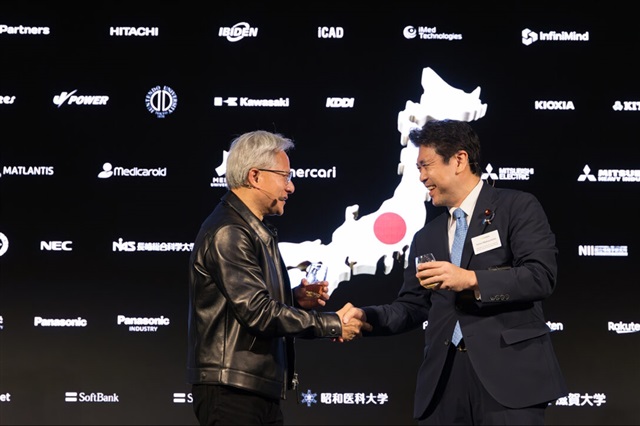
When Nvidia’s founder and CEO dedicates nearly a full week to a single country, the industry pays attention. Jensen Huang has just wrapped up a week in Tokyo, meeting with existing and potential partners, academia, and institutions. The immediate question is not «What did he say?» but «Who did he talk to, and what does it change for enterprise hardware?»
Japan is a mosaic of industrial conglomerates, telco operators like SoftBank and KDDI, semiconductor giants (Tokyo Electron, Rapidus), and a research ecosystem pushing hard on generative AI. Huang’s visit comes as the country allocates billions to upgrade data networks and local processing capacity, driven by a focus on information sovereignty. It’s no coincidence: for Nvidia, Japan’s fabric represents an ideal testing ground for alliances that go beyond GPU supply, embracing hybrid and on-premise deployments.
The spotlight isn’t just on H100 GPUs or upcoming B200 systems, but on what it means to build inference clusters within national borders. In an environment where data sovereignty becomes a tender requirement, Japanese partners are seeking expertise to run LLMs self-hosted, reducing reliance on external cloud APIs. This translates into concrete interest in compute nodes integrating Nvidia AI Enterprise, DPUs, and low-latency networking—a theme where players like SoftBank (already an investor and customer with the «Japan AI Datacenter» project) could accelerate. Huang’s presence in Tokyo aligns incentives: who will control the hardware and software stack to train and serve models tailored to the Japanese market? The answer appears to lean toward local consortia, with Nvidia as enabler.
In parallel, the visit may have touched on collaboration with Rapidus, the national 2nm chip manufacturing consortium, and with institutions like RIKEN, home of the Fugaku supercomputer. While no official announcements surfaced, the direction is clear: Japan wants to replicate locally the hardware-software stack Nvidia perfected with global cloud providers. This paves the way for low-latency inference systems for smart factories, robotics, and healthcare—sectors where processing must remain on-site for regulatory or security reasons.
From a market perspective, Huang’s week reaffirms that Nvidia’s partnerships will increasingly be measured by the ability to transfer skills, not just silicon. Organizations evaluating on-premise paths will find in Japan an early case study: shared infrastructure between industry and government, enablement of a local AI ecosystem, and a cross-pollination between telcos and system integrators still embryonic in the West. It’s not only about who buys the GPUs, but who writes the rules for data access and management—a critical step for long-term TCO.







💬 Comments (0)
🔒 Log in or register to comment on articles.
No comments yet. Be the first to comment!