
The parameter that no longer fits in the GPU
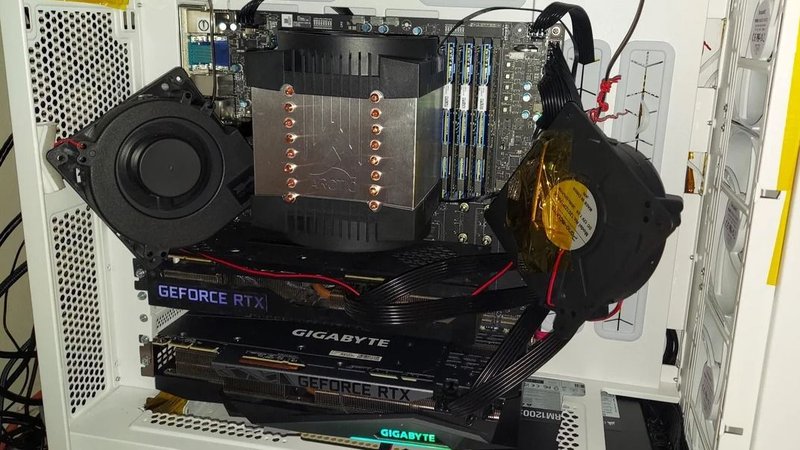
At first glance the news looks like an enthusiast curiosity: a homelab configuration with two GeForce RTX 3090 cards and second-generation Intel Optane can load and run a 2.8-trillion-parameter Large Language Model, returning 3.11 tokens per second. The number does not shift datacenter dynamics, but it forces a different lens on self-hosted inference. Until now the question was almost always the same: how much VRAM is needed to hold model weights? The answer determined the number and type of GPUs, the budget, and the boundary between what could be experimented and what remained out of reach.
The value of the experiment lies in how it bypasses that constraint. The checkpoint weights are not compressed to fit into GPU memory, nor is the work distributed across a cluster. The setup uses a memory hierarchy: the GPUs process only the portion of parameters needed to produce the current token, while the rest resides on low-latency persistent storage. It is a shift in perspective: VRAM stops being the exclusive container for the model and becomes a compute window over a much larger checkpoint.
The price is throughput. A little over three tokens per second makes the system unsuitable for a fluid conversational assistant or interactive workloads. But not all workloads require low latency. Evaluations, batch jobs, quality tests on local datasets, behavior probes on complex prompts can tolerate long runtimes, especially when the value is being able to examine a huge model without sending data to an external API. That is where technical curiosity becomes a market signal.
Memory hierarchy as a design variable
The experiment makes a structural change explicit: in inference design, volatile and persistent memory are no longer separate levels but a continuum to orchestrate. GPUs accelerate computation, system RAM absorbs part of the swapping, and low-latency storage keeps inactive parameters. The point is not only capacity, but the ability to move data at the right time. A 2.8-trillion-parameter checkpoint cannot be shifted entirely at every token; a pipeline is needed that selects, transfers, and prefetches the necessary portions.
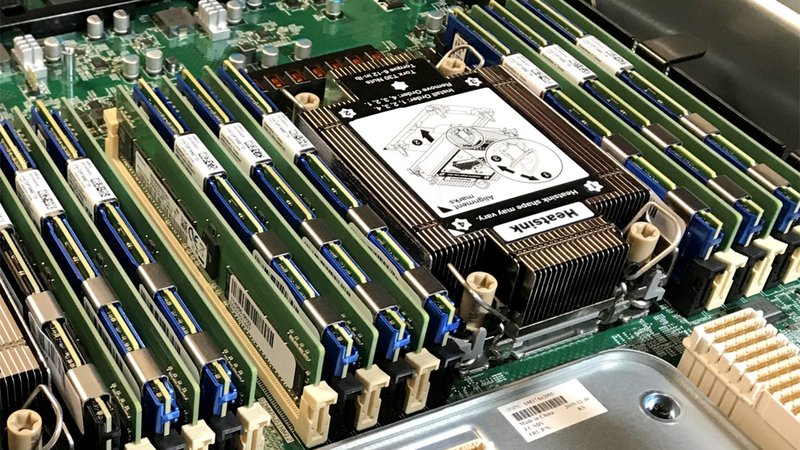
Optane has a specific role because it reduces the gap between persistent memory and working memory compared with traditional NAND SSDs, especially on random reads and latency. It is not a panacea: throughput remains far from VRAM and cost per gigabyte can be high. Yet in scenarios where the model exceeds GPU capacity and workloads are batch or asynchronous, low-latency persistence changes the terms of the trade-off. The problem is no longer whether the model fits in VRAM, but how quickly only what is needed can be brought into VRAM.
This has implications for inference software developers. Frameworks will need to handle tiering more explicitly: deciding which model blocks to load, when to free memory, how to prefetch parameters for upcoming tokens, and how to maintain coherence across levels. Optimizations are no longer limited to kernel fusion or quantization, although the latter remains an ally for reducing the overall footprint. A data orchestration dimension is added that rewards those who can read checkpoint access patterns and adapt them to available hardware.
For organizations, the message is ambivalent. On one hand, the hardware barrier to experiment with huge self-hosted models is lowered. On the other, operational complexity grows: a heterogeneous setup requires skills to manage storage, memory, and GPUs, and to tune the pipeline. Merely having two RTX 3090 cards and Optane is not enough; fine control over how data crosses the different levels is required. Those evaluating this path must ask whether the initial hardware savings justify the time spent making the system stable and repeatable.
Data sovereignty and TCO: the bill does not stop at purchase
For an organization with data sovereignty constraints, the experiment has value beyond tokens per second. Being able to run a huge model on local hardware, accepting high latency, means maintaining control over sensitive data without sending it to a cloud endpoint. In regulated sectors this can shift the boundary between what can be tested internally and what is blocked by policies or contracts. It is not about replacing a production service: it opens spaces for validation, testing, and analysis that previously required out-of-reach infrastructure.
TCO must be calculated carefully and without shortcuts. CapEx may be contained, especially with used components or repurposed machines. But OpEx is not negligible: electricity, cooling, maintenance, and updates add up over time. Human labor is also a cost: building a tiering pipeline, resolving bottlenecks, monitoring transfers, and documenting choices require skills that are not free. The true cost of such a setup is often hidden in engineering, not hardware.
There is also a risk of operational lock-in. A system that depends on a specific combination of persistent storage, drivers, frameworks, and models can become difficult to maintain and evolve. The declared performance may vary with software versions, batch size, prompt length, and checkpoint access patterns. Anyone who wants to replicate the experiment should treat the result as a starting point for internal evaluation, not as a production-ready configuration.
The signal remains relevant: the economic and technical threshold for self-hosted inference with very large models is no longer determined only by total VRAM. The ability to orchestrate volatile and persistent memory also matters, and this shifts attention from pure GPU purchasing to system design. It can favor those with on-premise infrastructure skills and penalize those looking for turnkey solutions.
Who benefits from the lower threshold and who must rethink pricing
The first effect of experiments like this is the widening of the audience that can touch very large models. Homelabbers, independent researchers, small labs, and company teams with limited budgets can run checkpoints that until recently seemed reserved for large providers. This is not only technical prestige: direct access to weights allows studying model behavior, benchmarking on internal datasets, and building qualitative evaluations without intermediaries.
For cloud service providers, the impact is not immediate nor linear. Datacenters retain huge advantages in scale, reliability, latency, and integration. But for intermittent or batch workloads, pricing pressure may increase. If part of the experimentation can move to local hardware at limited marginal cost, providers must justify the added value of managed infrastructure, operational security, and orchestration tools. It does not mean cloud providers come out weakened: it means competition moves to a more complex terrain, where price per GPU hour is not the only variable.
Hardware makers and storage vendors can also read a signal. Demand for low-latency storage, memory pooling, and more efficient interconnects could grow not only in datacenters but also in smaller configurations. Technologies that narrow the gap between persistent and volatile memory become more strategic when checkpoints cannot be fully hosted in VRAM. However, the consumer and prosumer market remains price-sensitive: adoption of these solutions will depend on the ability to deliver concrete benefits without prohibitive costs.
There is also a second-order effect on research and open source. When a homelab can run a 2.8-trillion-parameter model, albeit slowly, control over models becomes less abstract. The ability to inspect, test, and compare huge checkpoints on owned hardware feeds an ecosystem of independent analysis. It is not an immediate commercial revolution, but it changes the boundary conditions for those building tools, datasets, and evaluation methods.
What to watch in the coming months
The first signal to monitor is the evolution of inference frameworks in tiering. Today many pipelines are optimized for the case where weights fit in VRAM or are loaded in blocks on a single machine. The interesting direction is systems that explicitly describe where each model portion resides, with configurable prefetching and eviction policies. If this becomes standard, the boundary between VRAM, RAM, and persistent storage will become an ordinary design choice, not an experiment for enthusiasts.
The second front concerns persistent memory and interconnects. Technologies like CXL and the evolution of low-latency storage can further reduce the distance between system memory and persistent memory. No major announcements are needed: it is enough to observe whether access times and bandwidth for checkpoints improve to the point of making tiering more transparent. Integration between GPUs and direct storage, with access to persistent memory without passing through the CPU, could also change performance in these scenarios.
The third signal is on the model side. If LLM architectures continue to separate active and inactive parameters, or if sparsity becomes an explicit lever, the space for tiering will widen. A model that uses only a fraction of parameters for each token is naturally better suited to run on heterogeneous hardware. This should not be confused with a reduction in overall computational cost: the checkpoint remains huge, but VRAM pressure decreases if the active portion is limited.
Finally, the least visible but most important point is operations. Organizations evaluating on-premise deployments today need not only more accessible hardware: they need ways to measure real cost, stability, and security of heterogeneous configurations. Analytical frameworks serve exactly this purpose: turning an experiment into an infrastructure decision. The point is not to say whether two RTX 3090 cards and Optane are a valid solution in absolute terms, but to understand under what conditions a memory and latency compromise is acceptable.
The boundary is no longer the number of GPUs
The Kimi experiment should not be read as a performance record. It should be read as proof that the distance between a homelab and a datacenter is no longer measured only in number of GPUs or teraflops. It is measured in memory compromises, in the ability to orchestrate different levels, and in willingness to accept high latency in exchange for control and autonomy. Three tokens per second are slow for a chatbot, but may be sufficient for a quality check or internal validation.
The structural change is that the entry cost for self-hosted inference is no longer dictated exclusively by total VRAM. Memory hierarchy becomes a design variable, with implications for software developers, hardware buyers, and cloud service sellers. There is no single winner: there are more complex trade-offs and greater responsibility in system design.
For those following AI-RADAR, the point is to maintain a sober reading. Heterogeneous configurations do not turn a homelab into a datacenter, nor do they make cloud infrastructure obsolete. But they raise the bar for experimentation and force a more precise evaluation of where hardware savings end and operational cost begins. That is exactly the kind of signal that deserves structural analysis, not a sensational headline.



💬 Comments (0)
🔒 Log in or register to comment on articles.
No comments yet. Be the first to comment!