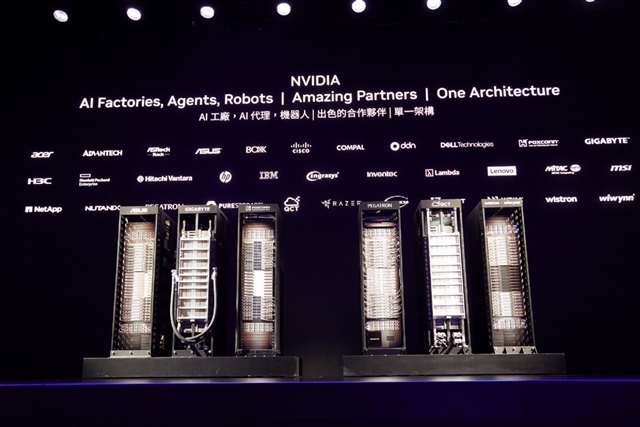
A detail picked up by DIGITIMES triggered a brief stir among integrators: a rumored delay in the next-generation rack platform that Nvidia is said to be developing under the Kyber codename. The company’s reaction was swift and blunt — “we deny the rumor” — but the nature of the rumor itself says more than the denial.
Kyber, based on what can be pieced together from unofficial sources, is expected to represent the rack-scale evolution of architectures we currently know as DGX or HGX, with a level of integration designed to reduce cabling, power, and cooling complexity in data centers housing hundreds of GPUs for LLM workloads. It fits neatly into Nvidia’s established trajectory of liquid-cooled systems and modular logic, where the minimum deployment unit is no longer a single node but an entire pre-assembled rack.
Why, then, is the news of a possible slip already framed as “limited impact” in the source’s headline? The answer lies in market stratification. Those waiting for Kyber to upgrade compute capacity belong almost entirely to two groups: hyperscale cloud builders working with tightly bound roadmaps and locked-in supply contracts, and large enterprises moving inference on-premise to their own facilities, driven by data sovereignty or latency requirements. In both cases, the time variable is managed with quarterly buffers, not weekly ones. A delay of a few months on a platform not yet officially announced hardly shifts investment decisions built on multi-year horizons.
There is, however, a second, more structural layer. The rumor, even if unfounded, signals how hypersensitive the sector has become to any ripple in the AI component supply chain. Interposers, cooling modules, high-density power supplies: all are choke points that have caused real slips in the past. The fact that Nvidia feels the need to strongly deny, and that analysts quickly defuse the alarm, shows that the market has learned to distinguish between genuine bottlenecks and background noise. For those evaluating on-premise deployment of LLMs, this is a useful lesson: TCO and the actual availability of integrated solutions matter more than launch rumors.
The most compelling aspect for an AI-RADAR reader is different: platforms like Kyber, when they arrive, will reshape the granularity at which an organization can self-host. Instead of buying nodes and assembling clusters, the move will be toward purchasing entire pre-configured, pre-validated racks, shifting the problem from hardware integration to software management and pipelines. That transition, while simplifying operations, also ties the buyer more tightly to a single vendor. And that’s where the timing window becomes irrelevant: enterprises embracing this logic do so out of a medium-to-long-term architectural choice, not because the rack ships in one quarter rather than another.
Nvidia’s denial, then, restores a fact: the roadmap hasn’t changed. But the real news is that the Kyber discussion reveals how the industry has already internalized the rack as the atomic unit of AI compute. The second- and third-order implications — supply chain consolidation, less flexibility in vendor mix, yet greater operational efficiency — are already in motion, regardless of a few weeks’ delay.





💬 Comments (0)
🔒 Log in or register to comment on articles.
No comments yet. Be the first to comment!