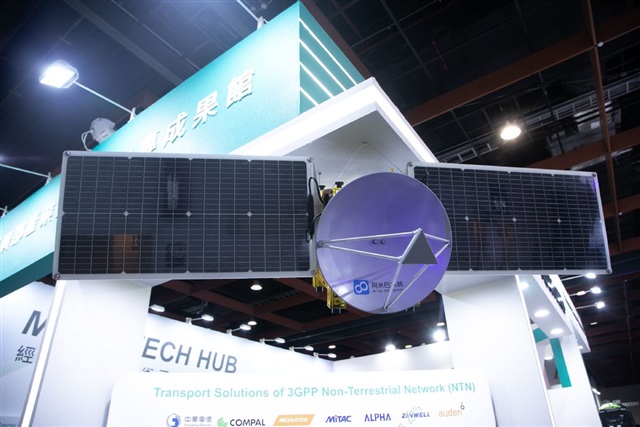
The Impact of LEO Satellites on Global Supply Chains
The space industry is undergoing a profound transformation, driven by the proliferation of Low Earth Orbit (LEO) satellite constellations. These systems, designed to provide low-latency internet connectivity on a global scale, are not only revolutionizing network access but also triggering a significant realignment of international supply chains. At the heart of this evolution are Taiwanese manufacturers, who, with their established expertise in the electronics and semiconductor sectors, are making a decisive contribution to the production of essential components for these new space infrastructures.
The growing demand for LEO satellites, fueled by operators such as Starlink, OneWeb, and Kuiper, has generated a wave of innovation and investment. This scenario directly impacts the production and distribution of critical components, from specialized communication chips to power systems and advanced sensors. Taiwan's ability to provide cutting-edge technological solutions and manage high production volumes positions it as an indispensable player in this new landscape.
Advanced Connectivity and Implications for AI Deployment
The advent of LEO constellations promises to extend connectivity to previously unserved areas or those with limited infrastructure. This increased broadband availability and reduced latency have direct repercussions on deployment strategies for artificial intelligence workloads, particularly for Large Language Models (LLM). For companies evaluating self-hosted or edge computing solutions, LEO connectivity can unlock new possibilities.
In contexts where data sovereignty is a priority or where compliance requirements dictate that data remains on-premise, reliable, low-latency connectivity becomes fundamental. Distributed architectures, which involve AI Inference close to the data source (edge AI), can greatly benefit from these satellite networks, reducing the need to transfer massive volumes of data to centralized cloud data centers. This approach can help optimize Total Cost of Ownership (TCO), balancing local infrastructure costs with data transmission expenses.
Reshaping Supply Chains and Strategic Choices
The involvement of Taiwanese manufacturers in the LEO satellite sector is not limited to component supply but extends to innovation and optimization of production processes. This dynamism is redefining global supply chains, creating new dependencies and opportunities. For companies investing in AI infrastructure, understanding these dynamics is crucial. The availability, costs, and delivery times of specialized hardware, such as high-VRAM GPUs or high-performance storage systems, can be influenced by these macroeconomic and geopolitical shifts.
The choice between an on-premise deployment and a cloud solution for LLM workloads is increasingly complex. While the cloud offers scalability and flexibility, self-hosted solutions provide greater data control, security, and, in many cases, a more advantageous TCO in the long run, especially for predictable and intensive workloads. The evolution of supply chains, also influenced by the LEO sector, can alter the economic equation, making the procurement of on-premise hardware more or less cost-effective.
Future Prospects and Infrastructure Decisions
The expansion of LEO constellations is an ongoing phenomenon, destined to further shape the global technological landscape. For CTOs, DevOps leads, and infrastructure architects, it is imperative to monitor these trends. Decisions regarding the deployment of LLMs and other AI applications must consider not only the technical specifications of models and hardware but also the broader context of supply chains and connectivity.
An organization's ability to adapt to these dynamics, choosing the most suitable infrastructural approach – whether self-hosted, cloud, or hybrid – will be a determining factor for success. AI-RADAR, for example, offers analytical frameworks on /llm-onpremise to evaluate the trade-offs between different options, helping companies make informed decisions that balance performance, costs, security, and data sovereignty in an increasingly interconnected world.









💬 Comments (0)
🔒 Log in or register to comment on articles.
No comments yet. Be the first to comment!