A Counter-Current Investment: Climate Tech at the Forefront
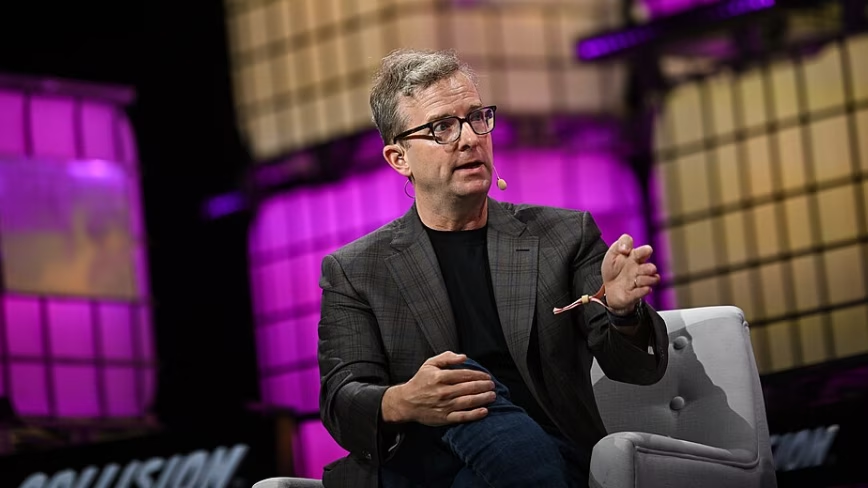
Gigascale Capital, the venture firm led by Mike Schroepfer, former Chief Technology Officer at Meta, has announced the closing of its second fund, the first to include institutional investors, with a raise of $250 million. This capital will be entirely allocated to innovative startups in the climate technology sector, with a specific focus on energy, grid infrastructure, and critical minerals. Gigascale's move stands out sharply in the current tech investment landscape.
While much of the venture capital industry is directing its resources towards artificial intelligence, and particularly towards Large Language Models (LLM) and their associated infrastructure, Schroepfer and his team have chosen a different strategic direction. This decision underscores a long-term vision that recognizes the urgency and market potential of climate solutions, even while operating in a context where AI dominates conversations and capital inflows.
The Context of Tech Investments and Its Implications
The current AI gold rush has catalyzed massive investments in every aspect of the technology pipeline, from training complex models to optimizing Inference at scale. This has generated unprecedented demand for specialized hardware, such as GPUs with high VRAM, and for flexible deployment solutions, both in the cloud and on-premise. Companies find themselves having to balance CapEx and OpEx costs, carefully evaluating the Total Cost of Ownership (TCO) of their AI infrastructures.
In this scenario, Gigascale's choice to focus on climate tech is not just a diversification, but also a signal that other areas of innovation, while less "glamorous" at the moment, require substantial investment and a robust infrastructural approach. Startups in the energy and infrastructure sectors, for example, often need computing and data storage solutions that ensure sovereignty and control, critical aspects that AI-RADAR explores for on-premise deployments.
Data Sovereignty and Infrastructure for Climate Tech
Climate technologies, while distinct from AI, share with it the need for resilient and secure IT infrastructures. Projects related to power grid management, renewable energy production, or the extraction and processing of critical minerals often involve the collection and analysis of large volumes of sensitive data. For these applications, data sovereignty and regulatory compliance become absolute priorities.
A self-hosted or air-gapped deployment can offer the required level of control and security, reducing dependence on third-party providers and mitigating risks related to privacy and compliance. Similar to what happens for the most demanding AI workloads, climate tech solutions can also benefit from bare metal architectures or locally managed Kubernetes clusters, where performance, latency, and throughput can be optimized for specific needs, without the uncertainties of cloud pricing models.
Future Prospects and Deployment Strategies
Gigascale Capital's investment in climate tech highlights how innovation is not confined to a single sector but extends to global challenges that require advanced technological solutions. Whether it's optimizing energy efficiency with machine learning algorithms or managing complex grids with distributed control systems, the infrastructural foundation remains a key element.
For companies operating in these sectors, the evaluation between on-premise deployment and cloud solutions remains a crucial point. AI-RADAR, for example, offers analytical frameworks on /llm-onpremise to help decision-makers evaluate the trade-offs between initial and operational costs, performance, and data sovereignty requirements. Schroepfer's choice to invest in such a vital sector, yet less frequented by venture capital, could catalyze a wave of innovation that, in turn, will demand increasingly robust and controlled IT infrastructures.







💬 Comments (0)
🔒 Log in or register to comment on articles.
No comments yet. Be the first to comment!