From Generative to Agentic AI: A New Era for the Enterprise
Generative artificial intelligence has already redefined the enterprise landscape, offering powerful tools for drafting documents, summarizing complex information, and advanced searching. Companies have rapidly integrated these capabilities to optimize workflows related to data management and content production, experiencing significant benefits in operational efficiency. However, the evolution of AI does not stop at these applications.
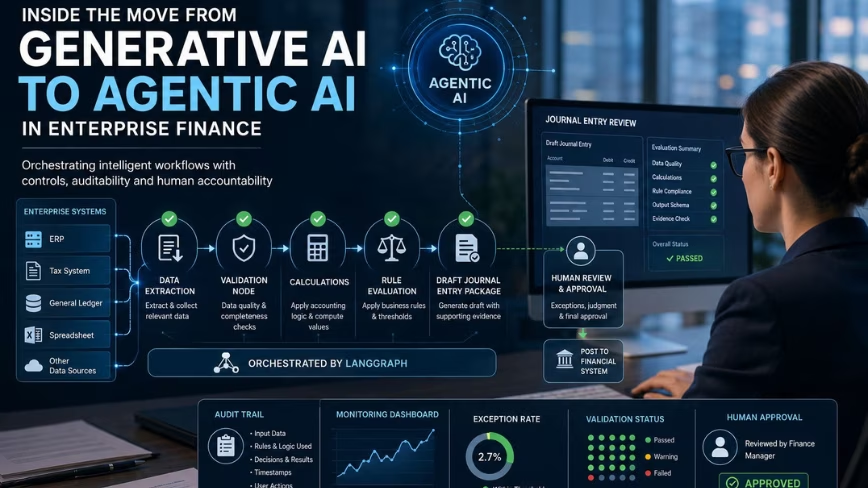
The next frontier, particularly relevant for critical sectors such as enterprise finance, is represented by agentic AI. Unlike a chatbot that merely provides answers based on a prompt, an agentic AI system is designed to interpret a complex goal and autonomously coordinate a series of actions across different business systems. This ability to act proactively and interdependently opens up unprecedented scenarios for process automation and optimization.
The Crucial Challenges of Agentic AI in Regulated Environments
The introduction of agentic AI into enterprise contexts, especially in finance, brings with it a series of complex challenges that extend beyond mere technological implementation. The central question is how these systems can effectively coordinate work across various business systems while maintaining rigorous control, full auditability, and clear human accountability. These aspects are fundamental in sectors where regulatory compliance and risk management are absolute priorities.
An agentic AI's ability to make decisions and initiate autonomous actions requires an architecture that ensures transparency and traceability of every operation. Each "step" taken by the agent must be documentable and verifiable, allowing human operators to understand the underlying reasoning and intervene if necessary. This is essential not only for compliance but also for building trust in advanced automation and mitigating potential errors or unexpected behaviors.
Implications for Infrastructure and Data Sovereignty
The adoption of agentic AI, with its need for inter-system coordination and the maintenance of stringent controls, has profound implications for infrastructure decisions. Companies operating in highly regulated sectors, such as finance, often prioritize on-premise or hybrid deployment solutions. This approach allows for greater control over data sovereignty, security, and compliance, aspects that become even more critical when AI begins to orchestrate sensitive business processes.
Managing an agentic AI requires robust infrastructure, capable of supporting not only the inference of Large Language Models (LLMs) that often power these agents but also the complex pipeline of integration with legacy systems and corporate databases. This implies investments in adequate hardware, such as GPUs with sufficient VRAM for intensive workloads, and low-latency networking. The evaluation of Total Cost of Ownership (TCO) thus becomes a key factor, balancing initial capital expenditures (CapEx) for on-premise infrastructure with operational expenditures (OpEx) for management and maintenance, compared to cloud-based models.
Future Prospects and Strategic Considerations
The transition from generative AI to agentic AI represents a significant evolution, laying the groundwork for more autonomous and integrated AI systems. The challenge for companies, particularly those operating in highly regulated contexts, will be to implement these technologies responsibly and securely. An agentic AI's ability to interpret a goal and coordinate actions across different systems is promising, but success will depend on strict adherence to principles of control, auditability, and human accountability.
CTOs and infrastructure architects face complex strategic decisions, requiring them to balance innovation with the need to maintain data governance and security. For those evaluating on-premise deployment for AI/LLM workloads, AI-RADAR offers analytical frameworks on /llm-onpremise to assess the trade-offs between control, data sovereignty, and TCO, providing tools to navigate these complexities without direct recommendations, but with an in-depth analysis of constraints and opportunities.






💬 Comments (0)
🔒 Log in or register to comment on articles.
No comments yet. Be the first to comment!