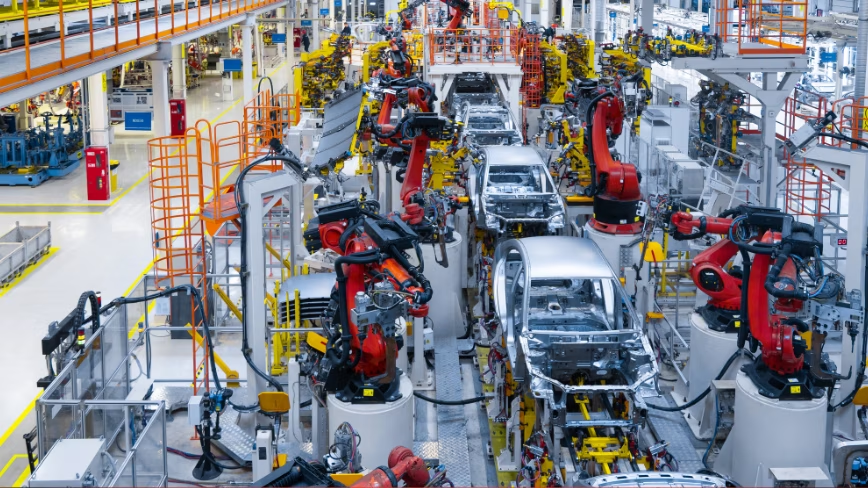
A Strategic Shift for the European Automotive Industry
The European industrial landscape is witnessing a significant transformation, with several automakers reorienting their production strategies towards the defense sector. This trend is clearly evident from last week's announcements, which saw four major players in the automotive industry forge partnerships for the development of military vehicles. A key factor in this pivot is the slowdown in electric vehicle (EV) demand, combined with a marked increase in military budgets across the continent.
Among the most relevant initiatives, Ineos has submitted a bid for a contract with the UK Ministry of Defence. In parallel, Daimler Truck has launched a brand entirely dedicated to the defense sector, underscoring the strategic importance of this new direction. Renault, for its part, has signed a partnership with Thales for the production of armored vehicles, while Mercedes-Benz has collaborated with a German startup to develop anti-drone platforms. These examples highlight a clear trend of the European automotive industry retooling to meet the needs of an era of rearmament.
Technological Integration and AI Challenges in Defense
The automotive industry's shift towards defense is not just about producing robust vehicles; it also implies an acceleration in the adoption of advanced technologies. Modern defense systems, in fact, increasingly rely on artificial intelligence (AI) for critical functionalities such as autonomous driving, threat recognition, drone swarm management, and predictive analytics. Implementing these capabilities requires extremely powerful and reliable computing infrastructures.
For such sensitive applications, hardware requirements are stringent. Consider the need for GPUs with high VRAM for Large Language Models (LLM) Inference or for real-time sensor data processing. Latency and Throughput become crucial parameters, especially in operational contexts where rapid decisions can have significant consequences. This scenario drives Deployment solutions that ensure total control and optimal performance, often favoring on-premise or edge configurations over public cloud-based ones.
Data Sovereignty and TCO in Critical Deployments
The sensitive nature of military and defense operations raises fundamental questions regarding data sovereignty and security. Managing classified or strategic information imposes rigorous requirements in terms of data localization, regulatory compliance, and protection from external attacks. In this context, self-hosted or air-gapped Deployments often become the preferred choice, offering unparalleled control over infrastructure and data.
However, choosing an on-premise infrastructure also involves in-depth considerations regarding the Total Cost of Ownership (TCO). Although initial costs (CapEx) can be high for purchasing hardware such as servers, GPUs, and storage systems, long-term operational costs (OpEx) may prove more advantageous compared to cloud-based models, especially for intensive and predictable workloads. TCO evaluation must include not only hardware and software but also energy, cooling, maintenance, and specialized personnel. For those evaluating on-premise Deployments, AI-RADAR offers analytical frameworks on /llm-onpremise to assess these complex trade-offs.
Future Prospects for Innovation and Infrastructure
The reorientation of the automotive industry towards defense is a clear example of how market dynamics can accelerate the adoption and development of cutting-edge technologies. This transition not only stimulates innovation in vehicle design and engineering but also in the development of robust and secure AI and infrastructural solutions. The need for resilient systems, capable of operating in complex environments with high security requirements, will further drive research and development in areas such as edge computing, model Quantization for Inference on limited hardware, and Framework optimization for real-time data pipelines.
Ultimately, the convergence between automotive manufacturing expertise and defense needs, mediated by AI integration, outlines a future where the ability to manage and Deploy critical computational workloads on-premise will be a distinguishing factor. Companies that invest in controlled and secure infrastructures will be better positioned to face the challenges and seize the opportunities of this new industrial scenario.








💬 Comments (0)
🔒 Log in or register to comment on articles.
No comments yet. Be the first to comment!