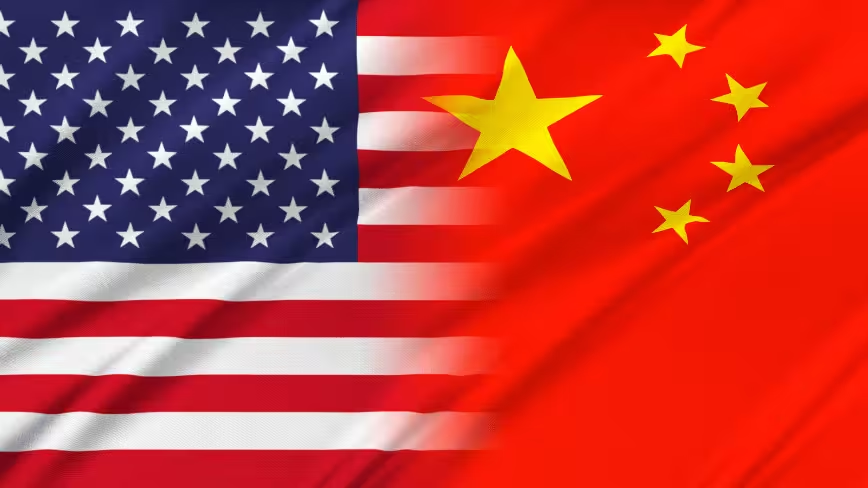
China has answered the Pentagon’s military blacklist with one of its own. On Monday, Beijing imposed trade restrictions on 56 US companies, targeting strategic sectors such as rare-earth mining and drone manufacturing. It is a direct retaliation against Washington’s decision to add Chinese firms to a defense-related blacklist, escalating the trade conflict into the realm of critical raw materials and dual-use technologies.
Rare earths: a geopolitical and technological knot
Rare earths — 17 chemical elements essential for high-power magnets, lasers, catalysts, and, crucially, semiconductors — represent a vulnerability for the global tech industry. China controls around 60% of world production and nearly 90% of refining. The restrictions now placed on US mining and refining companies could trigger price hikes and bottlenecks in the supply of components vital for AI hardware, from GPU servers to advanced cooling systems.
Implications for on-premise infrastructure adopters
For organizations running LLMs locally — be they businesses, research centers, or public administrations — this news is not marginal. GPUs and AI accelerators depend on rare earths for cooling fan magnets and other parts. A prolonged supply-chain disruption could lead to higher procurement costs and longer lead times, directly affecting the TCO of self-hosted systems. Moreover, the geopolitical dimension reinforces the trend toward technological autonomy that also favors on-premise deployments: having physical control of hardware becomes a strategic lever to mitigate reliance on foreign suppliers and trade tensions.
A scenario of accelerated “tech sovereignty”
The Chinese move fits into a broader fragmentation of global value chains. Europe and the US are ramping up investments to localize chip and rare-earth production. Those planning on-premise deployments should monitor these dynamics, as they could reshape the supplier landscape: new players may emerge, but with higher initial costs and timelines. In the medium to long term, the stated goal of reducing dependence on Beijing could lead to greater supply chain stability and predictability, though the transition will be bumpy.
In conclusion
The Chinese curbs on 56 American companies are more than a political clash. They are a wake-up call for anyone relying on advanced hardware for AI workloads. The resilience of on-premise infrastructures also depends on the ability to read geopolitical tensions and adapt procurement strategies. AI-RADAR continues to track the evolution of tech supply chains, offering analysis for those evaluating local architectures and the impact of the global context on operational choices.








💬 Comments (0)
🔒 Log in or register to comment on articles.
No comments yet. Be the first to comment!