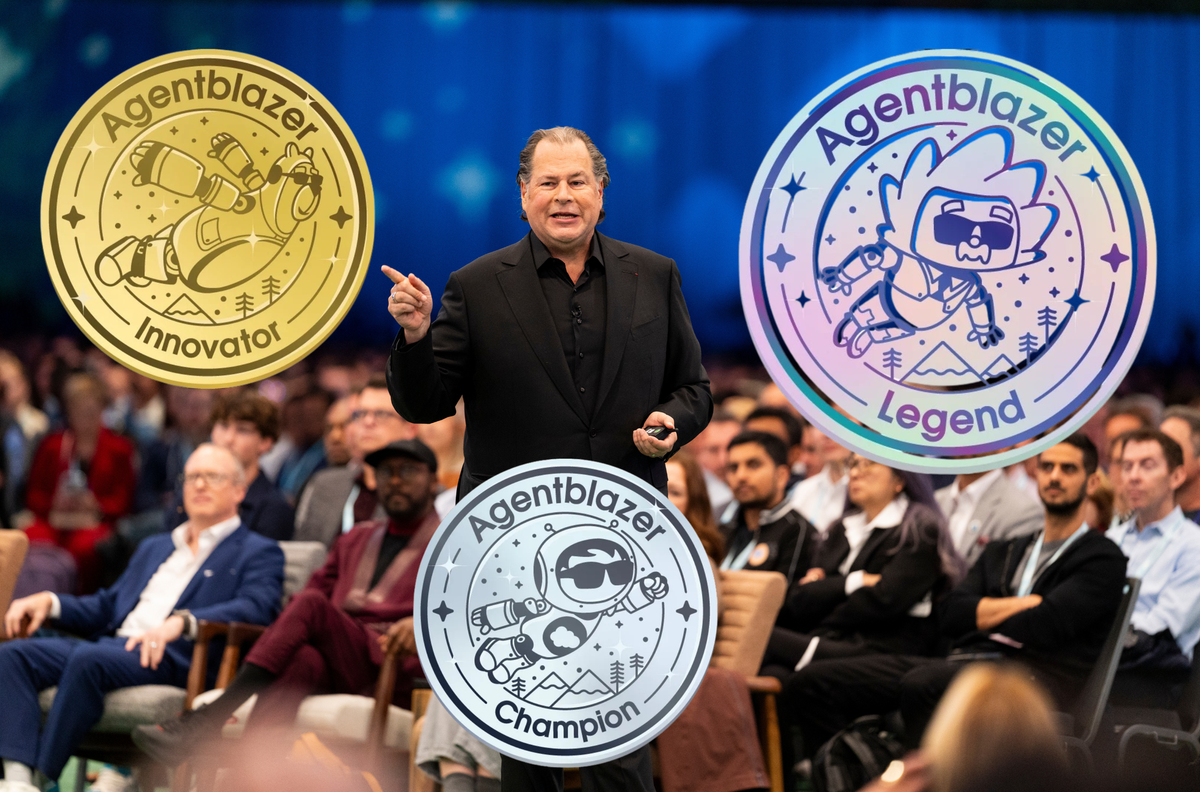
Deploying large language models and generative AI tools in an enterprise isn’t just an infrastructure challenge—it’s also a matter of internal culture. Salesforce is tackling it with a mix of social-network psychology and competition: a public internal leaderboard, sorted by executive and team, that displays who has earned AI-related badges and, with a telling “click to see who 👀,” who still lacks them.
The dynamic is as simple as it is powerful: every employee can see colleagues’ standings, informally reward the most active users, and, when needed, apply a gentle social nudge to those absent from the list. The system closely mirrors the gamification mechanics of consumer apps, but transplanted into an organization with thousands of workers it brings consequences that shouldn’t be underestimated.
How the badge system works
The leaderboard aggregates usage metrics from internal AI platforms—likely tied to Salesforce Einstein or other models made available to teams. Users accumulate points or badges based on their interaction with these tools: generated prompts, automated workflows, executed analyses. The data isn’t just aggregated; it’s made visible vertically, from top management down to individual contributors. The “click to see who” function adds an element of near-total transparency, turning inactivity into a noticeable absence. In terms of adoption, such positive (or negative) reinforcement can accelerate learning curves and push teams to integrate AI into daily work. At the same time, this level of public exposure risks rewarding superficial behavior: prompts launched just to climb the rankings, inflated metrics, shallow use of the technology.
Why gamification divides opinion
Salesforce’s approach is the latest piece of a broader debate on how companies measure real AI adoption. On one hand, gamification lowers the psychological barrier to complex tools, fosters emulation, and provides immediate feedback. On the other, it shifts focus from quality to quantity: an LLM used for marginal tasks can earn badges but not value. For those evaluating on-premise or self-hosted deployments of similar solutions, the topic is even more delicate. Environments with data access restrictions—air-gapped systems, GDPR compliance, healthcare, defense—often require internal monitoring dashboards to track actual model usage, but rarely do they contemplate public leaderboards. Data sovereignty also involves the ability to prevent sensitive information from being exposed through uncontrolled gamification mechanisms: a dashboard on a self-hosted stack could aggregate metrics without revealing content, but the line is fine. AI-RADAR follows these dynamics closely, offering analytical frameworks to assess the trade-offs between adoption incentives and risk control.
The metrics and privacy knot
A leaderboard of this kind immediately raises questions about what data is actually collected. If the system only logs the number of interactions, there’s a risk of chasing vanity metrics. If it instead goes into details of prompts or outputs, issues of confidentiality and potential exposure of corporate information arise. In contexts where AI is self-hosted, log ownership and the ability to keep everything on-premise already provide a higher level of protection, but the temptation to create internal rankings can drive organizations to expose granular metrics without fully assessing the implications. It’s no coincidence that many regulated entities choose anonymous or aggregated dashboards, forgoing the social element to preserve confidentiality. Salesforce’s choice seems to bet everything on the cultural lever, but balancing incentive and surveillance remains a complex exercise, especially when AI becomes a daily productivity tool.
Beyond the trophy: what Salesforce’s move teaches us
Salesforce’s experiment sends a clear signal: for large enterprises, AI adoption is no longer just a matter of licenses or compute power but of change management. The leaderboard is, ultimately, an attempt to make the digital transformation journey visible, breaking the inertia of teams less inclined to change. However, the same architecture that rewards the fastest risks excluding those who need more time or a different approach, generating divisions and performance anxiety. For those following on-premise deployment and digital sovereignty strategies, the Salesforce case offers food for thought: when AI is brought inside the corporate perimeter, we need success metrics that go beyond simple badge counts, and a design that respects the complexity of real processes. The challenge is to build culture without turning work into a trophy hunt.







💬 Comments (0)
🔒 Log in or register to comment on articles.
No comments yet. Be the first to comment!