
Welcome to AI-Radar’s Deep Dive: The Great UI War of 2026
If you had told a product designer in 2023 that a single tweet could wipe out 7% of Figma’s market cap in a matter of hours, they would have laughed you out of the room. But welcome to April 2026. Figma’s stock is down 85% since its peak in August 2025, sitting at a depressed ~$21—well below its $33 IPO price. The company has lost a staggering $120 billion in market cap in just eight months.
Why? Because the era of manually nudging vectors and tweaking padding is officially on life support. The professional digital product design landscape has violently transitioned from a decade defined by manual manipulation toward an era of intent-based generation and agentic orchestration. The execution phase—the first 60% of the design process—has been solved by artificial intelligence.
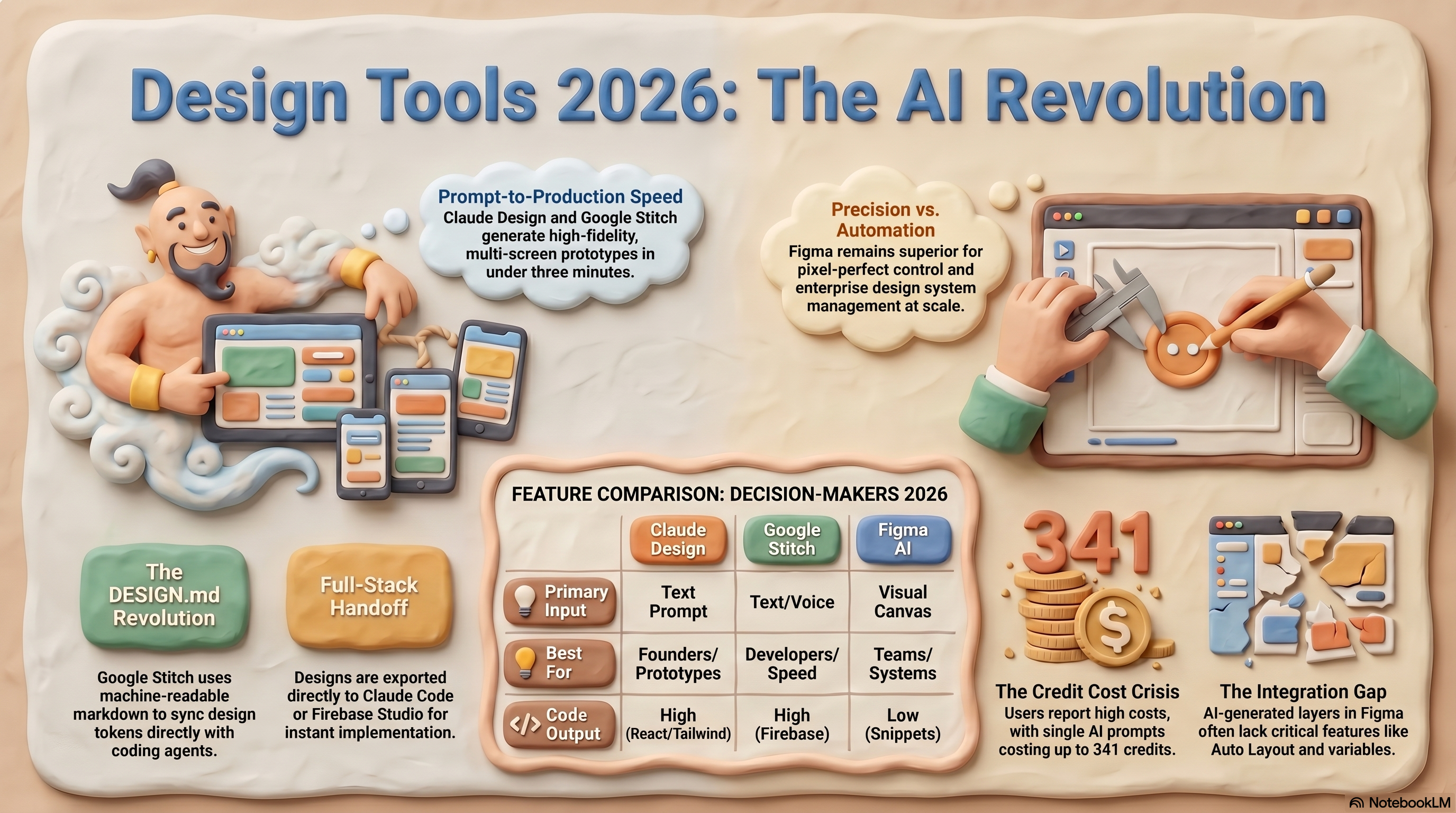
Today, we are looking at the three heavyweights locked in a brutal cage match for the future of digital product creation: Figma (the bleeding incumbent), Google Stitch (the chaotic but free "vibe" machine), and Claude Design (the full-stack terminator).
Grab your popcorn, your AI credits, and your DESIGN.md files. We are witnessing history in real time.
--------------------------------------------------------------------------------
Contender 1: Figma (The Wounded Goliath)
Figma is not dead, no matter what the hyper-enthusiastic Reddit "slop crowd" tells you. The platform still boasts over 13 million monthly active users and recently hit $1.1 billion in annualized revenue, growing at an impressive 41% year-over-year. Figma remains the absolute gold standard for real-time multiplayer editing, complex vector illustration, developer handoff annotations, and massive corporate design systems.
However, Wall Street isn't betting against Figma's current revenue; it is betting against its business model. Figma sells a productivity tool to designers, while its new competitors sell an agent that replaces part of the designer's work.
The Adobe Breakup and the AI Scramble
Let’s rewind slightly. On December 18, 2023, Adobe officially abandoned its $20 billion acquisition of Figma after facing severe antitrust pushback from the UK's CMA and European regulators. Adobe walked away, paying Figma a sweet $1 billion breakup fee.
Flush with cash but suddenly facing an existential threat from generative AI, Figma has spent the last year desperately layering AI onto its existing canvas. They introduced Figma Make, First Draft, and AI prototyping—features that allow you to generate UI layouts from a text prompt or automate interactions.
Figma has also leaned heavily into developer integration. In March 2026, they unveiled the Figma AI Design Development MCP (Model Context Protocol) server, enabling two-way UI-to-code workflows with coding environments like Cursor, Warp, Factory, Firebender, and Augment. This allows AI agents to write directly to Figma files, modifying assets using your actual components, variables, and tokens. On April 2, 2026, they launched "Make kits," allowing design system teams to bring public npm packages, private code packages, and Figma library styles directly into the AI's generation context.
The Pricing Disaster: The "Ghost Seat" Loophole
Despite these innovations, Figma’s monetization of AI has sparked a full-blown revolt. Starting March 18, 2026, Figma began strictly enforcing AI credit limits across all plans.
Under the 2026 pricing model, Figma costs $15/month for a Professional plan (which gives you 3,000 AI credits), $45/month for Organization (3,500 credits), and $75/month for Enterprise (4,250 credits). Actions like "First Draft" or "Make prototype" cost 20 credits per use, while simple image generation ranges from 5 to 25 credits depending on the model.
When designers inevitably burn through their credits, admins are forced to buy overages. The cost? A staggering $0.03 per credit on the pay-as-you-go tier, or $150/month for a shared subscription pool of 5,000 credits.
As one furious Reddit user (u/pipmo) pointed out, buying a 3,000-credit overage costs $90. But adding a brand new "Full Seat" to the Professional plan costs only $16 and comes with 3,000 credits included. This means official extra credits are 5.6x more expensive than simply spinning up a fake "ghost" seat. When your pricing model makes it cheaper for enterprise users to create burner accounts than to pay for your official add-ons, you have a massive structural problem.
Figma's Current Vibe: It's the kitchen where professional meals are still cooked, but the chefs are furious about the cost of ingredients, and investors are fleeing the restaurant.
--------------------------------------------------------------------------------
Contender 2: Google Stitch (The Free "Vibe" Machine)
In early 2025, Google quietly acquired the pioneering AI startup Galileo AI and integrated it into Google Labs. The result was Google Stitch. But it was the release of Google Stitch 2.0 on March 19, 2026, that sent shockwaves through the industry, instantly crashing Figma's stock by 12% over two days.
Infinite Canvas and "Vibe Design"
Google Stitch operates on a philosophy Google calls "vibe design". There is no traditional layer panel or complex vector manipulation here. You are presented with an AI-native infinite canvas where you can mix text, images, code, and competitor screenshots.
Stitch allows for native voice control. You can literally talk to the canvas. You can say, "make the header darker," or "switch this list to a card grid layout," and the AI agent updates the design in real-time while you are still finishing your sentence. It features an "Agent Manager" that handles tasks in parallel—one agent can redesign a dashboard while another explores landing page variations.
Powered by Gemini 2.5 Pro (for deep reasoning and high-fidelity output) and Gemini 2.5 Flash (for rapid 45-second ideation), Stitch generates multi-screen flows that maintain remarkable consistency in colors, typography, and component styles across the entire user journey. Best of all? It's completely free, offering 50 Pro generations and 350 Flash generations per month per user.
The DESIGN.md Revolution
Google Stitch's most brilliant (and potentially most disruptive) contribution is the introduction of the DESIGN.md format.
Instead of locking your design system inside a proprietary binary .fig file that requires a paid viewer seat to access, Stitch externalizes your design specifications into a simple, human-readable Markdown file. This DESIGN.md file captures design tokens (colors, typography, spacing units), component structures, layout rules, and interaction behaviors.
This is a paradigm shift. A DESIGN.md file can be committed to a Git repository and version-controlled like code. More importantly, AI coding agents like Claude Code, Cursor, Gemini CLI, and Antigravity can ingest this text file directly via Stitch's MCP server. The coding agent implements the frontend using the explicit brand and UX rules defined in the Markdown document, completely bridging the gap between design intent and frontend engineering.
The Reality Check
But is Stitch actually good? If you ask the r/UXDesign subreddit, you'll get a mixed bag of existential dread and visceral hatred. User TabsIsHaunted called it an "atrocious P.O.S." that produces "lifeless, basic designs" that don't even follow WCAG accessibility requirements. User bfig complained that Stitch generated a dull color palette with "wasted space" and "huge fonts". Another user noted the irony of searching Reddit for Stitch feedback and finding a post from r/crochet saying, "I lost on the last 3 stitches 😭".
Stitch is currently limited by its generic output. It generates UI from its own models, meaning it cannot deeply ingest your company's highly bespoke React component library to generate production-ready variants. It doesn't do presentations, and it lacks the multiplayer collaboration required by large enterprise teams.
Google Stitch's Current Vibe: It is the ultimate ideation accelerator and hackathon darling. It is a wildly powerful, slightly unpolished brainstorming partner that bridges design and code beautifully via DESIGN.md—but it isn't ready to replace a senior designer.
--------------------------------------------------------------------------------
Contender 3: Claude Design (The Visual Orchestrator)
If Google Stitch wounded Figma, Anthropic’s Claude Design dropped a tactical nuke on it. Launched on April 17, 2026, Claude Design caused Figma's stock to immediately plummet another 6.8% intraday. It wasn't just the product that spooked Wall Street; it was the optics. Three days before the launch, Mike Krieger, Anthropic’s Chief Product Officer, abruptly resigned from Figma’s board of directors. The market read it exactly for what it was: a declaration of war.
The Power of Opus 4.7
Claude Design is not a standalone app; it lives inside the Claude.ai interface under the Design tab, powered by Anthropic's brand-new Claude Opus 4.7 vision model. Opus 4.7 boasts a massive jump in vision resolution (from 1,568px to 2,576px), allowing it to analyze complex references with incredible precision.
What makes Claude Design the most terrifying threat to traditional workflows is its Design System Extraction. You don't start with a blank canvas. Upon first run, you simply point Claude Design to your GitHub repository, upload a ZIP of your source code, or import your existing Figma files and brand logos. Claude intelligently infers your palette, typography, spacing, and custom React/Vue components. From that point on, every text prompt you write is generated natively using your company's exact visual identity.
A Full-Stack Powerhouse
While Google Stitch is strictly a UI tool, Claude Design is an omnivorous visual orchestrator. You can upload a Word document (DOCX), an Excel sheet (XLSX), or a messy sketch, and Claude will spit out an interactive HTML prototype, an investor pitch deck, or a marketing one-pager. It even features a "Web Capture Tool" that allows you to paste a live URL, prompting Claude to pull in the visual elements directly from the live site so your new mockup matches the actual production product perfectly.
It natively supports "Frontier Design" elements—embedding functional chatbots, video players, and fully interactive 3D assets directly into the mockup stage.
Once generated, the iterations happen conversationally via chat, inline comments, or dynamically generated UI sliders (e.g., a custom light/dark mode toggle that Claude builds on the fly just for your session). Finally, you can export the bundle directly to Canva, download it as a PowerPoint (PPTX), save it as a PDF, or use the Claude Code Handoff. With a single click, Claude Design packages the extracted components and generated layouts and passes them directly to the Claude Code CLI, allowing your AI coding agent to implement the production backend and logic immediately.
The Token Burn
The catch? It’s extraordinarily expensive in terms of compute. Claude Design is only available to paying subscribers on the Pro (20/month),Max(100-$200/month), Team, and Enterprise plans.
Even worse, Claude Design uses a separate usage quota from your standard chat limits, and the rich HTML/JS interactive outputs burn through tokens like wildfire. A review published by VibeCoding noted that just two design sessions ate up 58% of a Pro user's weekly limit. Professional agencies are basically forced onto the $100/month Max plan just to keep the lights on during a busy Tuesday.
Additionally, like Stitch, Claude Design lacks real-time multiplayer collaboration—it is a single-seat conversational experience. Two designers cannot drag their cursors around the same file simultaneously.
Claude Design's Current Vibe: It is the ultimate Swiss Army knife for founders, PMs, and marketers. It bridges the gap between idea and code flawlessly, destroying the awkward middle step where non-designers used to wait weeks for a Figma mockup. It is brilliant, expensive, and wildly disruptive.
--------------------------------------------------------------------------------
The Head-to-Head Showdown: 2026 Edition
Let's break down exactly how these three titans stack up against each other across the metrics that actually matter.
| Feature / Capability | Figma (The Incumbent) | Google Stitch (The Rebel) | Claude Design (The Terminator) |
|---|---|---|---|
| Primary Interface | Visual Canvas (Mouse/Keyboard) | AI-Native Infinite Canvas & Voice | Conversational Chat & Web UI |
| Underlying AI Model | Third-party integrations (OpenAI/Claude) | Gemini 2.5 Pro & Gemini 2.5 Flash | Claude Opus 4.7 Vision |
| Pricing | Free Tier; $15/mo Pro; $45/mo Org; $75/mo Ent | 100% Free (Google Labs) | Requires Pro ($20/mo), Max, Team, or Ent |
| Usage Limits | 3,000 AI credits/mo on Pro. Overage: $0.03/credit | 50 Pro generations + 350 Flash generations/mo | Strict, separate token quotas; burns fast |
| Design System Extraction | Manual creation & Make Kits | Basic Theme Settings + DESIGN.md standard |
Exceptional: Reads GitHub, Code, & Figma files |
| Presentations / Slide Decks | Yes (Figma Slides module) | No: Strictly Web/Mobile UI | Yes: PPTX export with speaker notes |
| Marketing / Social Assets | Limited (Requires plugins/manual work) | No | Yes: Exports directly to Canva & PDF |
| Developer Handoff Output | Dev Mode (CSS, Inspection) + MCP Server | Direct Code (React, Tailwind, Vue, Flutter, HTML) | Claude Code Handoff (Interactive HTML/React) |
| Multiplayer Collaboration | Industry Leading: Real-time cursors, branching | None / Nascent (Agent Manager) | None (Single-seat conversational) |
| Best Target Audience | Pro UI/UX Designers, Enterprise Teams | Devs, Solo Founders, Rapid Prototypers | PMs, Marketers, Founders, Agencies |
--------------------------------------------------------------------------------
The Verdict: Who is the Real Winner?
If we are asking who built the best traditional design software, the answer is still Figma. No enterprise organization with 500 designers is going to delete their Figma source code tomorrow to run their entire Fortune 500 application out of a Claude chat window, despite what the Reddit trolls claim. Figma remains the only viable solution for rigorous, pixel-perfect design governance, complex component architecture, and multi-stakeholder collaboration.
But if we are asking who won the AI revolution of 2026, Claude Design takes the crown.
Anthropic recognized a fundamental truth: the majority of digital creation doesn’t require pixel-perfect vector math; it requires speed, context, and code. By building an engine that can read your existing GitHub repository, extract your design tokens, and generate interactive, code-backed prototypes that can immediately be passed to an AI developer agent, Claude Design effectively eliminated the most painful bottleneck in software development: the design-to-engineering handoff.
When a company like EdTech giant Brilliant reports that they reduced a 20-prompt workflow in competing tools down to just 2 prompts in Claude Design, or when Datadog compresses a week-long brief-and-mockup cycle into a single afternoon, the ROI math becomes undeniable. Claude Design expands the Total Addressable Market of "designers" to literally anyone who can type a coherent sentence.
Google Stitch deserves an honorable mention. It is an absolute powerhouse for zero-budget solo developers and hackathon sprinters. Furthermore, Google's DESIGN.md protocol is a visionary step forward for the industry. If DESIGN.md becomes the open-source standard that allows AI agents across all platforms to read and execute brand guidelines dynamically, Google will have won the infrastructure war, even if Stitch itself remains a niche Google Labs experiment.
Final Thoughts
Are designers going extinct? No. But the definition of the job has permanently changed. As the AI handles the first 60% of the mundane execution—the wireframes, the padding adjustments, the basic component layouts—the human designer's value shifts entirely to the remaining 40%.
The designers who thrive in 2026 and beyond will not be "pixel pushers". They will be strategic orchestrators, user research synthesizers, and AI wranglers who use Google Stitch to brainstorm in a meeting, Claude Design to build the prototype, and Figma to finalize the enterprise design system.
Figma may be bleeding stock value today, but they aren't dead yet. However, the days of forcing a non-technical product manager to wait three weeks for a simple landing page mockup are over forever. And honestly? Good riddance.
My personal experience is floating between Canva and esepecially Google Stitch. This site and most of my AI projects have ben implemented with Canva and especially Google Stitch. Now I started using Claude Design too and... ok yes I like it but Opus 4.7 is awfully expensive :(
BTW Stiil waiting for the big absent in this AI designer competition. You know who I mean... Hey Sam are you there?
(Disclaimer: The information regarding generative AI outputs, code functionalities, and market strategies mentioned in this editorial has been synthesized directly from the provided 2026 source materials. Any external implementation of these tools should be independently verified for commercial and accessibility compliance.)






💬 Comments (0)
🔒 Log in or register to comment on articles.
No comments yet. Be the first to comment!