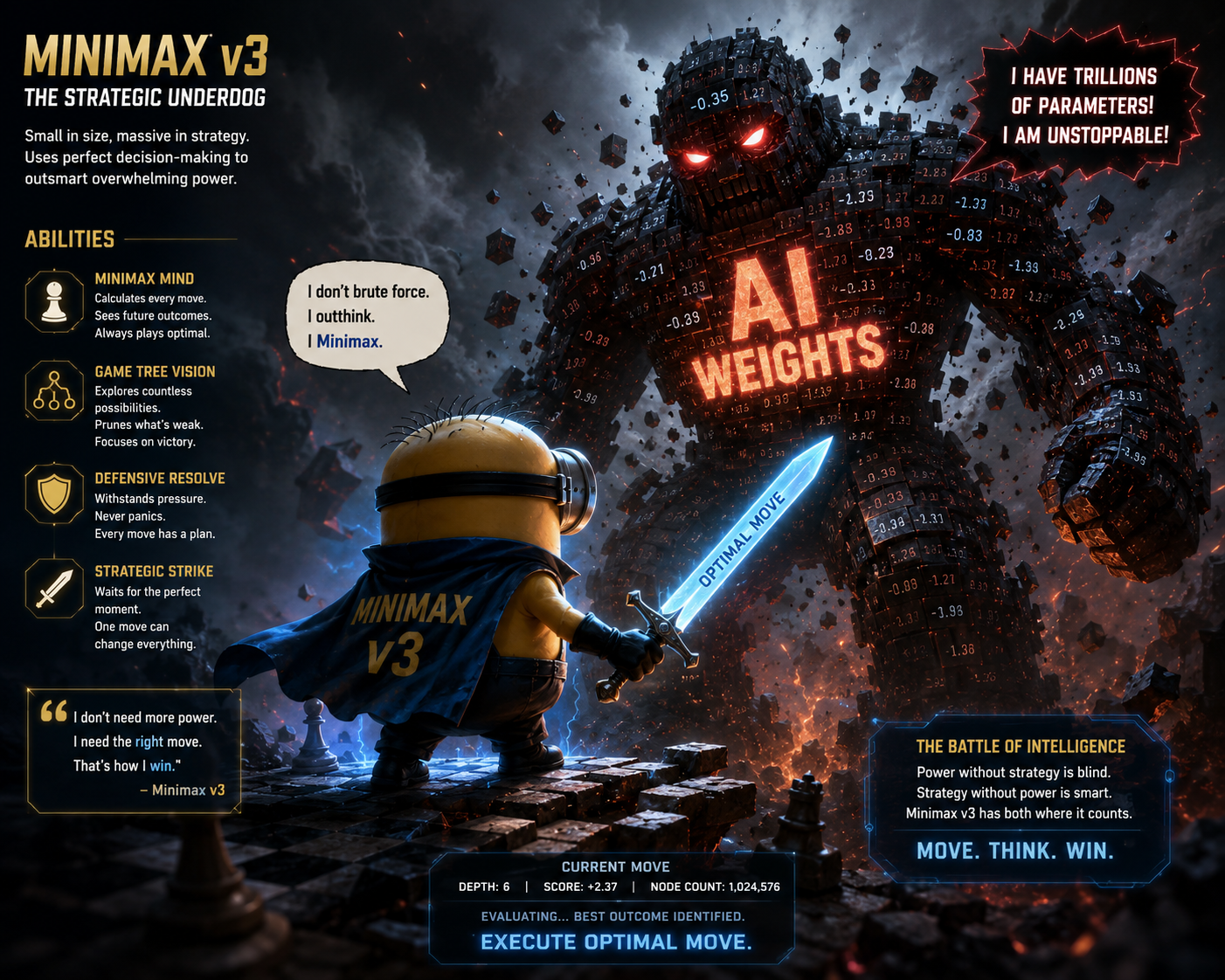
The generative AI landscape of 2026 is no longer a two-horse race between Google and OpenAI. We have officially entered an era characterized by rapid commoditization, aggressive token price-cutting, and a narrowing capability gap between proprietary behemoths and hyper-optimized open-weight alternatives. At the absolute center of this structural shift is a phenomenon industry insiders are calling the "revenge of the minis".
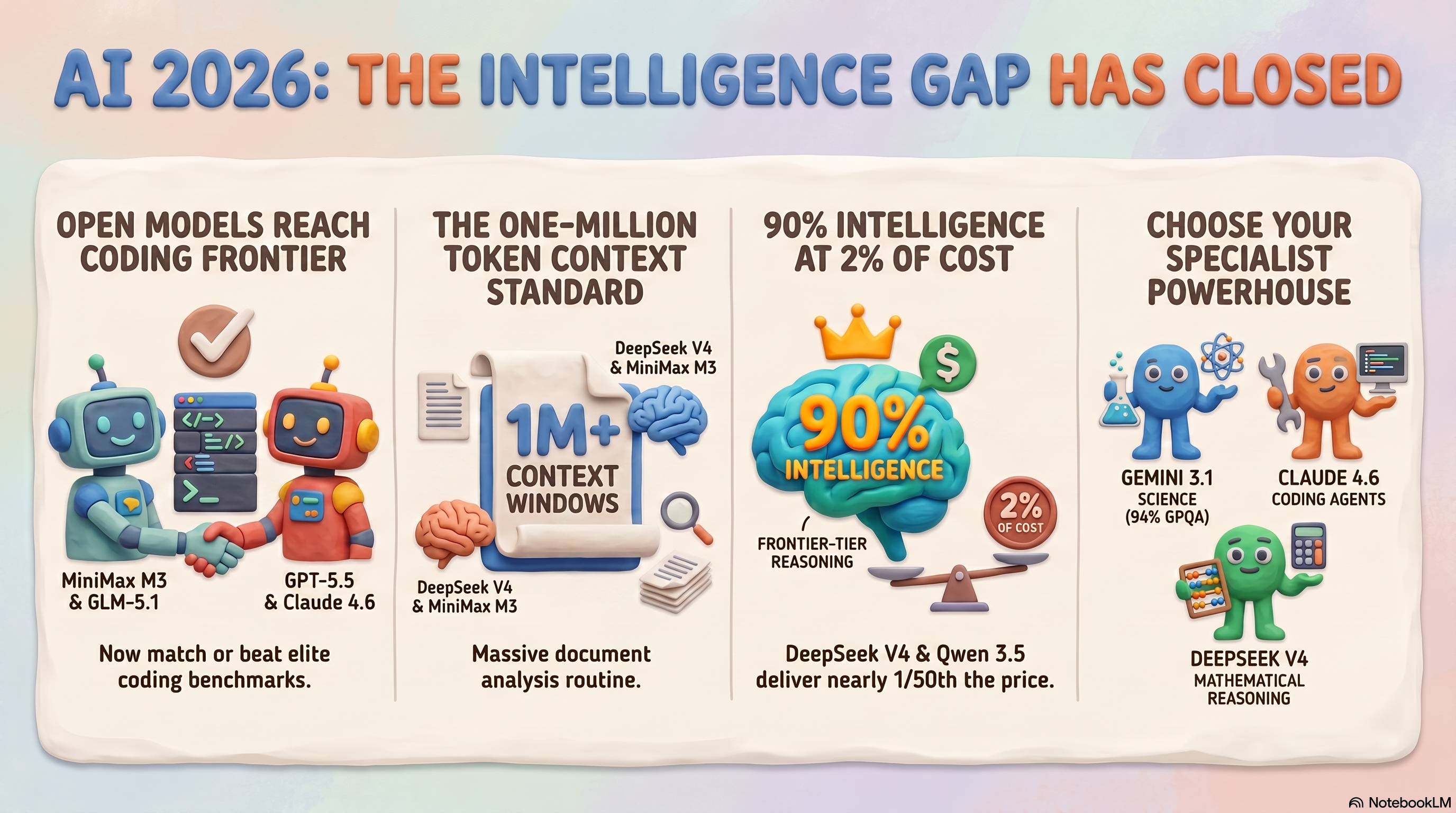
Shanghai-based AI unicorn MiniMax has just dropped its latest flagship model, MiniMax M3 (often referred to as V3 in developer circles). M3 is the first open-weight model to simultaneously combine frontier-level coding performance, a one-million-token context window, and native multimodality. Until now, this holy trinity of capabilities was strictly VIP access—reserved exclusively for closed-source titans like GPT-5 and Gemini.
So, let's deep dive into MiniMax. Is the M3/V3 release the maturity phase of this architecture? How does it stack up against infamous open-weight rivals like DeepSeek and GLM, and can it really bloody the nose of the big AI guys? Grab your coffee, because we are unpacking the architecture, the benchmarks, and the economics.
The Rocky Road to Maturity: From abab to M3
To understand if M3 is the "maturity phase," we have to look at the awkward teenage years of the MiniMax model family. The engineering team has been on a wild ride, navigating the core tension between processing efficiency, sequence scaling, and deep multi-step reasoning.
Phase 1: The Hybrid Experiment MiniMax entered the arena with the abab 6.5 series, a trillion-parameter Mixture-of-Experts (MoE) model that proved sparse routing could compete with early closed-source systems. They then pushed into linear attention with the MiniMax-01 series, adopting a hybrid architecture that placed one full Softmax attention layer after every seven Lightning Attention layers. While it looked great on static academic leaderboards, the compressed state representations of Lightning Attention caused semantic degradation during complex, multi-hop reasoning tasks. Turns out, you can't just squish data and expect the model to remain a genius.
Phase 2: The Full Attention Retreat Realizing hybrid architectures weren't quite ready for the big leagues, MiniMax pivoted back to classical full Multi-Head Attention (MHA) for its M2 series (M2, M2.1, M2.5, M2.7). The M2.5 model was a brute-force masterpiece, hitting 80.2% on SWE-bench Verified and matching top-tier proprietary systems. However, because full attention scales quadratically, scaling context windows beyond 200K tokens resulted in massive hardware prefill latencies and memory footprints that would make any cloud provider weep.
Phase 3: M3 and the Breakthrough of MSA Enter MiniMax M3, the definitive maturity phase. M3 resolves the tension between sparsity and reasoning by introducing MiniMax Sparse Attention (MSA). MSA partitions the Key-Value (KV) cache into fixed blocks and uses a lightweight Top-K router to isolate only high-relevance blocks. Rather than using a lossy compression method, MSA uses a "KV outer gather Q" approach—each block is read exactly once, keeping memory access contiguous.
The result? At a 1-million token context, M3's per-token compute is just 1/20th of the previous generation. It boasts a 9.7x prefill speedup and a 15.6x decoding boost. M3 proves MiniMax has graduated from architectural experimentation into pure, unadulterated engineering maturity.
Table 1: The Architectural Evolution of MiniMax
| Model Generation | Architecture Focus | Context Window | Key Milestone / Characteristic |
|---|---|---|---|
| abab 6.5 | Pure MoE | 200K | Early trillion-parameter sparse routing proof-of-concept. |
| MiniMax-01 | Hybrid (Lightning + Softmax) | 4M (Inference) | Highly efficient but suffered semantic loss in deep reasoning. |
| M2 Series | Full Multi-Head Attention | 200K | Uncompromising reasoning (M2.5 hit 80.2% SWE-Bench), but heavy compute. |
| M3 (V3) | MiniMax Sparse Attention (MSA) | 1M | The Maturity Phase: 1/20th compute cost at 1M context, frontier coding. |
Native Multimodality & Emotional Intelligence: Built In, Not Bolted On
Most models today are text-first systems wearing a vision adapter like a bad aftermarket spoiler. The semantic spaces of different modalities in those architectures interact through a translation layer, limiting natural reasoning.
M3, however, was trained on over 100 trillion tokens of natively interleaved text, image, and video data from "Step Zero". This deep alignment means M3 doesn't just "see" an image; it understands complex visual geometries like programming charts and UI maps, translating them directly into structural code. On OSWorld-Verified (controlling desktop GUIs), M3 scores a staggering 70.06%. You can literally ask it to open your local ERP client and batch-enter invoices from an Excel spreadsheet.
Furthermore, M3 isn't just a cold, calculating machine. Leveraging insights from the Flowith Blog, MiniMax-V3 is driving a new era of "conversational emotional intelligence". Integrated seamlessly with MiniMax Speech 2.8, the ecosystem supports ultra-realistic emotional voice generation across 40 languages. It understands sarcasm, de-escalates tense interactions, and maintains behavioral consistency across long character-driven roleplays. It is a model with both a high IQ and a high EQ.
Stop Looking at Benchmarks, Look at the Workflows
Yes, M3 scores 59.0% on SWE-Bench Pro, edging out GPT-5.5 (58.6%) and Gemini 3.1 Pro (54.2%). Yes, it hits 91.6% on OmniDocBench. But benchmarks are a leaky abstraction. Let's look at what M3 actually did in the wild.
1. The 24-Hour CUDA Kernel Optimization Writing a production-grade FP8 GEMM kernel on NVIDIA Hopper GPUs takes a human engineering team 1-2 weeks. MiniMax gave M3 a task description, a benchmark script, and a broken Triton skeleton. No reference code. M3 ran for 24 hours autonomously, made 1,959 tool calls, diagnosed bottlenecks, integrated CUDA graphs, and rewrote persistent kernels. It boosted hardware utilization from 7.6% to 71.3%—a 9.4x speedup. Most models gave up by submission 30; M3 kept grinding until submission 145.
2. The 12-Hour Autonomous Paper Reproduction M3 was fed the ICLR 2025 paper Learning Dynamics of LLM Finetuning and asked to reproduce it. It ran for 12 hours, generated 18 commits, and plotted 23 experimental figures, successfully matching the paper's complex deep learning curves. This required native vision to read the charts, 1M context to hold the logs, and elite agentic coding to execute.
The Battlefield: M3 vs. The Open-Weight Army
The open-source/open-weight ecosystem in 2026 is an absolute bloodbath. Let's see how M3 holds up against its peers.
Table 2: MiniMax M3 vs. Leading Open-Weight Models
| Model | Core Strength | Weakness | Comparison to M3 |
|---|---|---|---|
| DeepSeek V4 Pro | Pure execution efficiency & live coding (LiveCodeBench 93.5). | Lacks native image/video multimodality; strict API reasoning compliance issues. | M3 is vastly superior for multimodal agentic tasks and desktop automation, though DeepSeek is cheaper for pure text. |
| Zhipu GLM-5.1 | Long-horizon agentic workflow stability; massive 128K output. | Capped at a 200K input context window. | M3's 1M context crushes GLM-5.1 when ingesting entire multi-repo codebases. |
| Moonshot Kimi K2.6 | Swarm intelligence (up to 300 sub-agents coordinating). | Extremely verbose; burns excessive tokens causing latency issues. | M3’s MSA architecture makes long-context processing highly cost-effective and significantly faster. |
| Qwen 3.6-27B | Unmatched parameter efficiency; runs beautifully on consumer hardware. | Dense, smaller model lacks enterprise-scale context and advanced vision. | Qwen is perfect for local laptops; M3 is an enterprise-scale multimodal brain. |
Goliath's Headache: M3 vs. The Closed-Source Titans
The standard argument for years was that open-source models were a generation behind. In 2026, that argument is empirically dead.
Table 3: MiniMax M3 vs. Proprietary Giants
| Model | SWE-Bench Pro | Context Window | Notable Feature | Cost per 1M Input / Output | M3's Competitive Edge |
|---|---|---|---|---|---|
| Claude Opus 4.7/4.8 | 64.3% | 1M (Beta) | The reigning king of complex coding. | $15.00 / $75.00 | M3 costs roughly 15x-25x less. Opus is a luxury vehicle; M3 is a fleet of dependable sports cars. |
| GPT-5.5 | 58.6% | 272K - 1M | Tool Search & structured reasoning. | $2.50 / $15.00 (+ hidden reasoning token costs) | M3 beats GPT-5.5 on SWE-bench Pro (59.0% vs 58.6%) without hidden "reasoning token" upcharges. |
| Gemini 3.1 Pro | 54.2% | 1M (GA) | Abstract reasoning (ARC-AGI-2: 77.1%). | $2.00 / $12.00 | M3 is vastly superior for software engineering and tool orchestration, though Gemini wins on PhD-level science. |
The Economics: Why M3 Breaks the Market
Let's talk money, because finance departments are tired of paying Anthropic and OpenAI tax.
M3’s standard API rate is $0.60 per million input tokens and 2.40 per million output tokens.
However, MiniMax heavily subsidizes prompt caching.
Cached read operations cost just 0.06 per million tokens. In a high-concurrency developer workflow where you are repeatedly pinging a cached codebase, the blended cost drops to roughly $0.06 - $0.18 per million tokens.
If API billing isn't your speed, MiniMax offers an aggressive Token Plan. For $20/month (the same price as a ChatGPT Plus or Claude Pro subscription), you get an allocation of 1.7 billion tokens per month for M3. That is roughly 10x the throughput allowed by Western proprietary subscriptions.
For the paranoid enterprise (and rightly so), M3 is an open-weight model. You don't have to send your highly classified, proprietary source code to a Shanghai-based server. You can pull the weights from Hugging Face or use sovereignty-isolated APIs on US-based platforms like Ollama Cloud, which operate with zero data retention.
Conclusion: The Maturity Phase is Here
To answer the core query: Yes, MiniMax M3 (V3) represents the definitive maturity phase of the MiniMax lineage.
They survived the awkward hybrid linear attention experiments of MiniMax-01. They pushed through the brute-force, high-compute era of the full-attention M2 series. With M3, they have successfully solved the holy grail of transformer mechanics: scaling context to 1 Million tokens using MiniMax Sparse Attention (MSA) without losing the reasoning capability required for elite software engineering.
MiniMax M3 proves that the future of AI isn't just about throwing more H100s at a dense model. It's about architectural elegance, native multimodality from Step 0, and empowering developer choice through open weights. The proprietary giants are officially on notice. The minis have taken their revenge, and they are writing the code to prove it.
My pros and cons after a few days of usage:
Pros: quick, good at coding, easy integration with VS Code, agent mode effective and autonomous (not like continue.dev and deepseek asking always for approval),Minimax Code.
Cons: The minimax.io site is not so clear about the differences between Token Plans ,api keys usage and credit redeems.


💬 Comments (0)
🔒 Log in or register to comment on articles.
No comments yet. Be the first to comment!