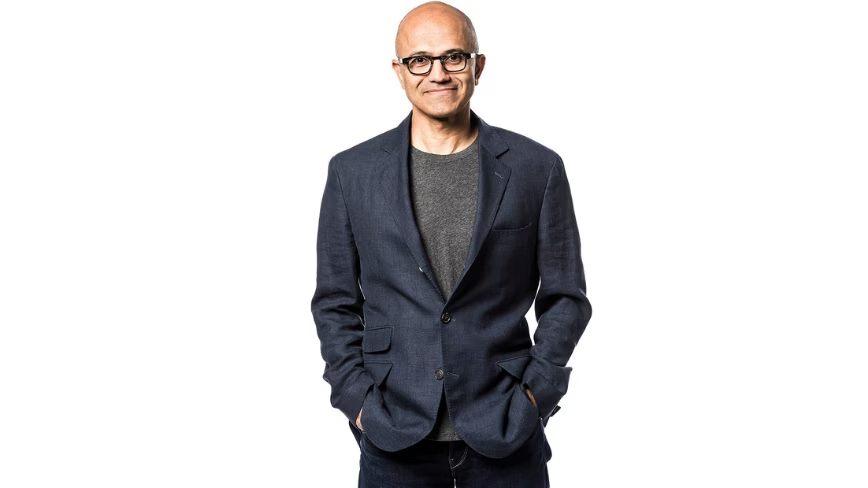
Nadella's Revelation and the Fear of an IBM-like Fate
The technology landscape has been shaken by recent court testimony from Satya Nadella, Microsoft's CEO, offering an unprecedented glimpse into the strategic motivations behind the company's massive investment in OpenAI. During a federal hearing, Nadella admitted he feared Microsoft could become the "next IBM," while OpenAI established itself as the new giant, mirroring Microsoft's own historical trajectory.
This statement, which emerged from an internal email from April 2022 presented by Elon Musk's lead attorney, reveals the profound strategic anxiety that drove what has been called the largest corporate investment in artificial intelligence history. The fear of missing the innovation wave and finding itself at a competitive disadvantage pushed Microsoft to make a bold move, repositioning the company at the center of the LLM revolution.
The Strategic Context of the OpenAI Investment
Microsoft's investment in OpenAI was not merely a commercial agreement but a calculated strategic move to secure a leadership position in a rapidly evolving sector. Nadella's vision reflects a keen awareness of the speed at which technological paradigms can shift and the need to act decisively to avoid being overtaken. In an era dominated by LLMs, the ability to integrate these foundational technologies into products and services has become crucial for maintaining market relevance.
This strategy highlights the increasing importance of partnerships and acquisitions in the AI sector, where the internal development of cutting-edge models requires immense resources and long timelines. Collaborating with a pioneer like OpenAI allowed Microsoft to accelerate its AI roadmap, integrating advanced capabilities into products like Azure and Microsoft 365, and to face emerging competition with greater agility. The stakes are the control of the next generation of computational platforms.
Implications for the Market and Deployment Choices
Strategic moves by giants like Microsoft have significant repercussions across the entire technology ecosystem. The deep integration of LLMs into cloud services prompts many companies to consider adopting cloud-based solutions for their AI workloads. However, for CTOs, DevOps leads, and infrastructure architects, the decision between a cloud and a self-hosted or on-premise deployment remains complex and full of trade-offs.
For those evaluating on-premise deployments, factors such as data sovereignty, regulatory compliance (e.g., GDPR), security in air-gapped environments, and the long-term Total Cost of Ownership (TCO) are often priorities. While large cloud platforms offer scalability and immediate access to advanced computational resources, self-hosted solutions can provide greater control over data and infrastructure, as well as potential operational cost savings for stable and predictable workloads. AI-RADAR offers analytical frameworks on /llm-onpremise to evaluate these trade-offs, providing tools for informed decisions.
Future Prospects and Technological Control
Nadella's revelation underscores the highly competitive nature of the artificial intelligence sector and the constant pressure on technology leaders to anticipate and shape the future. The race for LLM development and Deployment is far from over, with new architectures, Quantization techniques, and Inference optimizations continuously emerging. Companies must balance rapid innovation with the need to maintain control over their critical infrastructure and sensitive data.
The future will likely see further diversification of deployment strategies, with hybrid models combining the flexibility of the cloud with the security and control of on-premise. The ability to choose the solution best suited to specific needs, considering not only technical performance (such as VRAM or Throughput) but also business and regulatory constraints, will be a key factor for success in the AI era.






💬 Comments (0)
🔒 Log in or register to comment on articles.
No comments yet. Be the first to comment!