AI Beyond the "Brain": NXP's Metaphor at COMPUTEX
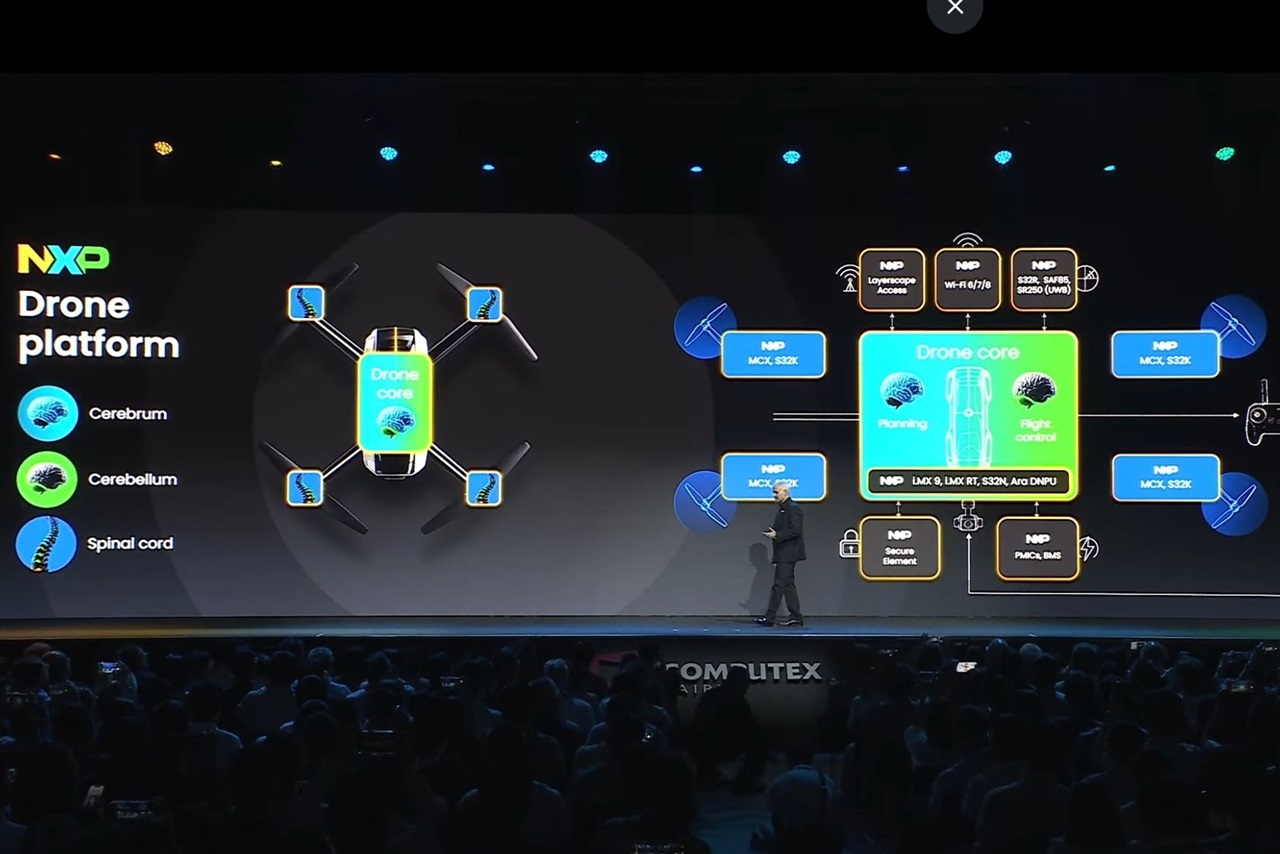
At the recent COMPUTEX in Taipei, NXP's CEO offered a thought-provoking perspective on the future of artificial intelligence, suggesting that physical AI must evolve to "think like a spine, not just a brain." This metaphor highlights a fundamental shift in how AI is conceived and implemented, moving the focus from centralized, purely cognitive processing to a more distributed, reactive system intrinsically linked to the physical environment. NXP's vision aligns with the growing need for AI systems that operate with low latency and high reliability directly in the field, where data is generated and actions must be taken.
Traditionally, much of AI development has focused on complex processing capabilities, emulating the cognitive functions of a "brain" through Large Language Models (LLM) and deep neural networks that require substantial computational resources, often hosted in the cloud. NXP's proposal, however, pushes towards an architecture that reflects the spine: a system that manages rapid reflexes, motor coordination, and immediate responses, distributing intelligence and processing to the network's edge. This approach is crucial for applications in sectors such as industrial automation, robotics, and autonomous vehicles, where every millisecond counts.
Edge AI and the Challenges of Distributed Processing
The idea of AI acting like a spine finds its fullest expression in the Edge AI paradigm. Here, data processing occurs as close as possible to the source, reducing latency and dependence on network connectivity to remote data centers. This demands specialized hardware, optimized for Inference with reduced power consumption and minimal footprint, capable of handling even complex AI models, perhaps after Quantization processes to adapt them to limited resources. Decisions must be made in real-time, based on continuous data streams from sensors, without the delay imposed by transferring data to the cloud and back.
The implications for DevOps teams and infrastructure architects are significant. Deploying AI solutions at the edge involves managing a distributed infrastructure, which can range from embedded devices to bare metal servers in remote locations. This scenario presents unique challenges in terms of provisioning, updating, and monitoring models and hardware. The choice of silicon, available VRAM, and supported Throughput become critical factors to ensure that AI can operate effectively in uncontrolled environments unlike those of a traditional data center.
Data Sovereignty and TCO: The Value of On-Premise
NXP's vision further reinforces the importance of on-premise and air-gapped Deployments for organizations handling sensitive data. Processing information locally, without sending it to external cloud services, ensures greater data sovereignty and facilitates compliance with stringent regulations like GDPR. This is particularly relevant for sectors such as finance, healthcare, or defense, where security and privacy are absolute priorities. Physical AI, operating autonomously at the edge, minimizes the risks associated with data transmission and storage in external locations.
From a Total Cost of Ownership (TCO) perspective, the initial investment in hardware for Edge AI and self-hosted Deployments might seem high. However, this initial expenditure (CapEx) can be amortized over time, reducing the operational costs (OpEx) associated with continuous use of cloud resources, which are often consumption-based. For those evaluating on-premise Deployments, AI-RADAR offers analytical Frameworks on /llm-onpremise to assess the trade-offs between hardware acquisition costs, energy consumption, maintenance, and the benefits in terms of latency, security, and control. The ability to manage the entire AI Pipeline locally offers unprecedented control over infrastructure and data.
Future Prospects and the Evolution of Distributed AI
The direction indicated by NXP suggests a future where AI will no longer be confined to a few centralized "brains," but will be pervasive and distributed, integrated into the very fabric of the physical world. This evolution will require not only advancements in hardware and silicon but also in the development of robust and flexible software Frameworks capable of orchestrating and managing AI models across a multitude of heterogeneous devices. The challenge will be to balance the complexity of these distributed systems with the need for simplicity in Deployment and maintenance.
For businesses, understanding this transition is crucial for planning their AI strategies. The choice between a cloud-first approach and an infrastructure more oriented towards the edge or on-premise will depend on critical factors such as latency requirements, data sovereignty regulations, budget, and internal capacity to manage complex infrastructures. NXP's vision highlights that the effectiveness of AI in the real world will increasingly depend on its ability to act with the speed and adaptability of a spine, rather than solely with the computational power of an isolated brain.









💬 Comments (0)
🔒 Log in or register to comment on articles.
No comments yet. Be the first to comment!