Origins of life: an asteroid reveals its secrets
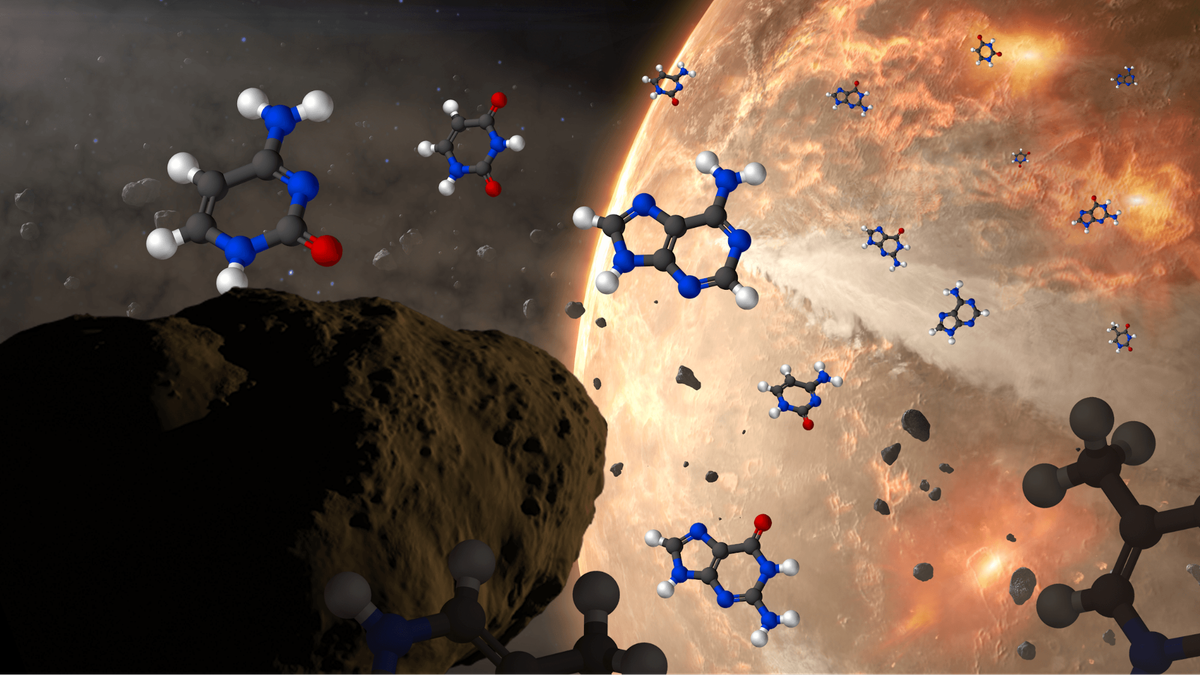
A team of researchers has identified all five nucleobases (adenine, guanine, cytosine, thymine, and uracil), the fundamental building blocks of DNA and RNA, in samples taken from the asteroid Ryugu by the Japanese probe Hayabusa-2. The discovery, published in Nature Astronomy, reinforces the hypothesis that the building blocks of life are widely distributed in the solar system and may have reached the primordial Earth through asteroid impacts.
Ryugu and Bennu: two asteroids, one answer?
This discovery echoes the results obtained by NASA's OSIRIS-REx mission, which analyzed samples from the asteroid Bennu, also belonging to the family of C-type carbonaceous asteroids. Both asteroids contain the five nucleobases, although in different proportions, suggesting varying formation processes.
Implications for abiogenesis
The presence of these organic molecules in asteroids supports the "RNA world" model, in which RNA, a self-replicating molecule, would have played a crucial role in the early stages of life on Earth. The Ryugu and Bennu samples suggest that at least some of the nucleobases that made up these early lifeforms may have an extraterrestrial origin.
Future perspectives
Further studies on different types of meteorites and laboratory experiments simulating the conditions of the early solar system could help to better understand how these molecules formed in space and to assess whether life is a rare event or a common process in the universe. Sample return missions such as Hayabusa-2 and OSIRIS-REx provide valuable data to answer these fundamental questions.








💬 Comments (0)
🔒 Log in or register to comment on articles.
No comments yet. Be the first to comment!