
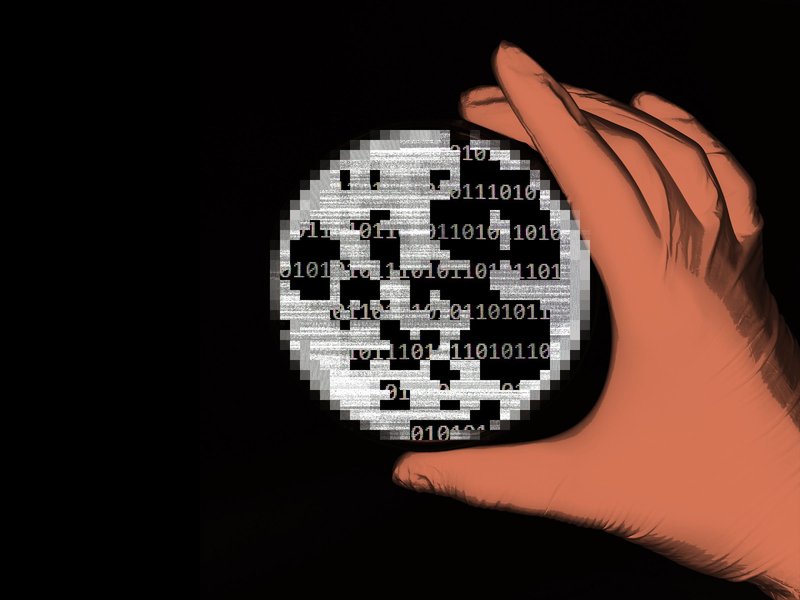
Dogs, stars, and the Mona Lisa aren’t just drawings, but DNA nanostructures precisely folded by artificial intelligence. A team from Seoul National University and Hanyang University has developed Generative SNUPI, a generative model that turns a contour into a sequence of nitrogenous bases capable of self-assembling into the desired shape. The work, accepted in Nature Communications, promises to unlock two decades of DNA origami research, so far held back by the complexity of manual design.
At the heart of the innovation is a diffusion model, the same approach behind image generators like DALL-E. Generative SNUPI doesn’t just trace an outline: it learns the chemical rules of adenine-thymine and cytosine-guanine pairing to calculate how DNA strands — staples and scaffold — must be sequenced so that molecular forces do the rest. The result is a design ready for chemical synthesis, without algorithmic tweaking by an expert.
“Traditionally we need expertise, background knowledge, and know-how to design the nanostructures we intend to make,” says Kyounghwa Jeon, a PhD candidate at SNU. With the new model, in theory, you go straight from drawing to physical assembly. The metaphor of children’s crafts is fitting: you sprinkle the shape with glue and glitter (the noise in the diffusion model), then shake off the excess and the structure appears. The AI knows how DNA comes together because it’s been trained on exactly that.
It doesn’t always work on the first try. Some shapes collapsed because the initial drawing was structurally unstable. The team added a predictive stage that assesses the integrity of the outline before computing the sequence. Do-Nyun Kim, a professor of mechanical engineering at SNU, admits the structures are still too rigid for many biomedical uses: “Most molecular structures are dynamic and reconfigure in response to external stimuli. We plan to extend the work to reconfigurable designs.”
The signal for AI infrastructure
For those tracking on-premise AI evolution, Generative SNUPI is a wake-up call. The model isn’t a Large Language Model, but it raises the same question: where do you run computational science that touches sensitive data? Designing DNA origami to deliver a drug means manipulating sequences that might be patented or tied to an individual genomic profile. Running the model in the cloud means exposing that data. An on-premise deployment, on enterprise GPUs or in a lab, becomes the only path for those who want to keep control without sacrificing iteration speed.
From a hardware perspective, a DNA diffusion model isn’t a hundred-billion-parameter transformer, but it must simulate the folding of thousands of nucleotides. VRAM and compute power aren’t negligible, and demand will grow when AI-assisted molecular design moves from academic papers into pharmaceutical pipelines. Those setting up servers for LLM inference today might tomorrow find themselves computing nanostructures, and GPU vendors will discover a new scientific user segment to court.
The spread of generative models into the hard sciences isn’t a fad. It signals that AI is becoming a manufacturing tool, not just a text generator. And with this shift, deployment decisions — cloud vs on-premise — will no longer be a matter of convenience but a competitive factor.




💬 Comments (0)
🔒 Log in or register to comment on articles.
No comments yet. Be the first to comment!