Linux 7.1: A Deep Clean in the Kernel
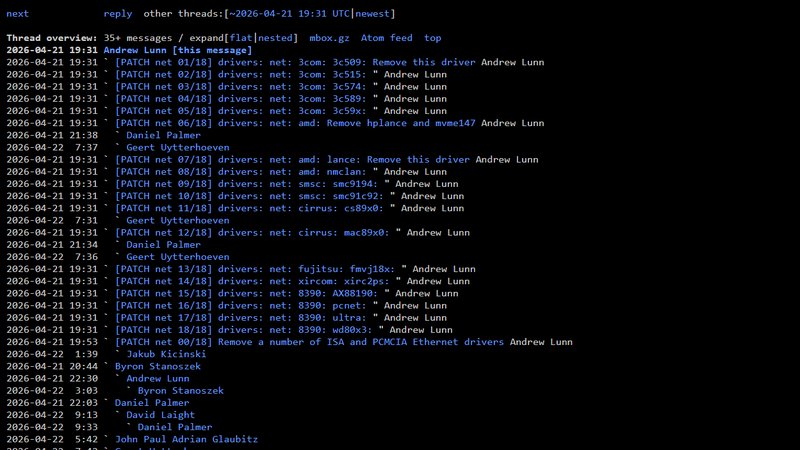
The release of the Linux 7.1 kernel marks a significant step in the operating system's evolution, bringing not only improvements and new features but also a decisive "cleanup" operation. As part of this strategy, the development team has decided to remove several drivers considered obsolete, which have likely not been actively used for years. This practice is common in the development of large-scale Open Source projects like Linux, aiming to reduce code complexity, improve maintainability, and focus resources on more current technologies.
Among the most notable removals are some drivers for PCMCIA host controllers, a technology that peaked in laptops from the late 90s and early 2000s. The elimination of these components reflects a pragmatic approach: maintaining support for hardware no longer in use incurs a cost in terms of development time, testing, and potential introduction of vulnerabilities.
Technical Details of the Removals
The Linux 7.1 kernel was not limited to just PCMCIA drivers. The cleanup also affected some network drivers, whose obsolescence was highlighted, in part, by AI-related bug reports. While the direct link between AI and obsolete network drivers may seem indirect, it underscores how even modern workloads can interact with legacy components, revealing their weaknesses or inefficiencies. For organizations managing self-hosted infrastructures, this aspect highlights the importance of constant hardware and software updates to support the latest computational needs.
Another significant elimination concerns various drivers for Russian-made Baikal CPUs. This decision, although not explicitly motivated by the source, fits into a broader context of reviewing and optimizing hardware support within the kernel. For system architects and CTOs planning on-premise deployments, the stability and longevity of driver support are critical factors in hardware selection, directly impacting TCO and infrastructure resilience.
Implications for On-Premise Infrastructure
The driver removal decisions in the Linux 7.1 kernel have direct implications for those managing on-premise infrastructures. Reliance on legacy hardware, even if still functional, can become a significant burden. The lack of updated driver support can lead to security issues, system instability, or incompatibility with new Frameworks and applications, including those for Large Language Models (LLM) workloads or other AI applications.
For companies investing in self-hosted deployments, hardware lifecycle management becomes a key strategic element. Maintaining an updated infrastructure is not just a matter of performance, but also of security and compliance. The need to ensure data sovereignty and operate in air-gapped environments often pushes towards on-premise solutions, but these require meticulous planning to prevent hardware from becoming a bottleneck or a security risk due to insufficient software support. AI-RADAR offers analytical frameworks on /llm-onpremise to evaluate the trade-offs between initial and operational costs, and hardware lifecycle management is a determining factor.
Future Prospects and Upgrade Strategies
The evolution of the Linux kernel is a continuous process that balances innovation with stability. Driver removals like those seen in 7.1 are a constant reminder for IT decision-makers: strategic infrastructure planning must include a careful evaluation of the longevity of software support for chosen hardware. This is particularly true in an era where computational demands, driven by AI and LLMs, are evolving rapidly.
For CTOs and DevOps leads, this means not only choosing the most performant hardware today but also hardware that will ensure robust and updated support over time. The transition from obsolete hardware to more modern and supported solutions is essential for maintaining operational efficiency, security, and the ability to innovate. The ability to perform LLM Inference efficiently, for example, depends not only on the VRAM of GPUs but also on the stability and optimization of the underlying operating system.





💬 Comments (0)
🔒 Log in or register to comment on articles.
No comments yet. Be the first to comment!