Running Massive LLMs Locally: A New Perspective
Deploying Large Language Models (LLMs) with billions or even trillions of parameters presents a significant challenge for companies aiming to maintain control over their data and infrastructure. Traditionally, models of this scale demand extensive computational and memory resources, often exclusively available through cloud services. However, a recent experiment showcased an alternative approach, successfully running a one-trillion-parameter LLM on a system equipped with a single GPU, thanks to the strategic use of Intel Optane DIMM memory.
This demonstration offers crucial insights for CTOs, DevOps leads, and infrastructure architects evaluating self-hosted solutions. The ability to manage such complex models in a local environment opens new possibilities for scenarios requiring data sovereignty, regulatory compliance, and granular control over the entire inference pipeline.
Technical Details: Optane and Performance
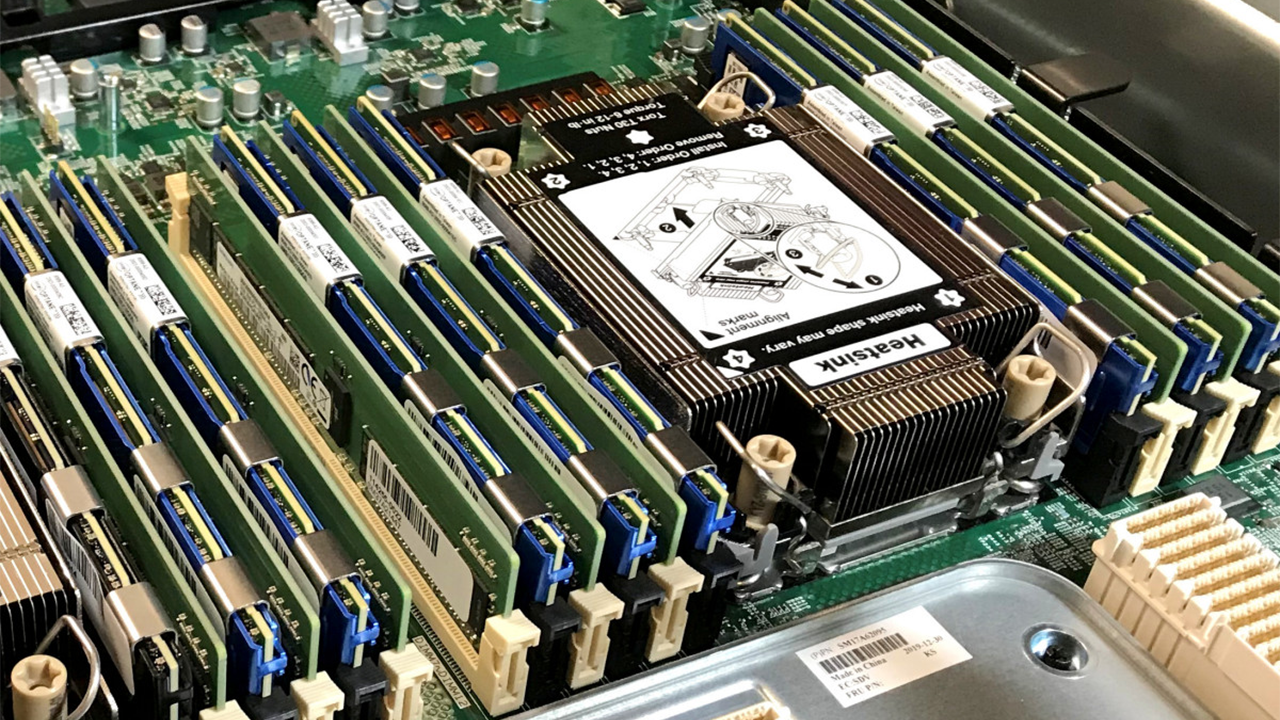
The core of this configuration lies in the utilization of 768GB of Intel Optane DIMM memory modules. These modules, known for their cost-effectiveness compared to GPU VRAM and their high capacity, were instrumental in hosting the parameters of the one-trillion-parameter model. This architecture allowed overcoming the typical memory limitations of a single GPU, which often lacks sufficient capacity to load models of this size entirely.
The local installation, based on Kimi K2.5, recorded a performance of approximately 4 tokens per second. While this speed might not be suitable for all real-time applications demanding high throughput, it represents an interesting compromise for workloads where latency is not the primary critical factor, but the ability to process extremely large models and control over the execution environment are. This setup highlights how innovation in memory utilization can unlock new possibilities for LLM deployment.
Implications for On-Premise Deployment
The experiment with Intel Optane and Kimi K2.5 underscores the importance of exploring alternative hardware solutions for on-premise LLM deployment. For organizations operating in regulated sectors or handling sensitive data, the ability to keep models and data within their own perimeter is a non-negotiable requirement. This approach offers a concrete alternative to cloud services, where data sovereignty and TCO can become significant concerns.
The choice of hardware like Intel Optane, which provides a good capacity-to-cost ratio per GB compared to VRAM, can drastically impact the Total Cost of Ownership of an AI infrastructure. While high-end GPUs offer superior performance, their cost and limited VRAM per unit can make deploying gigantic models prohibitive. This scenario demonstrates that it is possible to balance performance needs with capacity and cost, paving the way for hybrid or fully self-hosted configurations previously considered impractical for LLMs of this scale.
Future Prospects and Trade-offs
Adopting solutions like the one based on Intel Optane for on-premise LLM deployment is not without trade-offs. The performance of 4 tokens per second, while remarkable for a one-trillion-parameter model on a single GPU, might not meet the demands of applications requiring near-instantaneous responses. However, for batch workloads, offline analysis, or scenarios where latency can be tolerated in exchange for greater control and potentially lower costs, this configuration proves extremely valuable.
The industry continues to evolve, with new Quantization techniques and model optimizations promising to further reduce memory and computational requirements. Experiments like this demonstrate that innovation is not limited to the most powerful GPUs but also extends to optimizing the entire system architecture. For those evaluating on-premise deployments, AI-RADAR offers analytical frameworks on /llm-onpremise to assess the trade-offs between performance, TCO, and data sovereignty, helping to make informed decisions in a rapidly evolving technological landscape.








💬 Comments (0)
🔒 Log in or register to comment on articles.
No comments yet. Be the first to comment!