The experiment that overturns benchmark hierarchies
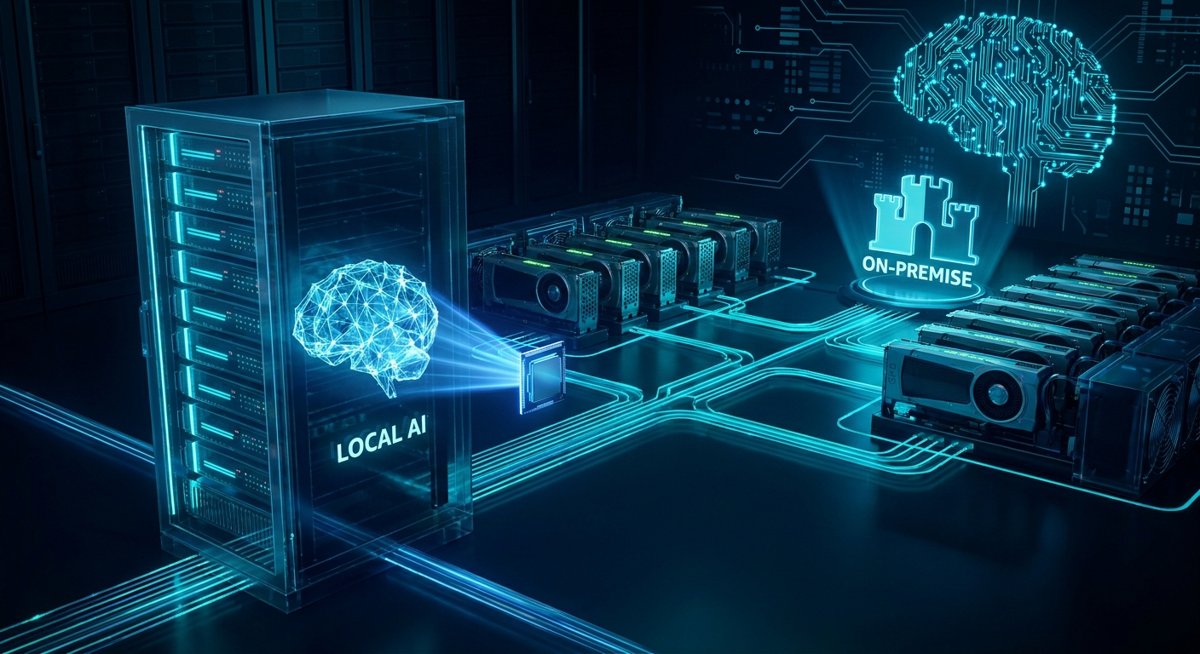
The scene is on-premise inference, where a head-to-head comparison between Qwen 3.6 (35 billion parameters, version 3a3B) and Gemma 4 with 26 billion parameters and QAT has produced a counterintuitive verdict: the smaller model, trained with quantization-aware training, appeared more intelligent in real dialogue. It is not a matter of absolute numbers – synthetic benchmarks still favor Qwen – but of behavior under compression. Both models were quantized to 4 bits, a typical condition for running on consumer GPUs or edge servers. Yet the difference emerged in instruction following, narrative coherence, and hallucination rate. The message is disruptive: when evaluating an LLM for local deployment, the classic dashboard is blind to quantization resilience.
The finding is all the more relevant in a context of growing adoption of self-hosted models, driven by privacy, control, and TCO constraints. Those who choose not to offload inference to cloud services look with interest at models like Qwen and Gemma, but risk trusting metrics that fail to capture the degradation introduced by compression. The experiment, though conducted on two specific models, shines a light on a broader dynamic: the perceived value of an LLM, when subjected to aggressive quantization, can diverge radically from academic rankings.
The hidden gap of quantization
Quantization is the process of reducing the numerical precision of model weights, for instance from 16 to 4 bits. The goal is to cut VRAM consumption and latency, enabling inference on hardware with limited resources. However, compression is not painless: it introduces noise, can degrade internal representations, and amplify prediction errors. Without specific training, the model loses fidelity to instructions, generation becomes less coherent, and hallucinations multiply.
This is where QAT (Quantization-Aware Training) comes in: a technique that simulates the effects of quantization already during fine-tuning or original training. In practice, the model learns to live with the constraints of low-precision representation, adapting weights to minimize quality loss. Gemma 4 leverages this philosophy, while Qwen 3.6, at least in the compared version, lacks it. The result is that the model with QAT retains much higher coherence when dropped to 4 bits, while the other, despite starting from a higher theoretical score, shows a performance collapse that classic benchmarks fail to intercept. It is not an implementation detail: it decides whether a model is usable in on-premise production.
QAT: from technical detail to strategic selection criterion
Quantization-aware training is often treated as a niche for insiders, but its absence or presence redefines incentives for those adopting LLMs locally. If a model excels in 16-bit benchmarks but collapses when compressed, then those metrics are useless for real deployment. Conversely, a model with QAT can deliver surprisingly high performance even with fewer parameters. This is the phenomenon observed with Gemma 4, which with only 26 billion parameters rivals larger models once quantized.
This shifts the balance from sheer size to robustness under compression. For an organization managing its own infrastructure, it means being able to choose smaller but well-trained models, with a direct impact on hardware spending and maintainability. Moreover, QAT becomes a signal of vendor maturity: it indicates that the model is designed for real-world scenarios, not just for scientific publication. The lesson is clear: in on-premise evaluation grids, QAT must weigh at least as much as parameter count or MMLU score.
Hardware and TCO: the ripple effect of QAT
The capability of QAT-quantized models has a concrete fallout on hardware. A 26-billion-parameter LLM that retains quality at 4 bits requires far less VRAM than an equivalent model without QAT, or a larger but degraded model. This allows inference on lower-tier GPUs – for example cards with 12 or 16 GB instead of the 24 or 48 GB that would be needed without effective compression. Acquisition cost drops, as do power consumption and heat dissipation, all factors that compress TCO.
There is more. With less VRAM occupied, headroom opens up for stacking multiple models, running complex pipelines on the same node, or increasing context length without saturating memory. Operators of on-premise servers can thus consolidate workloads, reduce machine count, and simplify architecture. All this strengthens data sovereignty: staying within corporate perimeters becomes cheaper and more technically feasible, without the need to rely on external cloud services.
When humans correct machines: the role of perceptual metrics
Another crucial piece of the experiment is perceptual validation. Automatic rankings often fail to reflect human experience. Arena.ai, which collects blind comparisons between models, gives Gemma 4 26B just 7 ELO points less than Qwen 3.6 Plus, a larger proprietary model. It’s a minimal gap, confirming that perceived quality can correct synthetic rankings. This is especially true when quantization alters behavior in ways that automatic benchmarks cannot capture, such as dialogue naturalness or long-term coherence.
For those doing serious deployment, this evidence suggests integrating hybrid evaluation grids, pairing automated tests with human validation sessions, especially after compression. In this picture, QAT is not only a technical enabler but also a multiplier of perceived quality. It also signals a possible paradigm shift: future leaderboards will need to report scores at quantization levels, not just the full-precision result.
What to watch: signals for the coming months
The Gemma vs Qwen episode prefigures a series of developments to monitor. First, QAT adoption will become an increasingly declared competitive element. Model providers will begin publishing quantization resilience numbers, and dedicated benchmarks will arise measuring model stability at 4, 3, or even 2 bits. Second, we will see a proliferation of “QAT-ready” models designed for edge deployment, capable of bridging the gap with cloud-only giants.
On the hardware front, consumer GPUs and inference-dedicated chips will be optimized to better exploit QAT-quantized models, with libraries like llama.cpp and frameworks implementing specific kernels for even more efficient compression. Finally, data sovereignty will receive an extra push: as TCO lowers, more companies and public entities will be able to afford keeping inference in-house, aligning with data protection regulations. The signal is clear: QAT is moving the line of what is possible with on-premise LLMs, and those who ignore it risk building their strategy on shifting sands.


💬 Comments (0)
🔒 Log in or register to comment on articles.
No comments yet. Be the first to comment!