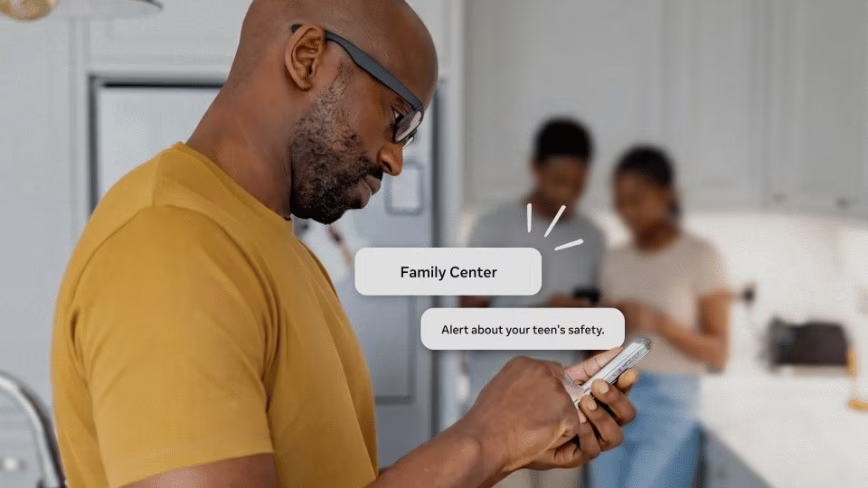
Meta will start notifying parents when a teenager discusses suicide or self-harm with its Meta AI chatbot. The feature, already live in the US, UK, Australia, and Canada, leverages Instagram’s existing supervision tools. The company outlined the change in a blog post, framing it as a way to give parents a timely warning. But the move lands amid mounting public and regulatory pressure on platforms to protect minors.
Beneath the announcement lies a deeper question: how much can a teenager trust an AI when facing a psychological crisis, and what happens when that same AI becomes a guardian that reports back to adults? Chatbots often promise a safe, judgment-free space to talk about difficult emotions. Meta AI, embedded in Instagram and WhatsApp, is an always-available companion for many young people. The introduction of parental alerts fundamentally alters that relationship.
On one hand, the initiative responds to legitimate demands for better safeguards. Regulators, especially in Europe with the Digital Services Act and in the UK with the Online Safety Bill, are imposing strict child-protection obligations on platforms. Meta itself has faced investigations and lawsuits over the mental health impact of its products on teens. Alerting parents seems like a commonsense step to prevent tragedies.
But the limits are clear. Effectiveness hinges on the language model’s ability to correctly identify self-harm intent. Current LLMs, however advanced, are not clinical instruments: they can miss nuances, downplay warning signs, or trigger false alarms. And a notification alone doesn’t ensure adequate help; a parent might miss the alert or not know how to respond.
Then there’s the risk that teens, aware of the surveillance, will avoid discussing sensitive topics with the AI altogether, drifting to less controlled spaces — anonymous Discord servers, unmoderated forums — where support is minimal or harmful. The paradoxical effect could be to push adolescents away from a technology that, if well designed, might offer an early line of defense.
Structurally, Meta’s decision signals a broader industry trajectory: consumer AI models will need to incorporate ever more invasive safety filters, influencing design and deployment choices. For those developing or adopting self-hosted LLM solutions — in healthcare, education, or enterprise — the lesson is twofold. First, the need to integrate crisis-detection mechanisms similar to Meta’s, but with the flexibility to customize them and keep data under local control. Second, the trade-off between automation and human intervention: in critical settings, qualified professional supervision remains irreplaceable.
Ultimately, Meta’s alert is a patch on a system that runs faster than its ability to protect the most vulnerable. Without a substantial improvement in LLMs’ capacity to understand and manage psychological distress — and without a support ecosystem that goes beyond the simple notification — the risk is that technological innovation offers only an illusion of control.





💬 Comments (0)
🔒 Log in or register to comment on articles.
No comments yet. Be the first to comment!