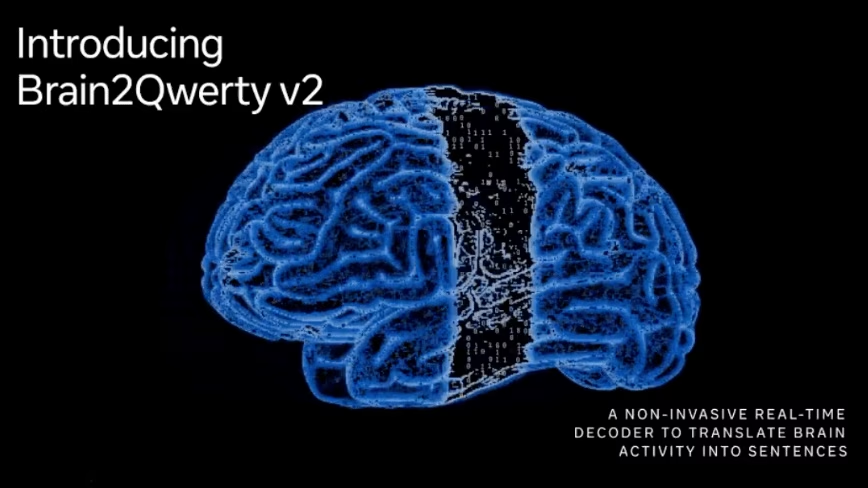
You don’t need an electrode implanted in your skull to translate brain activity into text. Meta has unveiled the second version of Brain2Qwerty, a system that observes brain signals while a person types on a keyboard and converts them into written sentences. Announced on Monday, the news marks a genuine step toward a non-invasive neural interface. Yet the progress comes with a paradox that’s impossible to overlook: the algorithm learns from voluntary typing, but the potential beneficiaries – patients with locked-in syndrome or severe motor disabilities – lack precisely that ability.
How the brain-to-text bridge works
The technical core of the project is a model that decodes brain activity recorded with non-invasive techniques such as magnetoencephalography (MEG) or electroencephalography (EEG). While a volunteer presses keys, the system captures neural activation sequences and learns to associate them with typed characters. With the second release, Meta’s researchers improved decoding accuracy, managing to generate full sentences from raw signals.
Compared to the first version, the architecture has evolved, but hardware details remain confined to the lab: no GPU specifications, tokens-per-second, or latency figures were disclosed. Scientific transparency is broad on methodology, while the computational aspects stay under wraps – a detail that weighs heavily for anyone tracking on-premise deployment of Large Language Models. In an inference-as-a-service world, such scenarios would inevitably land on the cloud, but the nature of neural data suggests very different choices.
The Achilles’ heel: learning from those who can write
The critical issue is conceptual, not technical. Training the model requires the user to be able to type: without typing examples, the system cannot associate any brain signal with a letter. Patients who are completely paralyzed, and who would most benefit from a direct communication channel, remain outside the loop today. This is no minor flaw; it’s the barrier separating scientific demonstration from clinical application.
Meta has not announced immediate plans for clinical trials. For now, Brain2Qwerty remains a proof of concept for healthy subjects – a laboratory tool to better understand the neural representation of written language. Still, the approach already holds value: it shows that superficial brain signals, when interpreted by sufficiently complex models, contain exploitable linguistic information.
Why data sovereignty will be decisive
Should such technologies ever leave the lab, deployment would become a central concern. Recording and processing brain activity – an enormously sensitive biometric data type – in a public cloud infrastructure would raise issues of compliance, control, and abuse risk. For a company or a healthcare institution, the only viable strategy would be an on-premise or dedicated edge architecture, where signals never leave the device and inference runs locally.
Here the connection to the current infrastructure AI debate is direct: while large language models push toward the cloud, the most intimate data demand precisely the opposite. A system like Brain2Qwerty, to become a regulated medical tool, would need isolated inference pipelines, end-to-end encryption, and acceptable latency – conditions that align with self-hosted stacks and dedicated accelerators. In this sense, Meta’s research acts as a litmus test for the limits of centralization.
Beyond the paradox
The road to a truly inclusive, non-invasive brain-computer interface is still long. Future steps will likely require unsupervised training paradigms or those based on implicit feedback, capable of learning without needing voluntary movement. Moreover, improving sensor spatial resolution and integrating neurostimulation techniques could amplify signal quality.
For those evaluating AI deployment scenarios for highly regulated data today, the Brain2Qwerty case is a reminder: the research frontier often anticipates the problems the market will have to face. And when the data to process originates from the human brain, the argument for on-premise becomes not merely economic, but ethical and legal. AI-RADAR will follow developments, aware that tomorrow’s architectural decisions hinge on the insights – and the paradoxes – of today’s prototypes.






💬 Comments (0)
🔒 Log in or register to comment on articles.
No comments yet. Be the first to comment!