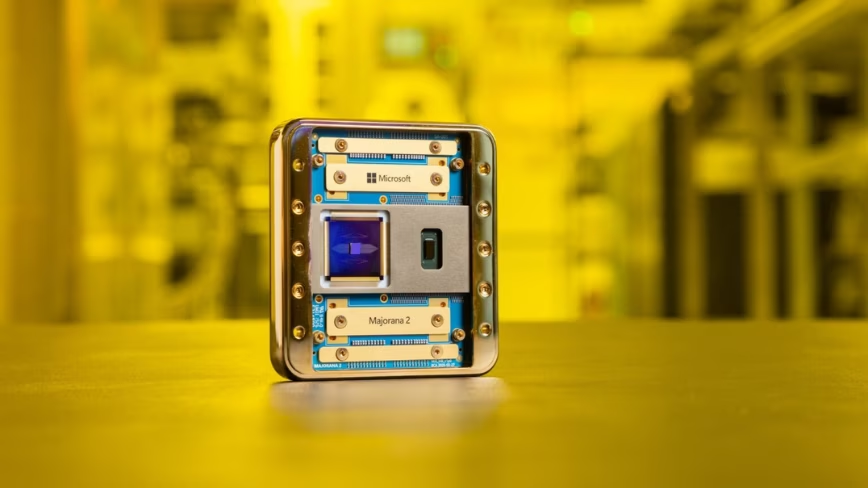
Microsoft Accelerates Quantum Timeline: Majorana 2 Promises 1,000x Reliability
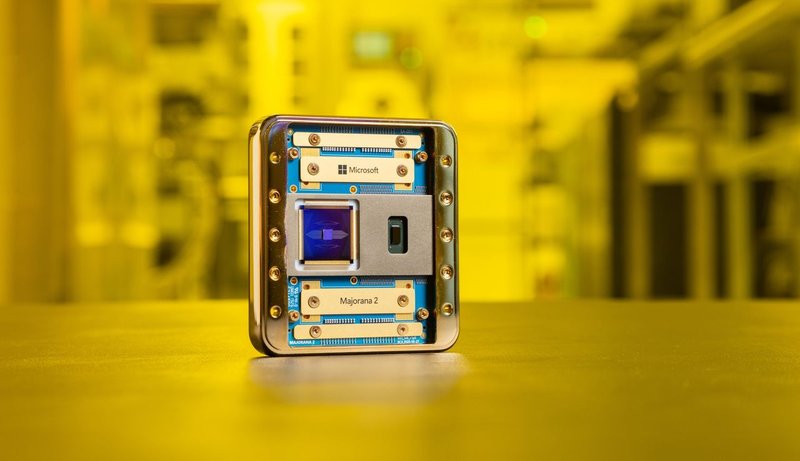
Microsoft has unveiled Majorana 2, a next-generation topological quantum chip that marks a significant advancement in the field of quantum computing. The company announced that Majorana 2's qubits are an impressive 1,000 times more reliable than those in the first Majorana chip, which was introduced last year. This substantial leap in reliability has prompted Microsoft to drastically revise its roadmap.
The goal of achieving a scalable quantum computer has been brought forward from 2033 to 2029, effectively halving the original timeline. This remarkable acceleration is attributed by the company to the use of agentic AI in the chip's development and optimization process. This innovative approach highlights how artificial intelligence is becoming a crucial tool even for the design and improvement of advanced computational hardware.
The Reliability Challenge and the Role of Agentic AI
The stability and reliability of qubits represent one of the most formidable challenges in the development of quantum computers. Unlike classical bits, qubits are extremely sensitive to environmental interference, which can cause errors and decoherence, compromising the accuracy of calculations. Topological chips, such as Majorana 2, are designed to mitigate these issues by leveraging intrinsic properties of matter that make qubits more robust and less susceptible to errors.
The 1,000-fold improvement in Majorana 2's qubit reliability is a major technical achievement. Microsoft specified that this result was made possible through the use of agentic AI. While the source does not delve into specific implementation details, agentic AI refers to systems that can perceive their environment, make decisions, and act autonomously to achieve predefined goals. In this context, it is likely that AI was employed to optimize chip design, identify and correct defects, or to control qubit operating conditions with greater precision, thereby accelerating the research and development cycle.
Implications for the Roadmap and the Future of Computing
Microsoft's accelerated roadmap for a scalable quantum computer, from 2033 to 2029, has a significant impact on the entire industry. A scalable quantum computer is a system capable of maintaining qubit coherence and performing complex calculations on a sufficient number of qubits to solve problems intractable for classical supercomputers. Achieving this milestone earlier than anticipated could open new frontiers in fields such as drug discovery, materials science, cryptography, and optimization.
For businesses and organizations evaluating the future of computational infrastructure, these advancements underscore the importance of monitoring the evolution of quantum computing. Although on-premise deployments of quantum systems are still distant for most entities, research and development in this field indirectly influence long-term strategies for AI and Large Language Models. The need for ever-increasing computing power and innovative solutions for data management and security remains a constant, both for classical and emerging architectures.
Future Prospects and Remaining Challenges
Despite the progress with Majorana 2, the path towards a universal and commercially available quantum computer is still long and fraught with challenges. Qubit reliability is just one obstacle; issues related to scalability, quantum error correction, and the creation of efficient algorithms that can fully exploit the potential of these machines still need to be resolved.
With this announcement, Microsoft reaffirms its position as a key player in the quantum race, demonstrating how hardware innovation, supported by advanced methodologies like agentic AI, can unlock otherwise difficult-to-achieve progress. For tech decision-makers, it is crucial to understand that the evolution of these frontier technologies, while not immediately applicable to current workloads, shapes the computational landscape of the next decade, influencing strategic choices in terms of research, development, and potential adoption.





💬 Comments (0)
🔒 Log in or register to comment on articles.
No comments yet. Be the first to comment!