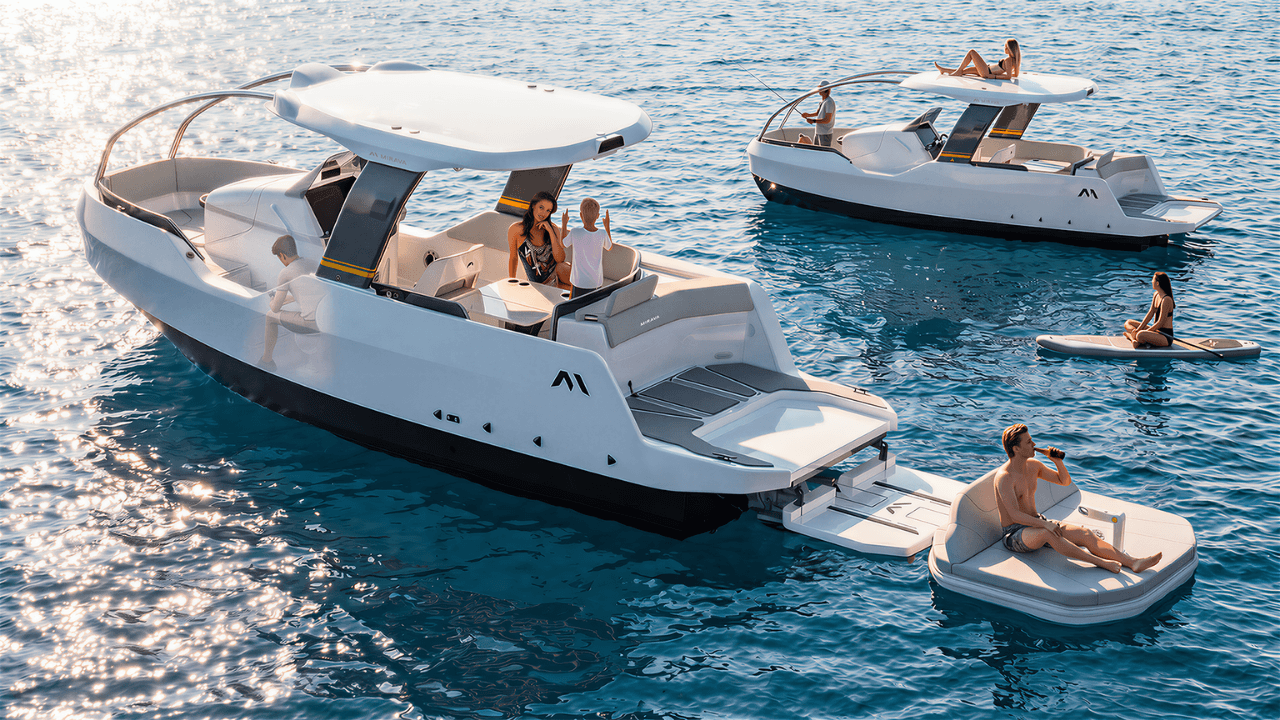
MIRAVA has closed a $5 million angel round and is preparing to move from development to small-batch production. After three years of R&D, the company plans to show its first production model at the Cannes Yachting Festival in September 2026 and then at boot Düsseldorf in January 2027. That roadmap signals something more than fresh capital: recreational boating is experimenting with a shift from assisted machine to software-defined platform.
MIRAVA's pitch centers on autonomous docking, autonomous departure and arrival, station keeping, and intelligent following. A companion wearable handles user recognition and presence detection, with the goal of communicating intent rather than managing controls. The modular rear section can be reconfigured as an expanded platform or tender-style function, allowing one hull to cover cruising, relaxing, hosting guests, and watersports. The argument is not more technology but less operational friction.
The real constraint is on-board inference
The less discussed part is deployment. At sea, connectivity is not guaranteed and latency is not optional: an autonomous docking system must react to wind, current, and obstacles without depending on a remote data center. That shifts the center of gravity toward local processing on embedded platforms built to handle saltwater, vibration, and thermal swings. The source does not disclose the computing architecture, but the application leaves little room for cloud-only solutions: the last mile of control must remain on board.
For anyone evaluating on-premise or edge deployments, marine autonomy is a useful edge case: it is not an alternative to the cloud but a domain where the cloud is often absent by definition. AI-RADAR publishes an analytical framework at /llm-onpremise for assessing these trade-offs; here the value is not measured in tokens per second but in the predictability and resilience of the local system.
Who wins and who loses if the hull becomes a platform
The most concrete figure from the source is operational data: more than 500,000 nautical miles accumulated and intelligent driving systems deployed across more than 1,500 boats. That is not a performance number; it is a repository of real-world scenarios that becomes the real competitive asset. If MIRAVA can turn that data into more reliable models, the differentiator will be software and sensors, not the hull.
That shifts incentives. Traditional builders, used to designing hulls for a single purpose, risk defending a value model based on selling a specialized machine. Suppliers of local processing components and marine sensing, by contrast, enter a market where software becomes recurring and data accumulates. The small-batch European entry is a cautious test: it does not validate technology in the lab but whether buyers will pay for assistance that stays out of the way.
The final point is not how much autonomy has been added. It is whether a boat, by removing complexity, can give people back time on the water.






💬 Comments (0)
🔒 Log in or register to comment on articles.
No comments yet. Be the first to comment!