The Legal Dispute Between Musk and Altman Over OpenAI
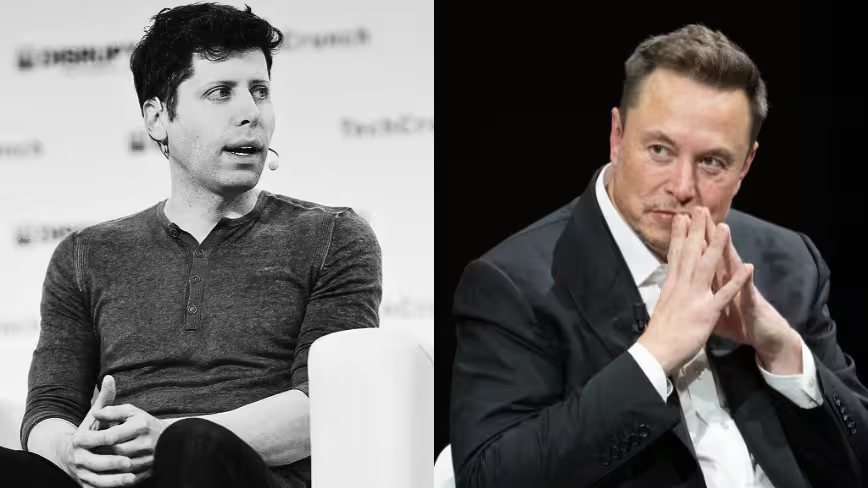
The years-long dispute between Elon Musk and Sam Altman, central figures in the artificial intelligence landscape, has moved from social media platforms to a federal courtroom in Oakland. The case, expected to last four weeks, focuses on the "soul" of OpenAI, the organization that has revolutionized the sector with its Large Language Models (LLM). At the heart of the debate is the question of whether an entity born as a non-profit can evolve to become one of the world's most valuable AI companies, with claimed damages amounting to $150 billion.
This legal battle is not merely a clash between prominent personalities; it reflects broader tensions within the AI industry. OpenAI's transition from an organization with a stated mission of public benefit to an entity with a strong commercial component has raised questions about governance, transparency, and the ethical direction of artificial intelligence development.
OpenAI's "Soul" and the AI Development Model
The core of the trial concerns the very nature of OpenAI and its evolution. Founded with the goal of developing artificial intelligence for the benefit of humanity, the organization later introduced a "capped-profit" structure to attract the massive investments required for the development of increasingly complex models. This move has generated heated debate about fidelity to founding principles and the compatibility between an altruistic mission and market logic.
For companies evaluating the deployment of AI solutions, the governance and development philosophy of an LLM provider are critical factors. The choice between Open Source models and proprietary solutions, often offered by commercial entities, implies significant trade-offs in terms of control, customization, data sovereignty, and Total Cost of Ownership (TCO). A company relying on a proprietary model might find itself bound by the provider's strategic decisions, whereas a self-hosted approach with Open Source LLMs offers greater flexibility and control over data and infrastructure.
Implications for the Market and Deployment Strategies
The outcome of this trial could have significant repercussions for the entire artificial intelligence market. If the court rules on the legitimacy of OpenAI's transformation, it could set a precedent for other organizations operating in the delicate balance between research and commercialization. This will influence how companies perceive the stability and reliability of AI providers, especially those with hybrid structures.
For CTOs and infrastructure architects, the situation underscores the importance of thorough due diligence when choosing partners and AI technologies. The decision to adopt cloud-based solutions or opt for an on-premise deployment, perhaps in air-gapped environments for compliance or data sovereignty needs, is closely linked to trust in the business model and long-term vision of providers. AI-RADAR, for instance, offers analytical frameworks to evaluate the trade-offs associated with on-premise LLM deployments, highlighting aspects such as hardware requirements, VRAM management, and throughput optimization.
Future Prospects and the AI Dilemma
The trial between Musk and Altman highlights a fundamental dilemma facing the AI industry: how to balance rapid innovation and immense resource requirements with the need to maintain ethical principles and a long-term vision for the common good. The question of whether AI should be developed as a public good or as a highly lucrative market opportunity remains open.
Regardless of the legal outcome, the discussion generated by this dispute reinforces the importance of a conscious and strategic approach to AI deployment. Companies must consider not only the technical capabilities of models but also the broader context in which they are developed and offered, carefully weighing the risks and opportunities associated with reliance on external providers versus investment in local stacks and self-hosted solutions.








💬 Comments (0)
🔒 Log in or register to comment on articles.
No comments yet. Be the first to comment!