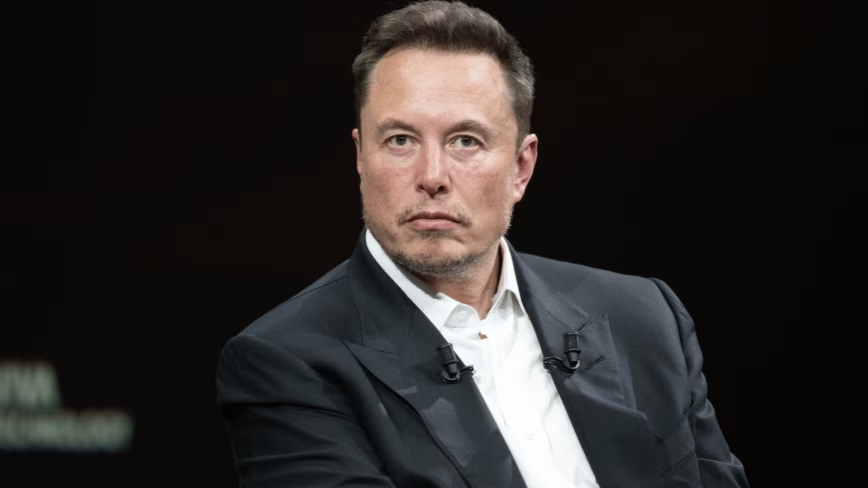
Musk's Testimony and the OpenAI Dispute
Elon Musk recently testified in a federal court, bringing to light a legal dispute that could have significant repercussions for the artificial intelligence landscape. His testimony, the first under oath in the case he filed in 2024 against OpenAI and its co-founders, focused on the organization's original nature and mission.
From the witness stand in Oakland, California, Musk expressed a clear stance, asserting that his legal action is not motivated by personal interests. His main argument revolves around the concept that 'it is not okay to steal a charity,' a statement that underscores his perception of an alleged deviation from OpenAI's initial objectives.
Implications for the AI Development Model
While the source does not delve into specific technical details regarding Large Language Models (LLM) or deployment infrastructures, the litigation initiated by Musk touches a raw nerve in the AI sector: the tension between Open Source development and commercialization. OpenAI, founded with a non-profit mission to ensure that Artificial General Intelligence (AGI) would benefit humanity, subsequently adopted a hybrid structure that includes a for-profit arm.
This evolution has sparked heated debates about the ethical and strategic direction of AI. For companies evaluating the adoption of LLMs, the stability and transparency of providers are crucial factors. The choice between cloud-based solutions and self-hosted or on-premise deployment often depends on trust in the provider's roadmap, data sovereignty, and the ability to maintain control over infrastructure and models. An uncertain legal context can influence these strategic decisions, prompting organizations to consider the long-term implications of their technology partners more carefully.
Market Context and Deployment Decisions
The Musk v. OpenAI case is not just a legal dispute but an indicator of the growing complexities surrounding the development and deployment of advanced AI technologies. The question of who controls and benefits from AI, and whether initial promises of an open and collaborative approach are upheld, is fundamental to the entire ecosystem.
For CTOs, DevOps leads, and infrastructure architects, these market dynamics translate into practical considerations. Choosing an LLM or a specific Framework is not just a matter of performance or initial cost, but also of alignment with governance principles and long-term sustainability. The possibility of on-premise deployment, which ensures greater control over data sovereignty and compliance, becomes even more attractive in scenarios of legal or strategic uncertainty from cloud providers. Evaluating the Total Cost of Ownership (TCO) in these contexts requires an in-depth analysis that goes beyond simple licenses or usage costs, including legal and reputational risks.
For those evaluating on-premise deployment, AI-RADAR offers analytical Frameworks on /llm-onpremise to assess trade-offs between control, costs, and performance, providing tools to navigate these complexities.
Future Prospects for Enterprise AI
Regardless of the outcome of this specific lawsuit, Elon Musk's testimony has reignited the debate on the ethical and commercial direction of artificial intelligence. The decisions made today, both in court and in research labs, will shape the future of AI and how companies can leverage it securely and responsibly.
Transparency, governance, and adherence to founding principles will increasingly be under scrutiny, pushing organizations to prioritize solutions that offer not only technical efficiency but also clarity and reliability in the long term. This scenario reinforces the importance of flexible and controllable deployment strategies, such as those offered by self-hosted and on-premise solutions.









💬 Comments (0)
🔒 Log in or register to comment on articles.
No comments yet. Be the first to comment!