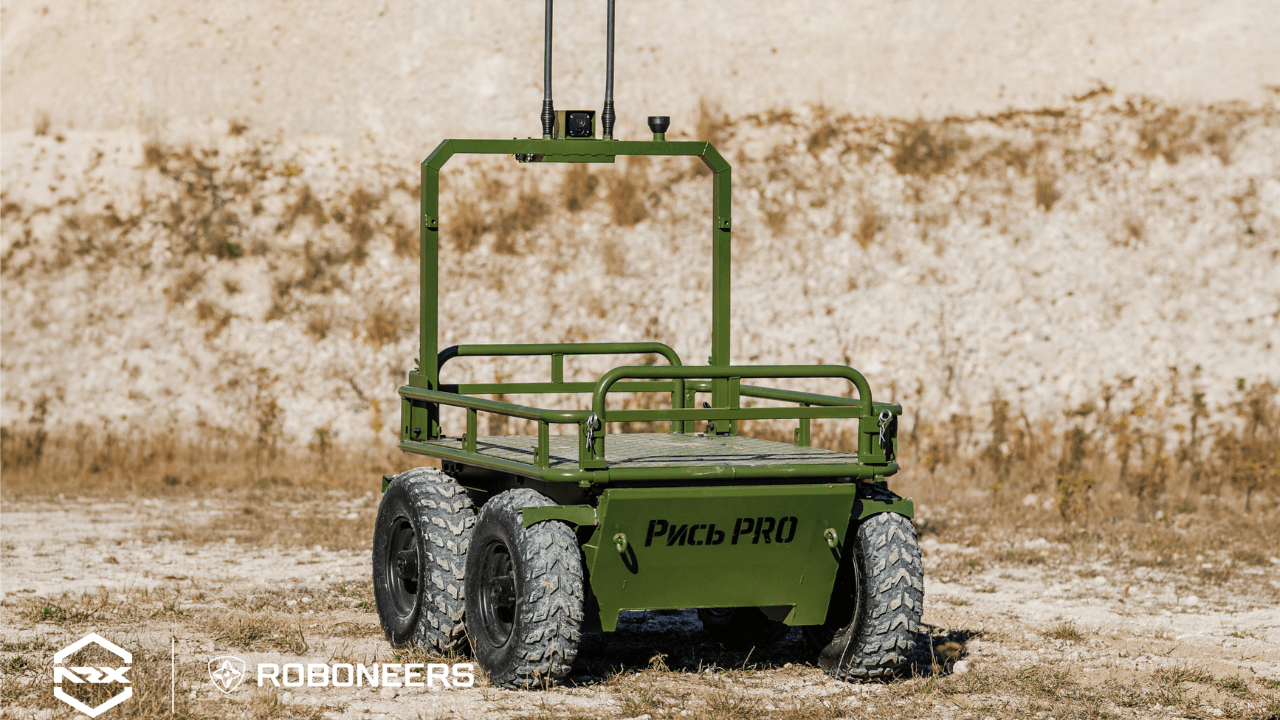
The war in Ukraine is sharply accelerating military robotics. German company ARX Robotics and Ukraine’s Roboneers have announced the formation of ARX Industries, a joint venture designed to mass-produce the Rys Pro unmanned ground vehicle (UGV). The move creates a new industrial pole meant to deliver thousands of software-defined robots directly to the front line.
Industrial twins for the battlefield
The collaborative architecture is straightforward yet powerful: production sites in Germany and Ukraine combine manufacturing scale with frontline proximity. The alliance is not purely commercial – it falls under the “Build with Ukraine” initiative, backed by both the German and Ukrainian governments, signaling that technological sovereignty has become a cornerstone of defense planning. Ukraine’s goal of supplying its armed forces with 50,000 UGVs by 2026 finds in ARX Industries a concrete response. The roadmap envisages thousands of units in the first year, scaling to tens of thousands annually thereafter.
The robots are not flying drones but reliable ground vehicles for mission-critical roles: casualty evacuation, supply and medical aid transport, mining and demining, and combat configurations. Each Rys Pro can be fitted with mission-specific modules, adapting rapidly to tactical needs.
The factory-frontline feedback loop
“Every week without the right equipment costs lives,” said Maximilian Wied, Co-Founder and CFO of ARX Robotics. ARX Industries aims to address this urgency not just with expanded output, but with a continuous feedback loop: operational lessons learned at the front feed directly back into production, informing subsequent batches without delay. Each new series of the Rys Pro embodies the latest combat-tested improvements.
Anton Skrypnyk, Executive Chairman of Roboneers, underscored: “Ukraine has proven that robots win battles. Now we are bringing that power to scale.” The message is clear: this is no longer about prototypes or small runs; it is an adaptive manufacturing system capable of keeping pace with a rapidly changing battlefield.
Defense sovereignty and European autonomy
The joint venture does more than supply Kyiv. It covers manufacturing, maintenance, and operational support, building a long-term base for sovereign UGV capacity. Europe is learning that relying on external supply chains for critical military production and innovation is a strategic risk. ARX Industries becomes a piece of that awareness: design, manufacturing, and sustainment remain in European hands, strengthening the continent’s defense posture.
A cross-domain lesson: owning critical infrastructure
For anyone involved in deploying sensitive technologies – from artificial intelligence models to autonomous platforms – the ARX Industries story offers a parallel worth considering. The focus on sovereignty, direct control of assets, and rapid iteration driven by proprietary data closely mirrors the rationale behind self-hosting LLMs and running inference on-premise. When security, latency, and autonomy requirements become stringent, owning the infrastructure and retaining the development loop become non-negotiable. It’s no coincidence that analytical frameworks for evaluating local AI deployment, such as those explored in AI-RADAR, emphasize the trade-offs between TCO and data control. Defense, in the end, simply takes this logic to its extreme, showing how the proximity of execution – whether an LLM inside a corporate data center or a UGV on a battlefield – can make the difference between effectiveness and vulnerability.





💬 Comments (0)
🔒 Log in or register to comment on articles.
No comments yet. Be the first to comment!