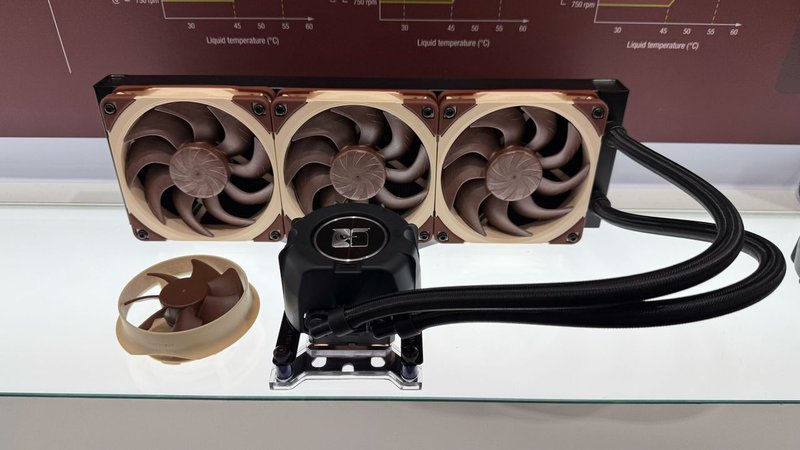
For those who have followed PC cooling for more than two decades, few brands still have the power to surprise like Noctua. The Austrian company, a pillar of high-end air cooling, has launched its first all-in-one liquid cooler, the NL-LC1-36, tested with a Ryzen 9 9950X3D. This is not a simple line expansion: it is an acknowledgment that the new generation of desktop CPUs, with power budgets above 200 W and increasingly dense architectures, demands a thermal step change – and that the mature liquid cooling market can no longer be ignored, even by a company that built its reputation on silence.
The choice to debut with a 360 mm radiator is no coincidence. High-end consumer CPUs like the Ryzen 9 9950X3D push the thermal envelope well beyond what the best air coolers can handle without noise or throttling, especially under sustained loads. Here lies the connection with on-premise processing: compact workstations and servers used for LLM inference, often built around high-end consumer processors, must maintain elevated boost frequencies for hours. The thermal headroom provided by a quality AIO is not a luxury but a throughput multiplier, because a single clock drop during token generation can translate into user-perceivable latency. In this context, Noctua’s reputation for silent, reliable fans is not a detail: it is a differentiating asset that weighs heavily in integration choices, where noise is often the primary enemy in work environments or small labs.
The technical framework of the NL-LC1-36, though not yet exhaustively detailed by the company, inherits Noctua’s know-how in fan design and patented mounting systems such as SecuFirm2, adapted to the pump and water block. The implicit bet is that the company can bring to liquid cooling the same obsessive rigor with which it dominated air, filling a gap for users who are not satisfied with gaming-oriented products and seek an AIO that lasts over time without acoustic performance degradation.
Second-order implications are profound. First, the legitimization of liquid cooling by the champion of silence puts pressure on competing manufacturers, forcing them to improve not only absolute thermal performance but also the noise profile at identical loads. Second, for system integrators serving local inference – where every decibel matters and where TCO includes prolonged usability – having a reference that combines decade-long technical support, warranty, and quality components can shift choices toward standardized hardware, reducing reliance on custom server solutions that are far more expensive and noisier. Finally, the presence of a Noctua AIO widens the spectrum of CPUs that can be cooled without compromise: processors like the Ryzen 9 9950X3D, with their temperature-sensitive 3D V-Cache, can fully express their potential in CPU-bound inference workloads or in hybrid configurations where the GPU leaves the processor to handle embedding, preprocessing, and orchestration.
However, a trade-off cannot be underestimated: the inherent complexity of liquid systems compared to air. An AIO introduces potential failure points (pump, connections, fluid permeability) that must be evaluated in scenarios where operational continuity is critical. Noctua’s bet is that build quality can overturn the perception of risk, just as it once did with its brown fans. If that bet pays off, the NL-LC1-36 will not be just a product, but a turning point for anyone designing silent, high-performance machines, inside and outside the data center.







💬 Comments (0)
🔒 Log in or register to comment on articles.
No comments yet. Be the first to comment!