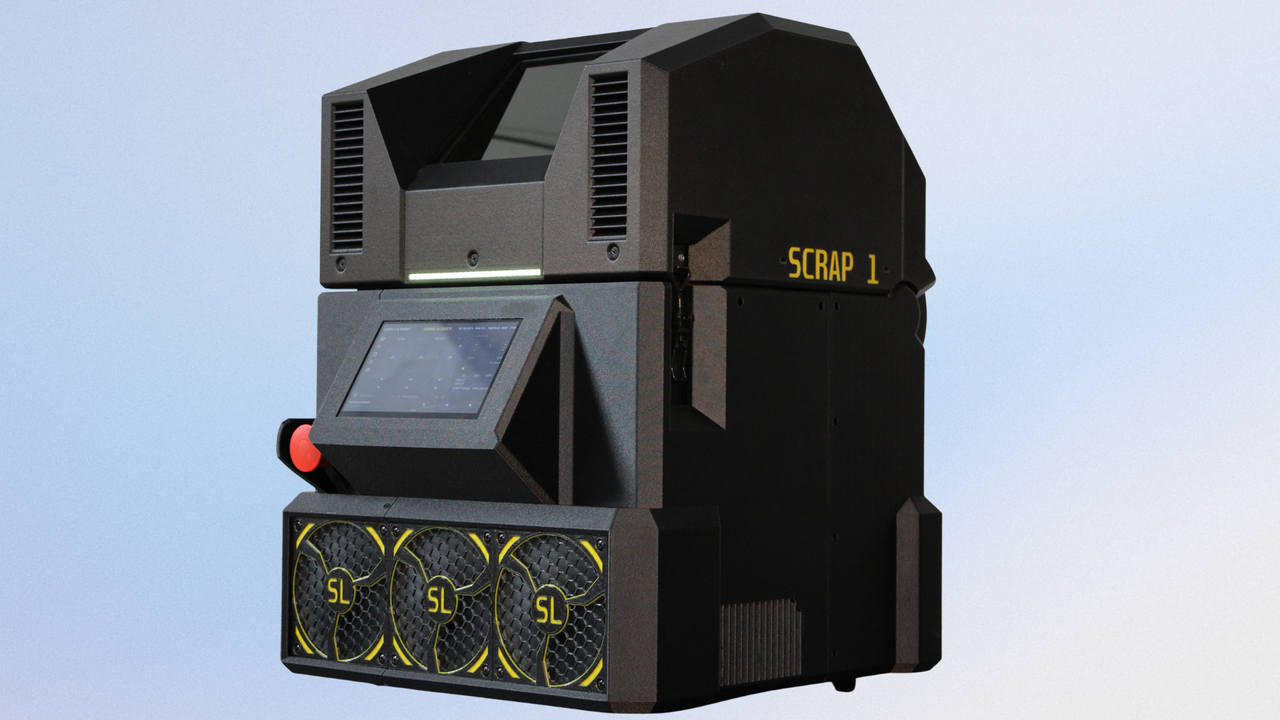
Desktop Metal 3D Printing Becomes Accessible: A New Horizon for Labs and Workshops
Technological innovation often follows a path of miniaturization and democratization, bringing advanced industrial capabilities within reach of a wider audience. This is the case with a new metal 3D printer that promises to revolutionize the sector by shrinking complex and expensive technology down to workbench size. Featuring a laser powder bed fusion system, this solution aims to make laser metal printing a tangible reality for workshops and labs, at a significantly lower cost compared to traditional industrial systems.
The launch of devices like the Scrap 1 Desktop Metal 3D Printer marks an important step towards the decentralization of additive manufacturing. Traditionally, metal 3D printing was the domain of large corporations with substantial budgets and dedicated spaces. Now, the goal is to break down these barriers, offering small and medium-sized enterprises, research centers, and educational institutions the ability to integrate these capabilities directly into their operational environments.
Technical Details and the Value of Accessibility
At the core of this innovation is a laser powder bed fusion system, a technology well-established in the industrial world for producing complex metal components with high precision and strength. This process involves the selective melting of metal powders layer by layer using a laser, creating solid objects directly from a digital model. The challenge has been to miniaturize this complex technological pipeline without compromising its reliability or the quality of the results.
The distinguishing factor of this new generation of printers is its compact size, designed to fit on a typical workbench. This characteristic is not just about physical space; it also implies less stringent infrastructure requirements, making deployment simpler and less costly. The $9,600 price point represents a turning point, positioning metal 3D printing in an accessible cost bracket for a much broader audience than in the past. This opens up new opportunities for rapid prototyping, small-batch production, and materials research.
Implications for Innovation and Production Sovereignty
The introduction of smaller, more affordable metal 3D printers has significant implications for innovation. It allows engineers, designers, and researchers to experiment with greater freedom, reducing the time and costs associated with creating prototypes or producing custom components. This can accelerate the development of new products and solutions in sectors ranging from aerospace to medical, and automotive.
From a broader perspective, the availability of advanced manufacturing technologies in local environments strengthens the concept of production sovereignty. Companies and laboratories can maintain complete control over their manufacturing processes, from design to realization, without relying on external suppliers or remote production infrastructures. This is particularly relevant for intellectual property protection and the management of sensitive data, aspects that AI-RADAR regularly explores in the context of on-premise deployments for AI workloads, where data control and security are paramount.
Future Prospects and TCO Considerations
The future of desktop metal 3D printing appears promising, with exponential growth potential as the technology matures and available materials diversify. However, adopting these solutions requires a careful evaluation of the Total Cost of Ownership (TCO), which extends beyond the initial purchase price. It is necessary to consider material costs, maintenance, energy consumption, and personnel training.
For organizations evaluating the integration of these technologies, it is crucial to analyze the trade-offs between the initial investment and the long-term benefits in terms of flexibility, speed of innovation, and control over production processes. The ability to bring metal additive manufacturing directly into the workshop or lab represents a unique opportunity to democratize access to advanced industrial capabilities, pushing the boundaries of engineering and design.



💬 Comments (0)
🔒 Log in or register to comment on articles.
No comments yet. Be the first to comment!